


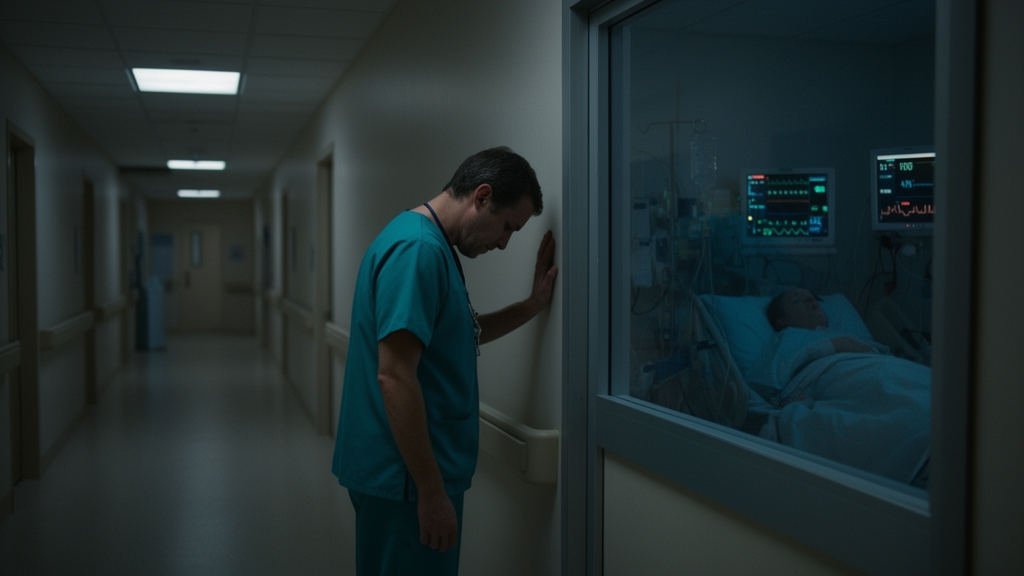
Intensive care units are designed to sustain life at its most fragile, yet the clinicians who staff them increasingly report a troubling experience: the sense that the care they are delivering is inappropriate. A new scientific letter published in Intensive Care Medicine by Gijs Hesselink of Radboud University Medical Center and colleagues, on behalf of the PICNL-ICU study group, adds a crucial piece of evidence to a growing body of research. The study finds that when intensive care clinicians perceive the care around them as inappropriate, that perception travels together with two of the most damaging outcomes in the modern healthcare workforce: burnout and the intention to leave the job.
The research team conducted a cross-sectional nationwide survey across the Netherlands, drawing on the participation of dozens of hospitals ranging from large academic medical centers such as University Medical Center Groningen and Leiden University Medical Center to community hospitals scattered across the country. The breadth of the PICNL-ICU study group, which lists local investigators at more than forty institutions, matters because it captures the reality of intensive care practice outside the rarefied environment of a single flagship center. Clinicians in both university hospitals and regional units confront moral strain, and the Dutch design allowed the researchers to examine prevalence, associated factors, and outcomes across an entire national system rather than a convenience sample of motivated departments.
The concept at the heart of the study, perceived inappropriateness of care, refers to a clinician’s judgment that the treatment being provided to a patient does not align with the patient’s goals, values, or best interests. In the intensive care unit this often takes the form of interventions that clinicians believe are nonbeneficial or even harmful: prolonged mechanical ventilation in patients with no realistic chance of meaningful recovery, escalating organ support in the final days of a terminal illness, or resuscitation efforts that family members request against the clinical team’s judgment. The perception is inherently subjective, but that subjectivity is precisely the point. What matters morally and psychologically to a nurse or physician is not whether an external audit would label a treatment futile, but whether the person administering it experiences it as a violation of professional integrity.
The intellectual lineage of this question stretches back more than a decade. In 2011, Ruth Piers and colleagues, working with Elie Azoulay and an international team, published a landmark study in JAMA surveying European and Israeli intensive care nurses and physicians and found that perceptions of inappropriateness were widespread and were linked to symptoms of burnout. Subsequent work extended the picture: a 2015 study by Michael Anstey and colleagues examined adult intensive care units in California, and in 2017 Daniel Schwarzkopf and colleagues reported in Critical Care Medicine that perceived nonbeneficial treatment among German ICU nurses and physicians was associated with both burnout and intention to leave the job. The new Dutch letter consolidates this evidence in a comprehensive national dataset and confirms that the association holds in a healthcare system with different structures, staffing norms, and end-of-life conventions.
Burnout itself is a well-characterized psychological syndrome, described classically by Christina Maslach and colleagues in their influential 2001 review as a constellation of emotional exhaustion, depersonalization, and a diminished sense of personal accomplishment. In healthcare settings, burnout is not merely a private misfortune. A 2024 analysis published in JAMA Network Open by Li and colleagues synthesized the evidence linking nurse burnout to patient safety incidents, reduced patient satisfaction, and degraded quality of care. In other words, the wellbeing of intensive care staff and the wellbeing of their patients are not separable problems; they are two faces of the same organizational system. When clinicians burn out and leave, the remaining staff face higher workloads, institutional knowledge erodes, and the cycle of attrition accelerates.
Why should perceiving care as inappropriate be so corrosive? The mechanisms proposed in the literature converge on the idea of moral injury, a term borrowed originally from military psychology. Moral injury arises when a person is compelled, often by circumstances beyond their control, to act in ways that transgress their own deeply held ethical commitments. A nurse who spends an entire shift performing painful procedures on a patient she believes is suffering without benefit experiences a daily accumulation of such transgressions. A physician who continues aggressive treatment because of family pressure or fear of litigation carries the same burden. Unlike a single traumatic event, this is a slow, repetitive erosion, and psychological research suggests that this kind of chronic moral distress is a particularly potent driver of the emotional exhaustion that defines burnout.
The association with intention to leave is the finding with the most immediate practical consequences. Intensive care medicine was already facing workforce strain before the COVID-19 pandemic, and the pandemic years intensified staffing shortages across high-income countries. A multinational survey published in 2026 in the Journal of Anesthesia, Analgesia and Critical Care by Battaglini and colleagues reflected on wellbeing in intensive care and underscored that the problem is global. If a substantial share of clinicians who perceive care as inappropriate are also the ones contemplating departure, then the quality of end-of-life decision-making and the stability of the ICU workforce become intertwined policy problems. Hospitals cannot address retention by improving salaries alone if the underlying driver is a moral one: clinicians do not want to work in environments where they feel forced to deliver care they believe patients would not want.
The Dutch study also points toward the factors that shape whether clinicians perceive care as inappropriate. Prior work in this field has identified communication failures within teams, conflicts between clinicians and patients’ families, the absence of timely goals-of-care conversations, and organizational cultures that discourage clinicians from raising concerns about treatment futility. Azoulay’s 2009 Conflictfus study, published in the American Journal of Respiratory and Critical Care Medicine, documented how common such conflicts are in ICUs and how they cluster around end-of-life decisions. These findings suggest concrete leverage points: structured family conferences, early and repeated advance care planning, ethics consultation services, and leadership that legitimizes discussions about withdrawing nonbeneficial interventions rather than treating them as admissions of defeat.
It is worth emphasizing what the new study does and does not establish. As a cross-sectional survey, it captures associations at a single point in time; it cannot prove that perceived inappropriateness causes burnout or resignation, only that the three travel together in a pattern that is difficult to dismiss as coincidence. The authors collected and analyzed the data with ethical approval from the Radboud University Medical Center research ethics committee and informed consent from participants, and they report no competing interests and no external funding, which strengthens the credibility of the work as an independent academic effort. The anonymized dataset is available from the corresponding author upon reasonable request, allowing other researchers to interrogate the findings. Longitudinal designs, in which clinicians are followed over time, would be needed to determine whether moral distress today predicts burnout and departure tomorrow, and intervention studies would be needed to show that reducing perceived inappropriateness actually improves retention.
Even with those caveats, the implications for intensive care units are hard to ignore. The study reframes clinician retention not simply as a human resources challenge but as an ethical one, tied directly to how well hospitals manage the boundaries of life-sustaining treatment. Every conversation that helps a family understand what their loved one would have wanted, every team huddle that gives a nurse permission to voice doubt about a treatment plan, and every institutional protocol that makes withdrawing futile support a routine act of good medicine rather than a contested battle may simultaneously protect patients from unwanted interventions and protect clinicians from the slow injury of providing them. As health systems worldwide grapple with staffing crises in critical care, the Dutch evidence offers a clear message: the fight against burnout in the ICU may begin not in the break room, but at the bedside, in the decisions about when continuing treatment stops being care.
Subject of Research: Perceived inappropriateness of intensive care and its association with clinician burnout and turnover intention
Article Title: Perceived inappropriateness of care among ICU clinicians is associated with burnout and intention to leave the job
Article References: Hesselink, G., Ramakers, B., van Dijk, D., Benoit, D. D., Zegers, M., on behalf the PICNL-ICU study group, So, R. K., van Valburg, M., Muntjewerff, I., Spaan, I., Zuurbier, A., Sauër, A.-M., Bouma, B., Herold, I. H. F., Ewalds, E., Verstoep, N., Stolk-Dijke, A., Beckmann-Stam, H., Rengers, E., … van der Horst, R. P. J. (2026). Perceived inappropriateness of care among ICU clinicians is associated with burnout and intention to leave the job. Intensive Care Medicine. https://doi.org/10.1007/s00134-026-08608-x
Image Credits: AI Generated
DOI: 10.1007/s00134-026-08608-x
Keywords: intensive care, burnout, moral distress, inappropriate care, ICU workforce, turnover intention, end-of-life care, clinician wellbeing, cross-sectional survey, netherlands, nonbeneficial treatment, healthcare quality
Cite Scienmag News
Ophelia Keating. (October 19, 2026). When ICU Care Feels Wrong, Clinicians Burn Out and Walk Away. Scienmag. https://scienmag.com/when-icu-care-feels-wrong-clinicians-burn-out-and-walk-away/
Ophelia Keating. "When ICU Care Feels Wrong, Clinicians Burn Out and Walk Away." Scienmag, 19 October 2026, https://scienmag.com/when-icu-care-feels-wrong-clinicians-burn-out-and-walk-away/. Accessed 19 October 2026.
Ophelia Keating. "When ICU Care Feels Wrong, Clinicians Burn Out and Walk Away." Scienmag. October 19, 2026. https://scienmag.com/when-icu-care-feels-wrong-clinicians-burn-out-and-walk-away/


