


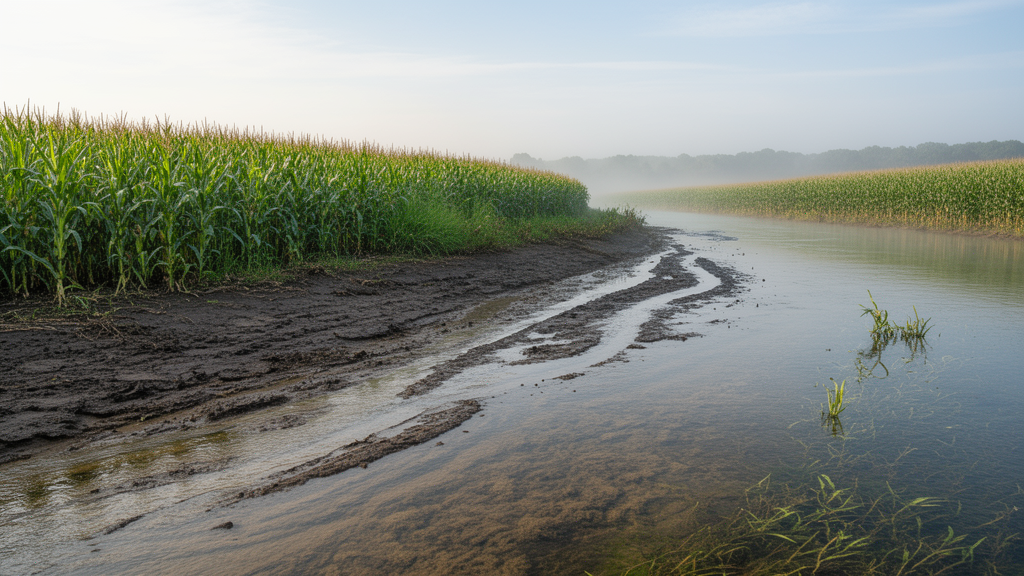
Every river tells two stories at once. One is written in its chemistry, in the dissolved organic molecules drifting downstream from forests, fields, and farms. The other is written in the genomes of the bacteria that consume those molecules. A new study of a reservoir-agricultural river continuum, published in Environmental Geochemistry and Health, shows that these two stories are not independent: as nitrogen and phosphorus enrichment rises along the flow path from an oligotrophic reservoir into intensively farmed river reaches, the molecular identity of dissolved organic matter (DOM) and the carbon-metabolism potential of bacterial communities shift together in a coordinated spatial pattern. The finding offers one of the most detailed pictures yet of how agricultural nutrient loading rewires the carbon cycle of a human-disturbed inland waterway.
Dissolved organic matter is the largest pool of organic carbon in most freshwaters, and its composition controls everything from how much carbon is buried in sediments to how much is respired back into the atmosphere as carbon dioxide. Because DOM contains thousands of distinct molecular formulas, researchers have long struggled to connect specific molecules to specific microbial consumers. The new work, led by Yue Jiang, Hongying Jiang, Yanhua Xie, and Tianliang Zheng of Chengdu University of Technology and partner institutions, attacked this problem by deploying an unusually broad analytical arsenal along a single nutrient gradient, from the nutrient-poor reservoir through agricultural river reaches where nitrogen and phosphorus concentrations climb steeply.
The team combined optical spectroscopy, which uses the way DOM absorbs and emits light to fingerprint its fluorescent components, with ultrahigh-resolution mass spectrometry capable of resolving individual molecular formulas containing carbon, hydrogen, oxygen, nitrogen, sulfur, and phosphorus. They added nitrate dual-isotope tracing, which measures the nitrogen-15 to nitrogen-14 and oxygen-18 to oxygen-16 ratios in nitrate to distinguish fertilizer, soil, and atmospheric sources, together with end-member mixing analysis (EMMA), a statistical technique that apportioned the relative contribution of each source to the riverine DOM pool. On the biological side, they sequenced 16S rRNA genes to identify which bacterial taxa occupied each sampling site and profiled metagenomes to estimate the functional genes present in each community.
The results revealed a systematic rearrangement of DOM source apportionment along the gradient. In agricultural river reaches, the relative abundance of humic-like fluorescent components, labeled C1 and C3 in the parallel factor analysis of the fluorescence data, rose alongside elevated abundances of heteroatomic molecular formulas, particularly those containing sulfur (CHOS) and both sulfur and nitrogen (CHONS), relative to the oligotrophic reservoir. These heteroatom-rich formulas are a classic molecular signature of anthropogenic organics, including pesticides, surfactants, and other farm-derived compounds that carry sulfur or nitrogen atoms into otherwise carbon-hydrogen-oxygen-dominated natural organic matter.
Two mechanisms appear to drive this molecular shift. The first is exogenous input: nutrient loading delivers heteroatom-rich anthropogenic organics directly into the river, adding new molecular formulas to the DOM pool. The second is in-situ microbial humification: elevated nitrogen and phosphorus stimulate bacterial metabolism, and the resulting microbial processing boosts the formation of humic-like components within the water column itself. In other words, agricultural nutrients do not merely add pollution; they also transform the existing organic matter into a more humified, more chemically complex form, changing the substrate landscape available to downstream microbes.
The EMMA modeling put a number on the anthropogenic contribution: 37.9 percent of the riverine DOM came from anthropogenic sources. This is a striking figure for a system where the reservoir end-member is relatively pristine, and it underscores how heavily agricultural land use can imprint itself on the molecular composition of a river even when point-source discharges are not the dominant concern. Nitrate dual-isotope tracing corroborated the EMMA results, confirming that fertilizer and soil-derived nitrogen were the principal nutrient sources in the agricultural reaches.
Principal coordinates analysis of the 16S rRNA sequencing data showed that reservoir and river bacterial communities differentiated along the same nutrient and fluorescent DOM gradients that structured the molecular chemistry. Reservoir samples were dominated by genera such as Acinetobacter, Exiguobacterium, and Clade_III, taxa adapted to the relatively simple, labile organic molecules typical of oligotrophic waters. River communities, by contrast, featured humic-adapted genera including Mycobacterium, hgcl_clade, Limnohabitans, and unclassified_Sporichthyaceae, organisms whose ecological strategies are geared toward the complex, recalcitrant molecules that accumulate in nutrient-enriched, humified river water.
Metagenomic functional profiling revealed that this taxonomic differentiation coincided with a coordinated shift in carbon-metabolism potential. Reservoir communities showed higher relative abundances of genes associated with carbohydrate and aromatic compound degradation, consistent with their role in processing the relatively simple, plant-derived molecules available in oligotrophic conditions. River communities showed higher relative abundances of genes associated with lipid utilization and terrestrial-polymer degradation, reflecting their capacity to break down the complex, high-molecular-weight organics that dominate humified agricultural river DOM. The genomic potential of each community thus matched the molecular composition of the DOM it encountered, a pattern the authors describe as coordinated spatial covariation.
This covariation matters because it implies that nutrient management is also carbon-cycle management. If nitrogen and phosphorus loading systematically rearranges DOM source apportionment and boosts in-situ humification, then reducing nutrient inputs should not only improve water quality but also alter the trajectory of organic matter processing, potentially reducing the microbial production of recalcitrant dissolved organic carbon that can persist in downstream waters. The authors argue that their findings supply theoretical guidance for pollution control and carbon cycling regulation in anthropogenic-disturbed inland water catchments, where the interplay between nutrient stoichiometry and organic matter chemistry is a central but poorly quantified control on carbon fate.
The study also highlights the value of integrating multiple analytical approaches within a single spatial framework. Optical spectroscopy alone can identify fluorescent components but not their molecular formulas; ultrahigh-resolution mass spectrometry alone can resolve formulas but not their sources; isotope tracing and EMMA together can apportion sources but not link them to specific microbial consumers. By combining all of these tools with 16S rRNA sequencing and metagenomic functional profiling, the researchers were able to trace a complete chain of causation, from nutrient enrichment through DOM molecular transformation to bacterial community restructuring and genomic carbon-metabolism potential. As agricultural intensification continues to reshape inland waters worldwide, this kind of multi-pronged approach offers a template for understanding how human land use rewrites the chemistry and biology of the carbon cycle, one river continuum at a time.
Subject of Research: Dissolved organic matter chemistry and bacterial carbon metabolism along a reservoir-agricultural river nutrient gradient
Article Title: Covariation of DOM molecular characteristics and bacterial carbon metabolism potential along a reservoir-agricultural river nutrient gradient
Article References: Jiang, Y., Jiang, H., Xie, Y., & Zheng, T. (2026). Covariation of DOM molecular characteristics and bacterial carbon metabolism potential along a reservoir-agricultural river nutrient gradient. Environmental Geochemistry and Health, 48(16), Article 645. https://doi.org/10.1007/s10653-026-03552-7
Image Credits: AI Generated
DOI: 10.1007/s10653-026-03552-7
Keywords: dissolved organic matter, bacterial communities, carbon metabolism, nutrient gradient, reservoir-agricultural river, metagenomics, fluorescence spectroscopy, end-member mixing analysis, Covariation, molecular, characteristics, bacterial
Cite Scienmag News
Daisy Hatcher. (October 18, 2026). Farm Nutrients Rewrite River Chemistry and Bacterial Carbon Metabolism. Scienmag. https://scienmag.com/farm-nutrients-rewrite-river-chemistry-and-bacterial-carbon-metabolism/
Daisy Hatcher. "Farm Nutrients Rewrite River Chemistry and Bacterial Carbon Metabolism." Scienmag, 18 October 2026, https://scienmag.com/farm-nutrients-rewrite-river-chemistry-and-bacterial-carbon-metabolism/. Accessed 18 October 2026.
Daisy Hatcher. "Farm Nutrients Rewrite River Chemistry and Bacterial Carbon Metabolism." Scienmag. October 18, 2026. https://scienmag.com/farm-nutrients-rewrite-river-chemistry-and-bacterial-carbon-metabolism/


