


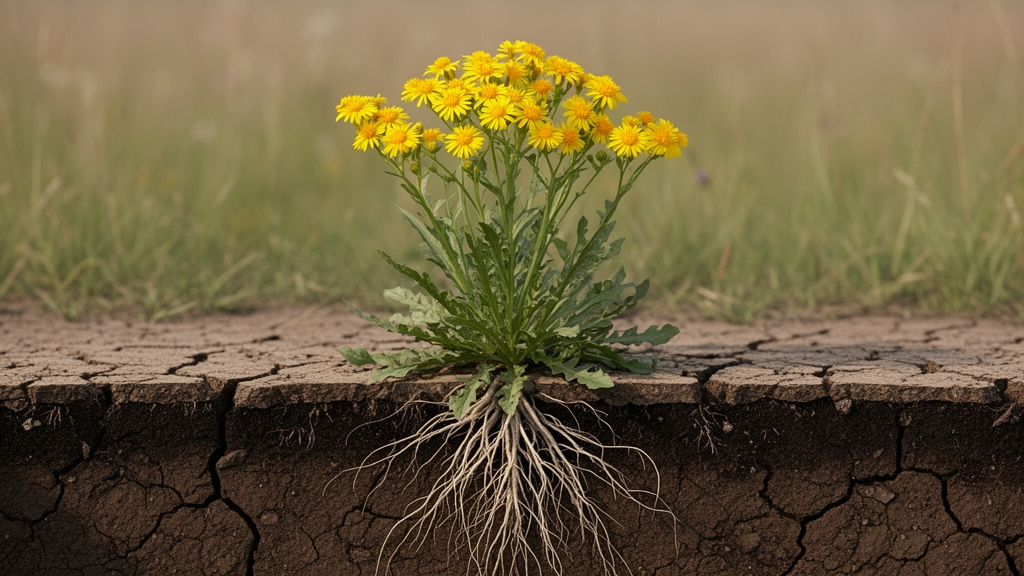
When a plant arrives in a new continent, it faces a gauntlet of unfamiliar neighbors, enemies, and soil-dwelling microbes. Whether it thrives or fizzles out depends on a tangled web of ecological and evolutionary history. A new study published in the journal NeoBiota has put two of the most debated factors in invasion biology head to head, and the results point to a clear winner. For the invasive South African ragwort, Senecio inaequidens, the eco-evolutionary experience of the plants it grows alongside matters far more than the microbial community living in the soil beneath it. The findings offer a strikingly practical message for restoration ecologists: to hold back a stubborn invader, recruit its closest relatives.
Senecio inaequidens, a perennial subshrub in the daisy family, is one of Europe’s most successful plant invaders. Native to the highlands of Southern Africa, it hitchhiked into Europe in the late nineteenth century as a contaminant of wool shipments. Since then it has spread aggressively along roadsides, railways, quarries, vineyards, and dry grasslands, reaching heights of 40 to 100 centimeters. Its arsenal includes pyrrolizidine alkaloids, allelopathic chemicals that deter herbivores both above and below ground and can reshape soil microbial communities. Only tetraploid populations, carrying forty chromosomes, made it to Europe, while both diploid and tetraploid forms persist in its native range. This history made it an ideal test subject for disentangling how shared evolutionary history versus soil conditions shape competitive outcomes.
The research team, working under controlled growth chamber conditions, designed a fully factorial experiment. Individual ragwort plants occupied the center of each pot, surrounded by one of three competitive scenarios: a community of five species from the invader’s native South African range, a community of five species from the invaded range in Northern Italy, or no competitors at all. Half of the pots contained soil that had been autoclaved at 120 degrees Celsius for 45 minutes to suppress microbial life, while the other half retained the natural bacterial communities collected from the invaded quarry site at Collepedrino, in the Italian province of Bergamo. The South African suite included Aristida congesta, Hibiscus trionum, Salvia disermas, and two Wahlenbergia species, while the Italian suite comprised Bromopsis erecta, Hypericum perforatum, Onobrychis viciifolia, Poterium sanguisorba, and Trifolium repens.
The rationale behind this design draws on a century-old idea. Darwin’s naturalization hypothesis proposes that introduced species should struggle to establish in communities dominated by closely related natives, because related species tend to share traits, resource requirements, and enemies shaped by common evolutionary history. Phylogenetic distance therefore serves as a proxy for niche overlap and for the strength of competition an invader will face. At the same time, a parallel line of research suggests that soil microbes can tip the scales. Introduced plants may escape coevolved specialist pathogens from home, accumulate novel mutualists or antagonists abroad, or actively cultivate bacterial communities that favor their own growth. Which of these mechanisms dominates in practice has remained remarkably unclear.
After 84 days of growth at 29 degrees Celsius under a 14-hour day cycle mimicking ruderal Mediterranean habitats, the answer was unambiguous. Competitor community identity had the strongest effect on ragwort’s performance, with plants growing significantly shorter when surrounded by species from their native South African range compared with plants growing alone. Autoclaving the soil, by contrast, had no significant effect on plant height, and neither community identity nor soil treatment significantly influenced lateral spread. Statistical analysis using two-way ANOVA revealed a significant community effect on height, while soil effects fell well short of significance. In short, the evolutionary familiarity of the competitors, not the living soil, was the dominant force suppressing the invader.
Phylogenetic analysis sharpened the picture. The researchers calculated two complementary measures of relatedness: a community-weighted phylogenetic distance that integrated all competitor species according to their abundance, and the distance between ragwort and the single most abundant competitor in each pot. The community-wide metric showed no relationship with ragwort’s growth, but the distance to the dominant species mattered. The closer the dominant competitor was to ragwort on the angiosperm tree of life, the smaller the invader grew. The two Wahlenbergia species from South Africa were the most phylogenetically similar competitors in the experiment, and the South African communities produced the smallest ragwort individuals overall. This pattern supports Darwin’s naturalization hypothesis in its strongest form, but with a crucial refinement: it is the dominant, closely related species that deliver biotic resistance, not the community as a whole.
The soil bacterial results added an unexpected twist. Sequencing the V5–V6 hypervariable regions of the bacterial 16S rRNA gene yielded nearly 690,000 valid sequences and 8,471 amplicon sequence variants across the samples. Pseudomonadota dominated the communities at 46.8 percent of sequences, followed by Actinomycetota and Bacteroidota. Both competitor identity and soil treatment significantly shaped bacterial community structure, together explaining nearly half of the variation. Most intriguingly, taller and wider ragwort plants were consistently associated with lower bacterial diversity in their pots, a statistically significant negative relationship for both species richness and the Shannon diversity index. Soils under South African communities, where ragwort performed worst, harbored the most diverse bacterial assemblages.
What could explain the link between vigorous invader growth and depauperate bacterial communities? The authors caution that their experiment cannot establish causality, but several mechanisms are plausible. Ragwort’s pyrrolizidine alkaloids may suppress susceptible microbial taxa, echoing earlier work showing that the species’ traits, particularly those linked to competitive ability and root allocation, correlate with rhizosphere bacterial diversity. Alternatively, the pattern may reflect the actions of co-introduced or generalist soil pathogens associated with native-range competitors, which could have compounded the aboveground suppression of ragwort in South African treatments. The authors also note an important methodological caveat: autoclaving can alter soil chemistry, nutrient availability, and physical structure, potentially confounding purely biotic interpretations, although residual DNA from cells killed some ninety days before sampling is likely negligible.
The findings also reconcile an apparent contradiction in the literature. An observational study in Northern Italy had found ragwort performing better in phylogenetically clustered communities, consistent with the pre-adaptation hypothesis, which holds that invaders succeed where they share environmental adaptations with natives. The new experimental results, showing the opposite pattern at fine spatial scales, fit an emerging synthesis in which both hypotheses operate simultaneously but at different scales. At broad geographic scales, environmental filtering favors aliens resembling native species; at the fine scale of individual interactions, where competition for limiting resources is intense, phylogenetic distance becomes an advantage and close relatedness becomes a liability. Context, scale, and resource levels determine which force prevails.
For land managers battling ragwort across Europe’s disturbed landscapes, the study’s implications are refreshingly concrete. Restoration efforts might do well to sow multi-species suites of native species that are phylogenetically close to the invader and competitively strong, deploying them at high abundance to maximize biotic resistance. The suggestion that diverse soil microbiota also constrain the invader opens a second avenue: testing soil amendments that boost microbial diversity and resilience in degraded sites. More broadly, the work demonstrates that the ecological naivety of recipient communities, their lack of evolutionary experience with a newcomer, can outweigh belowground feedbacks in determining invasion outcomes. As global trade continues to shuffle species across continents, understanding which natives are best equipped to resist them, and why, may prove one of the most valuable tools in restoration ecology’s growing arsenal.
Subject of Research: Eco-evolutionary experience and soil bacterial communities as drivers of the invasive success of Senecio inaequidens
Article Title: Eco-evolutionary experience outweighs soil effects in shaping Senecio inaequidens invasion success
Article References: Quaglini, L. A., Yannelli, F. A., Gandolfi, I., Franzetti, A., Caronni, S., Montagnani, C., Carbutt, C., Jeschke, J. M., Citterio, S., & Gentili, R. (2026). Eco-evolutionary experience outweighs soil effects in shaping Senecio inaequidens invasion success. NeoBiota, 106, 141-160. https://doi.org/10.3897/neobiota.106.182956
Image Credits: AI Generated
DOI: 10.3897/neobiota.106.182956
Keywords: invasive species, Senecio inaequidens, eco-evolutionary experience, Darwin's naturalization hypothesis, soil bacteria, plant competition, phylogenetic distance, biotic resistance, restoration ecology, allelopathy, soil microbiome, NeoBiota
Cite Scienmag News
Gavin Prescott. (October 18, 2026). Shared History Beats Soil Microbes in Explaining Ragwort’s Invasion Success. Scienmag. https://scienmag.com/shared-history-beats-soil-microbes-in-explaining-ragworts-invasion-success/
Gavin Prescott. "Shared History Beats Soil Microbes in Explaining Ragwort’s Invasion Success." Scienmag, 18 October 2026, https://scienmag.com/shared-history-beats-soil-microbes-in-explaining-ragworts-invasion-success/. Accessed 18 October 2026.
Gavin Prescott. "Shared History Beats Soil Microbes in Explaining Ragwort’s Invasion Success." Scienmag. October 18, 2026. https://scienmag.com/shared-history-beats-soil-microbes-in-explaining-ragworts-invasion-success/


