


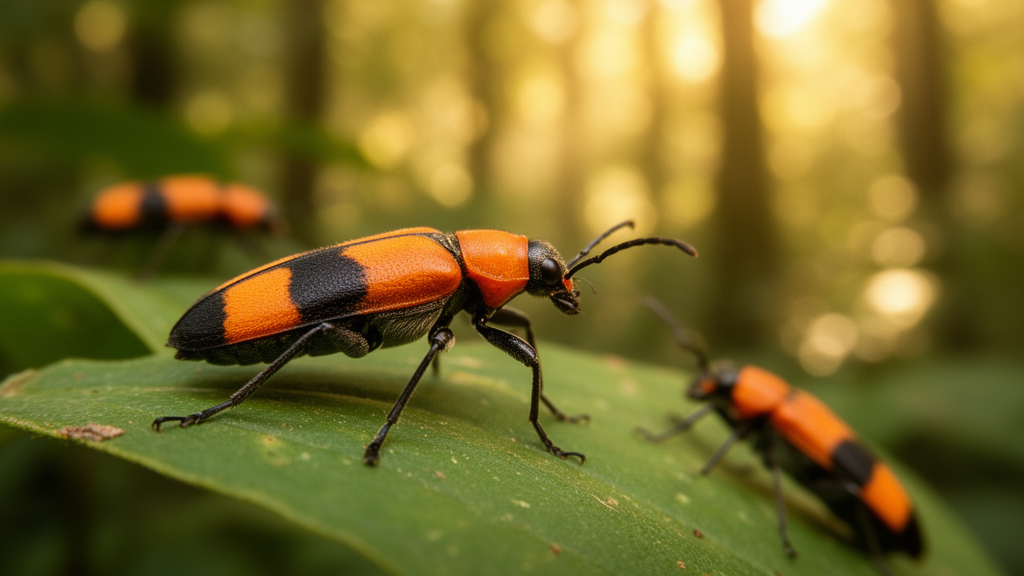
Deep in the mountain forests of Yunnan and Guangxi, and in museum drawers in Beijing, Genova, Paris and Baoding, a team of Chinese entomologists has quietly quadrupled the known frontier of one of the world’s most peculiar soldier beetle lineages. A comprehensive review of the genus Ichthyurus from China’s mainland, published in the Deutsche Entomologische Zeitschrift, describes four species entirely new to science, records four others for the first time on Chinese soil, and re-describes two long-neglected species in exhaustive modern detail. For a genus that had received only six mainland records as recently as the 1970s, the findings signal that one of the planet’s great biodiversity hotspots is still hiding an extraordinary amount of undiscovered life in plain sight.
Ichthyurus Westwood, 1848 is the largest genus within the tribe Ichthyurini of the beetle family Cantharidae, the so-called soldier beetles, comprising approximately 200 species worldwide. The genus exhibits a broad distribution across the Southern Hemisphere, with the exception of the Australian Region, and roughly 80 percent of its species are restricted to the Oriental Region, the belt of tropical and subtropical Asia that includes southern China. Despite this abundance, only a handful of focused faunal studies have ever been attempted, notably for Nepal and Taiwan Island. Prior to the research team’s earlier work, only six species had been recorded in China’s mainland, a figure that now looks like a dramatic underestimate of the true diversity.
The new review, led by entomologists at Hebei University and the Institute of Zoology of the Chinese Academy of Sciences, brings the mainland checklist to 21 species. Four new species are described, including Ichthyurus cleriformis sp. nov., known from Yunnan in China and from Vientiane and Champasak in Laos; Ichthyurus simplus sp. nov. from Guangxi; Ichthyurus senensomimus sp. nov. from Yunnan; and Ichthyurus terminalis sp. nov., also from Yunnan. Meanwhile, four species are recorded to China for the first time, including Ichthyurus platyurus Gestro, 1906, Ichthyurus laniger Gestro, 1891, Ichthyurus bisignatus Pic, 1926 and Ichthyurus phungi Pic, 1923. Additionally, both Ichthyurus senensis Pic, 1926 and Ichthyurus davidi Gestro, 1892 are re-described in detail within the review process.
The technical achievement rests on a meticulous dissection protocol applied to specimens preserved in five major collections: the Institute of Zoology of the Chinese Academy of Sciences in Beijing, the Museo Civico di Storia Naturale Giacomo Doria in Genova, the Museum of Hebei University in Baoding, the Muséum national d’Histoire naturelle in Paris, and Northwest A&F University in Yangling. Specimens were initially softened in water at room temperature for 12 hours, after which the genitalia and genital segments of both sexes were dissected. Male genitalia were immersed in a 10 percent sodium hydroxide solution and placed in a metal bath heated to 90 degrees Celsius for one minute, a clearing step that renders the chitinous structures transparent enough for photography in glycerol before permanent preservation on paper cards. Female genitalia underwent staining with haematoxylin, followed by examination in 75 percent alcohol and preservation in glycerol.
For each species, at least one specimen was dissected, and additional specimens were treated whenever damage occurred during the dissection process. In cases where a species is recorded from several localities, each locality was compared using dissections of both female and male specimens, a safeguard against the common taxonomic error of describing geographic variants as separate species. Images of the habitus were captured with a Canon EOS 80D digital camera, while finer structures were photographed through a Leica M205A stereo-microscope, with multiple focal layers stacked using Helicon Focus 7 software to produce razor-sharp composite images of structures barely a millimetre long.
The morphological detail now available for these beetles is staggering. In Ichthyurus senensis, for example, males measure 7.7 to 10.2 millimetres long, with large eyes whose minimum interocular distance is roughly 0.6 times the diameter of an eye, antennae reaching the posterior margin of abdominal tergite II, and elytra 1.5 times longer than wide and about 2.6 times longer than the pronotum. The male mesofemora are slightly swollen and 3.5 times longer than wide, each mesotibia bearing a spine-like process at its apex. The aedeagus, the male copulatory organ, features a right paramere that is dorso-ventrally flattened and tapered apically, a left paramere that is elongate, conical and nearly straight at roughly twice the length of the right, and a median lobe 1.5 times longer than the parameres and progressively narrowed basally. Females are larger than males, with less protruding eyes and uniformly black scape and pedicle, and their internal reproductive organs, including the bursa copulatrix and accessory gland, are now illustrated for the first time under contemporary standards.
Such characters matter because body colouration, the most obvious feature of these beetles, is a notoriously unreliable guide to species identity. The review’s discussion makes this point with two vivid examples. Ichthyurus senensis and the newly described Ichthyurus senensomimus, whose species name derives from the Latin -mimus, meaning imitate, display comparable body colouration, yet they show no similarity in their terminal abdominal tergites and ventrites of either sex or in the structure of the aedeagus. Another illustrative case involves Ichthyurus platyurus, Ichthyurus laniger, Ichthyurus bisignatus and Ichthyurus phungi, four species that share similar yellow-and-black colour patterns but are each distinctly characterised by unique features such as the strongly flattened terminal abdominal tergite of the male in Ichthyurus platyurus, the specialised male legs of Ichthyurus platyurus and Ichthyurus laniger, and the differing aedeagus structures of all four.
The new species themselves are anything but interchangeable. Ichthyurus terminalis, named for the Latin terminus, an end, referring to its characteristic terminal abdominal ventrite, is particularly distinctive in terms of its male abdominal sternites VIII and IX, its reniform proctiger protruding over a trapezoidal paraproct, and an aedeagus whose median lobe is extremely long, roughly 4.0 times longer than the tegmen and even in width along its whole length. Ichthyurus simplus, named for its simple aedeagus, stands out due to its characteristic bilobed proctiger and hexagonal paraproct bearing a short conical protrusion in the middle of its posterior margin. Ichthyurus cleriformis, whose name refers to its resemblance to some Cleridae beetles in appearance, is attributed to the Ichthyurus bourgeoisi species group by the male terminal abdominal tergite with postero-lateral projections excavated ventrally and arcuately, delimited with keeled and terminally hooked edges, but it is easily distinguished from other members by its yellowish-orange elytra with a pair of black rounded markings in the middle of the disc.
The review also establishes a comprehensive identification key for all Chinese mainland species, a tool the authors describe as increasingly necessary as more and more species are discovered. The key works through a branching sequence of morphological decisions, beginning with head colouration, then moving to the presence of strongly protruding mesotrochanters with opposing teeth on the mesofemora and mesotibiae in males, the emarginate protibiae and long-haired metatibiae of Ichthyurus laniger, and onward through the shapes of terminal abdominal tergites and ventrites, the degree of swelling of the mesofemora, and the fine architecture of the aedeagus. Only two mainland species are classified within the Ichthyurus vandepolli species group, four belong to the Ichthyurus bourgeoisi species group, and five are part of the Ichthyurus feae species group, while the remaining ones could not be assigned to any group at the moment. One species, Ichthyurus pieli from Shanghai, could not be included in the key because no types or determined specimens are available and the morphological information in its original description is limited.
Given that most species within this genus have not been reviewed for nearly a century, and that original descriptions are usually simple and without or with only simple illustrations, the re-descriptions update them according to contemporary standards, complete with habitus photographs, genital segments of both sexes, aedeagus and thoracic legs of males, and internal genitalia of females. The authors note that the Chinese mainland, recognised as one of the world’s renowned biodiversity hotspots, possesses significant potential for the discovery of additional Ichthyurus species, with some shared with neighbouring countries and some endemic to the Chinese fauna. With the discovery of an increasing number of species, it is expected that analogous ones will emerge in the near future, thereby enabling the classification of Chinese species into specific species groups. For now, the review stands as both a catalogue of what is known and a map of how much remains to be found, in a genus where nearly every new drawer of specimens seems to yield something the world has never seen.
Subject of Research: Taxonomy and biodiversity of soldier beetles
Article Title: Review of the Chinese species of Ichthyurus ( Coleoptera , Cantharidae )
Article References: Zhang, W., Lin, H., Liu, H., Yang, X., & Yang, Y. (2025). Review of the Chinese species of Ichthyurus (Coleoptera, Cantharidae). Deutsche Entomologische Zeitschrift, 72(2), 179-215. https://doi.org/10.3897/dez.72.158992
Image Credits: AI Generated
Keywords: entomology, taxonomy, beetles, Cantharidae, biodiversity, new species, China, soldier beetles, Review, Chinese, species, Ichthyurus
Cite Scienmag News
Drew Townsend. (October 18, 2026). Four New Beetle Species Emerge from Landmark Review of China’s Soldier Beetles. Scienmag. https://scienmag.com/four-new-beetle-species-emerge-from-landmark-review-of-chinas-soldier-beetles/
Drew Townsend. "Four New Beetle Species Emerge from Landmark Review of China’s Soldier Beetles." Scienmag, 18 October 2026, https://scienmag.com/four-new-beetle-species-emerge-from-landmark-review-of-chinas-soldier-beetles/. Accessed 18 October 2026.
Drew Townsend. "Four New Beetle Species Emerge from Landmark Review of China’s Soldier Beetles." Scienmag. October 18, 2026. https://scienmag.com/four-new-beetle-species-emerge-from-landmark-review-of-chinas-soldier-beetles/


