


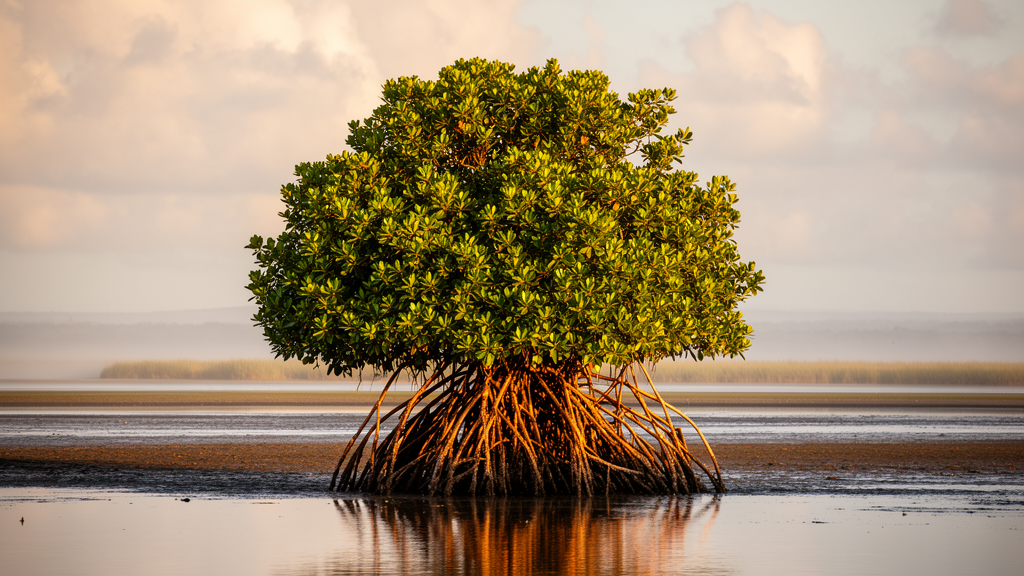
Deep in the mangroves of Con Dao National Park, an archipelago more than 100 kilometres off the Vietnamese coast, grows one of the rarest trees on Earth. Bruguiera hainesii, a member of the Rhizophoraceae family, is listed as Critically Endangered by the IUCN Red List, and only seven individuals have ever been documented in Vietnam. Yet a new study published in One Ecosystem suggests that the species’ bioclimatic zone — the band of temperature and rainfall conditions it can tolerate — extends across far more of Southeast Asia than its tiny known populations would imply, and that this zone may actually expand under future climate scenarios between 2080 and 2100.
The research team combined field surveys conducted during 2023 and 2024 with occurrence data drawn from the global GBIF biodiversity database, assembling records from all 13 population distribution areas where the species is found worldwide, including Vietnam, Thailand, Indonesia, Malaysia, Singapore, Australia and Papua New Guinea. With this dataset in hand, they turned to machine learning to answer a deceptively simple question: where, based on climate alone, could Bruguiera hainesii survive?
To model the species’ ecological niche, the researchers used Maxent, a widely adopted maximum-entropy algorithm that predicts species distributions from presence records and environmental layers. Nineteen bioclimatic variables were obtained from WorldClim version 2.1, and to avoid overfitting, any pair of variables correlated above 0.8 was pruned. Seven variables survived the screening: annual mean temperature, mean diurnal range, mean temperature of the wettest quarter, mean temperature of the driest quarter, mean temperature of the warmest quarter, annual precipitation and precipitation seasonality.
Two modelling pipelines were run in parallel. The first used Maxent software version 3.4.4 on a desktop platform, executed ten times with cross-validation, a random test-data seed and a maximum of 500 iterations, with a Jackknife test employed to evaluate the significance of each climatic variable and response curves generated to assess their impact. The second pipeline deployed the same algorithm on Google Earth Engine, a cloud-computing platform, incorporating both presence and pseudo-absence data. Model performance was validated using the Area Under the Curve (AUC) metric, where a value of 1 indicates perfect precision and values at or below 0.5 indicate performance no better than random guessing.
The desktop model decisively outperformed its cloud-based counterpart, achieving an AUC of 0.862 against 0.66 for the Google Earth Engine version. The high AUC indicates that the bioclimatic variables used in the model effectively explain the distribution range of Bruguiera hainesii, underscoring the critical role of climatic factors in shaping and maintaining its habitat. The weaker performance of the pseudo-absence model carries a practical lesson: for species with limited presence records or those inhabiting specialised environments such as mangrove forests, pseudo-absence data should be approached with caution, since random placement of absences can introduce inaccuracies.
Three climatic variables emerged as the decisive factors. The mean diurnal range — the difference between maximum and minimum temperatures within a day — contributed the most useful information when considered independently and also held the most distinct information not found in other variables, as revealed by the Jackknife test. The mean temperature of the driest quarter and the annual mean temperature completed the trio, together driving the model’s effectiveness in predicting habitat suitability. In other words, it is the stability of daily and seasonal temperatures, rather than rainfall alone, that defines where this rare mangrove can persist.
The resulting maps place the most suitable habitat squarely in Southeast Asia, encompassing Vietnam, Thailand, Indonesia, Malaysia, the Philippines, Singapore and Papua New Guinea, with parts of northern Australia also predicted to offer suitable conditions. Projections under the ACCESS-CM2 climate model — chosen for its high accuracy in the Asia region — and the medium-emission scenario SSP2-4.5, which assumes moderate socioeconomic development with coordinated emissions reductions, indicate a potential expansion of ideal habitats by 2080 to 2100, with a significant increase in the total area of high Habitat Suitability Index values across the region. The Habitat Suitability Index standardises predictions from 0 to 1, with values above 0.75 classified as highly suitable and below 0.45 as unsuitable.
The field component of the study provides the first detailed biological and ecological portrait of the Vietnamese population. The seven documented individuals on the Con Dao Islands average 15 metres in height with trunk diameters of 84 centimetres. The species possesses a distinctive aerial root system that resists erosion, stabilises soil and absorbs oxygen in the muddy, tidally submerged environment. Its small flowers, clustered in groups of two to three, predominantly bloom from January to March, yet fruiting trees are uncommon — a pattern consistent with the species’ notoriously low regeneration capacity. Soil analysis of 24 samples showed predominantly sandy composition exceeding 89 percent, slightly acidic to neutral pH between 4.62 and 6.77, moderate organic matter at 3.27 percent and low phosphorus at 0.04 percent.
The findings feed into a broader scientific conversation about mangroves and climate change. Research in the Gulf of Mexico and along the south-eastern coast of the United States indicates that warming temperatures and declining cold spells are enabling mangroves to expand poleward, with coverage increasing by 4.3 percent in Texas and southern Florida between 1980 and 2015. Mangroves possess complex adaptive mechanisms across morphology, anatomy, physiology and molecular biology that allow them to thrive in high-salinity, tidally fluctuating environments, and local assessments suggest Bruguiera hainesii may have reached the Con Dao Islands via ocean currents. Yet expansion is never straightforward: urbanisation, resource extraction and marine ecosystem changes can create barriers even where climatic conditions turn favourable, and local factors such as tidal range and sediment supply fundamentally shape how mangrove ecosystems respond to rising seas.
Herein lies the study’s central tension. The bioclimatic models suggest that Bruguiera hainesii could colonise new areas as temperatures and precipitation rise, potentially enhancing its distribution and ecological role. But climatic factors alone are evidently not responsible for the species’ global rarity. Its low regeneration capacity — possibly linked to poor seed viability, limited pollination or challenges in seedling establishment — remains a more critical limiting factor than climate in determining population dynamics. The authors recommend prioritising habitat protection where the species already exists, while simultaneously pursuing research into overcoming the physiological barriers to regeneration, whether through enhanced seedling establishment, improved pollination rates or genetic approaches. On a small island with limited access to external sediment sources, rising sea levels are likely to reduce the species’ geographical distribution in Con Dao National Park, making the preservation of existing populations and the management of suitable habitats essential to ensuring the long-term survival of this critically endangered mangrove and the coastal ecosystems it supports.
Subject of Research: Bioclimatic niche modelling extends the potential range of the critically endangered mangrove Bruguiera hainesii in Vietnam and Southeast Asia under current and future climates.
Article Title: Global range extension of bioclimatic zone of Bruguiera hainesii C.G.Rogers 1919 ( Rhizophoraceae )
Article References: Pham, M.-P., Hoang, T. T. T., Pham, V. D., Pham, T. T., & Vu, D. D. (2025). Global range extension of bioclimatic zone of Bruguiera hainesii C.G.Rogers 1919 (Rhizophoraceae). One Ecosystem, 10, Article e142064. https://doi.org/10.3897/oneeco.10.e142064
Image Credits: AI Generated
DOI: 10.3897/oneeco.10.e142064
Keywords: Bruguiera hainesii, mangrove, bioclimatic niche modelling, Maxent, climate change, Vietnam, Con Dao, conservation, Global, range, extension, bioclimatic
Cite Scienmag News
Margaret Porter. (October 18, 2026). Rare mangrove’s bioclimatic zone stretches far beyond its known range. Scienmag. https://scienmag.com/rare-mangroves-bioclimatic-zone-stretches-far-beyond-its-known-range/
Margaret Porter. "Rare mangrove’s bioclimatic zone stretches far beyond its known range." Scienmag, 18 October 2026, https://scienmag.com/rare-mangroves-bioclimatic-zone-stretches-far-beyond-its-known-range/. Accessed 18 October 2026.
Margaret Porter. "Rare mangrove’s bioclimatic zone stretches far beyond its known range." Scienmag. October 18, 2026. https://scienmag.com/rare-mangroves-bioclimatic-zone-stretches-far-beyond-its-known-range/


