


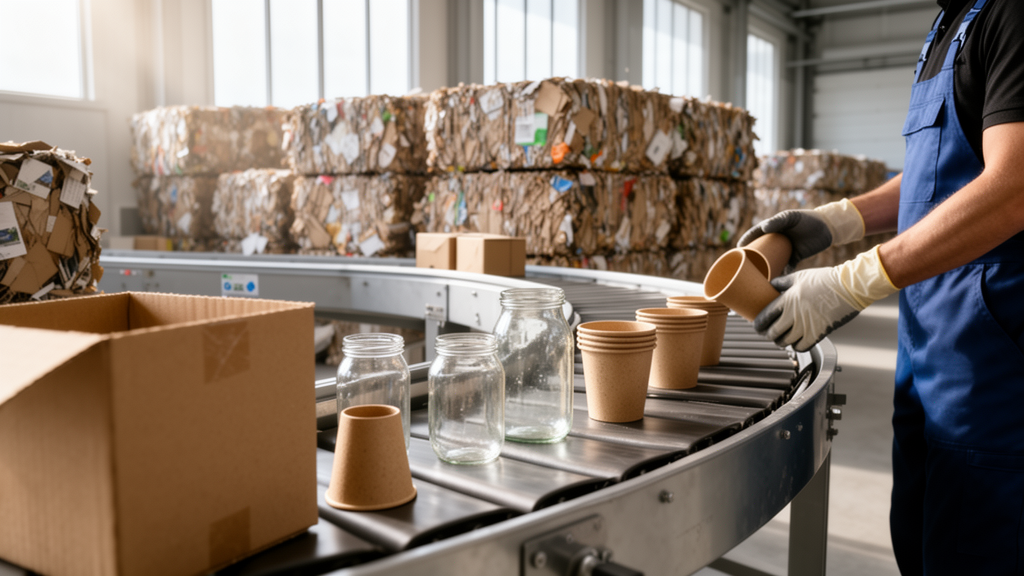
Every year, the world generates more than 155.9 million tonnes of plastic packaging waste, yet only about 14 percent of it is recycled. Those two numbers, pulled together in a sweeping new review published in Clean Technologies and Environmental Policy, capture the central paradox of modern packaging: consumption keeps climbing while the systems meant to handle the aftermath remain stubbornly linear. A team of researchers from CSIR institutes in India argues that the fix is not a single breakthrough technology but a coordinated overhaul spanning materials science, recycling infrastructure, policy, and digital traceability, all organized under the framework of the circular economy.
The review, led by Shruthi Yerraju and Sumana Chenna of CSIR-IICT in Hyderabad together with Karunakaran Venugopal and C. Anandharamakrishnan of CSIR-NIIST in Thiruvananthapuram, was conducted as a structured literature analysis using defined search terms, explicit inclusion and exclusion criteria, and PRISMA-based screening, the standard protocol for systematic reviews. Rather than treating packaging design, recycling technologies, biodegradable materials, environmental assessment, and policy as separate silos, the authors deliberately integrated them into a single analytical framework, a move they argue distinguishes their work from earlier reviews that examined these dimensions independently.
At the heart of the analysis is a sobering comparison of recycling pathways. The researchers critically evaluated mechanical recycling, chemical recycling, and energy recovery against four yardsticks: environmental performance, technology readiness, scalability, and suitability for different waste streams. Their conclusion is deliberately unsentimental. No single pathway wins outright, because effectiveness varies with polymer type, feedstock quality, energy demand, technology maturity, and the regional infrastructure available to process the waste. Mechanical recycling, which shreds, washes, and remelts plastics like polyethylene terephthalate and high-density polyethylene, remains the most mature option but falters on contaminated, multilayer, or mixed waste. Chemical recycling, including pyrolysis and depolymerization, can break polymers back down to monomers or feedstocks, offering a route for plastics that mechanical systems cannot handle, but it typically demands more energy and sits at lower technology readiness levels.
The polymer chemistry itself complicates matters. The review catalogs an extensive range of packaging plastics, from commodity polyolefins such as polyethylene and polypropylene to engineering polymers like polycarbonate and polyvinyl chloride, alongside a growing roster of biodegradable alternatives. Among the latter, polylactic acid, polyhydroxyalkanoates, polybutylene succinate, and polycaprolactone are the most prominent, each with distinct degradation kinetics, mechanical properties, and end-of-life requirements. Polylactic acid, derived from fermented plant starch, composts under industrial conditions but degrades slowly in ambient landfills. Polyhydroxyalkanoates, synthesized by bacteria, offer genuine marine biodegradability but remain expensive to produce at scale. The authors stress that biodegradability is not a universal escape hatch: without the composting or anaerobic digestion infrastructure to process these materials, they can end up contaminating conventional recycling streams, where even small amounts of PLA can compromise the quality of recycled PET.
Emerging feedstocks are also reshaping the materials landscape. The review highlights agricultural and agro-industrial waste as a promising source of biopolymers, including cellulose nanofibers extracted from wheat straw and orange peel, chitosan from crustacean shells, and pectin from fruit processing residues. These materials can form edible films and coatings, active packaging with antimicrobial properties, and barrier layers that reduce reliance on fossil-derived polymers. Nanocellulose films, in particular, have shown enhanced barrier and antioxidant performance in coating applications, while lignin, an abundant byproduct of papermaking, is being repurposed as a functional material for active packaging. The circular logic is appealing: waste from one industry becomes feedstock for another, reducing both disposal burdens and virgin material demand.
On the assessment side, the review examines two complementary analytical tools. Life cycle assessment quantifies environmental impacts across a product’s entire existence, from raw material extraction through manufacturing, use, and disposal, typically reporting metrics such as global warming potential. Material flow analysis, by contrast, tracks the physical stocks and flows of materials through an economy, revealing where plastics accumulate, leak, or cycle. The authors argue that neither tool alone is sufficient: LCA can identify that a reusable packaging system outperforms a single-use equivalent, but only after a certain number of reuse cycles, a threshold that depends on transport distances and washing energy. MFA can expose the sheer scale of material leakage, such as the finding that more than 1,000 rivers account for 80 percent of global riverine plastic emissions into the ocean. Used together, they provide both the environmental scorecard and the material balance sheet needed to steer policy.
Policy instruments receive equally close scrutiny. The review evaluates extended producer responsibility, deposit-return systems, and recycled-content mandates as the three principal levers for promoting resource circulation. Extended producer responsibility shifts the financial and operational burden of managing packaging waste from municipalities to the producers who put packaging on the market, creating an economic incentive to design for recyclability. Deposit-return systems, which charge consumers a small refundable fee at purchase, have demonstrated high collection rates for beverage containers in multiple jurisdictions. Recycled-content mandates, such as those embedded in the European Union’s Packaging and Packaging Waste Regulation, force demand for secondary materials, giving recyclers a guaranteed market. The authors note that these instruments work best in combination, and that their effectiveness depends heavily on regional governance capacity and enforcement.
The digital dimension may prove the most transformative frontier. The review surveys artificial intelligence-assisted sorting, which uses machine learning and near-infrared spectroscopy to identify polymer types on conveyor belts with increasing speed and accuracy, blockchain-enabled traceability that can verify the provenance of recycled content across supply chains, digital product passports that encode a package’s material composition and recycling instructions in a machine-readable format, and smart monitoring systems based on the Internet of Things and radio frequency identification. These technologies promise to enhance segregation, recycling efficiency, and supply-chain transparency, but the authors are candid about the barriers: cost, data availability, interoperability between systems, and the underlying infrastructure required to deploy them at scale remain significant hurdles, particularly in developing economies where informal waste sectors handle a large share of collection.
What emerges from the synthesis is not a blueprint but a decision framework. The authors argue that circular business models, from refill-and-reuse systems to product-as-service arrangements, must be matched to the specific technological and infrastructural context of each region. A deposit-return scheme that works in a European city with mature collection infrastructure may fail in a rapidly urbanizing region where waste collection itself is unreliable. Similarly, the choice between mechanical and chemical recycling should be driven by the local waste stream composition, energy prices, and the availability of markets for recycled outputs. The review’s contribution lies in making these trade-offs explicit, offering researchers, industry, and decision-makers a holistic roadmap for prioritizing innovation, accelerating technology adoption, and enabling the large-scale deployment of sustainable circular packaging systems. As plastic waste generation continues to outpace recycling capacity, the window for incremental fixes is closing; the authors suggest that only an integrated strategy, one that treats materials, technology, policy, and digitalization as a single system, can bend the curve.
Subject of Research: Circular economy roadmap for packaging waste: recycling, bioplastics, and digital tools converge
Article Title: Sustainable packaging waste management: circular economy strategies, technological innovations, and future perspectives
Article References: Yerraju, S., Venugopal, K., Anandharamakrishnan, C., & Chenna, S. (2026). Sustainable packaging waste management: circular economy strategies, technological innovations, and future perspectives. Clean Technologies and Environmental Policy, 28(11), Article 281. https://doi.org/10.1007/s10098-026-03628-z
Image Credits: AI Generated
DOI: 10.1007/s10098-026-03628-z
Keywords: circular economy, plastic packaging, recycling, biodegradable plastics, extended producer responsibility, life cycle assessment, AI sorting, digital product passport, sustainable packaging, plastic waste, Sustainable, packaging
Cite Scienmag News
Sloane Callahan. (October 17, 2026). Sustainable packaging waste management: circular economy strategies, technological innovations, and future perspectives. Scienmag. https://scienmag.com/sustainable-packaging-waste-management-circular-economy-strategies-technological-innovations-and-future-perspectives/
Sloane Callahan. "Sustainable packaging waste management: circular economy strategies, technological innovations, and future perspectives." Scienmag, 17 October 2026, https://scienmag.com/sustainable-packaging-waste-management-circular-economy-strategies-technological-innovations-and-future-perspectives/. Accessed 17 October 2026.
Sloane Callahan. "Sustainable packaging waste management: circular economy strategies, technological innovations, and future perspectives." Scienmag. October 17, 2026. https://scienmag.com/sustainable-packaging-waste-management-circular-economy-strategies-technological-innovations-and-future-perspectives/


