


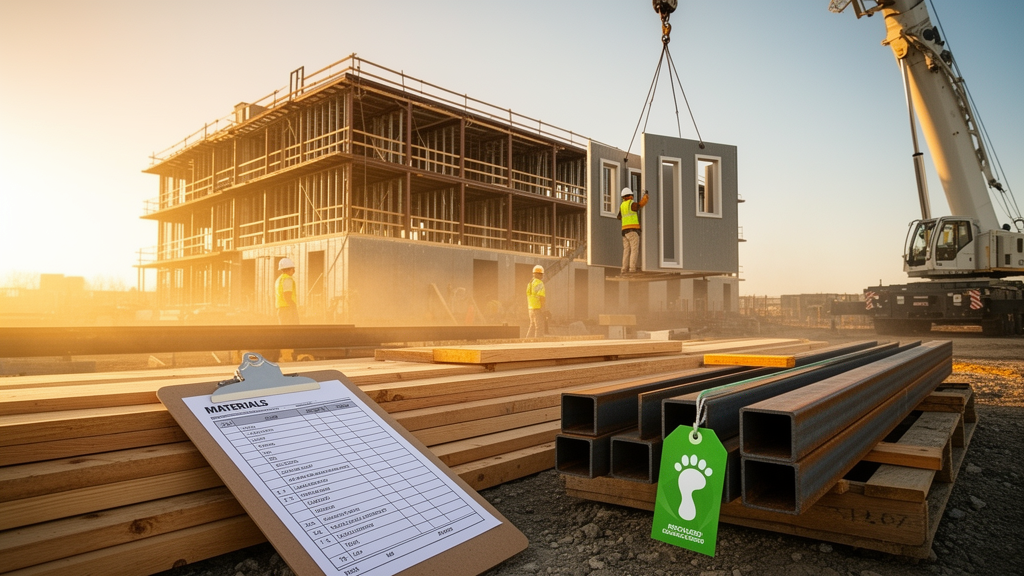
The construction industry has long been one of the planet’s most stubborn climate problems. Buildings account for a substantial share of global greenhouse gas emissions, driven by material-intensive processes, mountains of construction and demolition waste, and a pervasive lack of transparency about where carbon is actually generated on a building site. Now a new study published in Clean Technologies and Environmental Policy offers a strikingly practical answer: combine carbon labelling, lean construction practices, and life cycle assessment into a single unified framework, and the sector could slash embodied carbon emissions at the construction stage by roughly a third.
The research, led by J. S. Sudarsan of NICMAR University’s School of Energy and Environment in Pune, India, tackles a gap that has frustrated sustainability researchers for years. Lean construction and life cycle assessment, or LCA, have each been studied extensively in isolation. But few studies have integrated transparency, carbon labelling, lean execution, and embodied carbon assessment within one coherent framework aimed at construction-stage improvement. The new work does exactly that, using a mixed-method approach that combines questionnaire surveys, statistical analysis, respondent-weighted Pareto prioritization, lean-based waste quantification, and streamlined life cycle assessment.
One of the study’s most encouraging findings concerns transparency itself. Survey results show strong agreement, between 70 and 80 percent, on the importance of transparency in construction sustainability, and remarkably, this consensus held independent of respondents’ educational background. In an industry where information asymmetry has historically enabled waste, overruns, and hidden carbon, that near-universal recognition of transparency’s value suggests the cultural groundwork for carbon labelling may already be in place. Carbon labelling, which communicates the environmental footprint of materials and products much like nutrition labels do for food, depends on exactly this kind of shared stakeholder buy-in.
The study then applied Pareto analysis to identify where sustainability interventions would matter most. The results are unambiguous: concreting and masonry activities account for over 70 percent of cumulative sustainability impact. That concentration is good news for practitioners, because it means effort can be targeted at a small number of high-impact activities rather than diffused across the entire construction process. Concrete and masonry are also precisely the activities where embodied carbon is most intense, given the cement and brick production chains that feed them.
To test the framework in practice, the researchers turned to a ground-plus-three-floor residential building as a case study. The results reveal the power of lean thinking applied to carbon. Lean practices, which originated in manufacturing and focus on eliminating waste in all its forms, reduced construction and demolition waste-related embodied CO2 emissions by approximately 33 percent. That is not a marginal improvement; it is a transformative one, achieved not through exotic new materials but through disciplined execution, better planning, and waste elimination at the source.
Life cycle assessment benchmarking added another layer of insight. The streamlined LCA confirmed that material production contributes nearly 78 percent of cradle-to-site embodied carbon. In other words, the carbon embedded in making cement, steel, bricks, and other materials dwarfs the emissions from transporting them or assembling them on site. This finding has profound implications for carbon labelling schemes, because it means labels that capture production-stage emissions would address the overwhelming majority of a building’s construction-stage carbon footprint.
The integration of these three elements, transparency, lean execution, and LCA verification, is what gives the framework its strength. Transparency ensures stakeholders can see and compare carbon performance. Lean construction provides the operational tools to actually reduce waste and emissions. LCA verification offers the scientific rigour to confirm that reductions are real and not merely claimed. Together, they form a practical nexus that supports low-carbon construction practices and aligns with the United Nations Sustainable Development Goals, particularly those addressing sustainable cities, responsible consumption, and climate action.
The construction sector’s carbon challenge is not going away. The United Nations Environment Programme’s 2023 global status report for buildings and construction underscores how urgent the problem remains, and embodied carbon is increasingly recognized as the dominant share of a building’s lifetime emissions in efficient new structures. Frameworks like the one proposed here, grounded in standardized methods such as ISO 14040 and ISO 14044 for life cycle assessment and EN 15978 for building environmental performance, offer a credible pathway for the industry to move from aspiration to measurable action.
What makes this study genuinely viral in its implications is its accessibility. The framework does not require billion-dollar investments or futuristic technology. It requires transparency that stakeholders already agree is important, lean practices that are well understood and widely documented, and streamlined LCA methods that are technically mature. The finding that a third of waste-related embodied carbon can be eliminated through lean execution alone, verified by rigorous assessment, should send ripples through construction boards, procurement departments, and policy ministries alike. As the world races to decarbonize, the humble building site may prove to be one of the most consequential frontiers of the climate fight.
Subject of Research: The carbon transparency nexus: associating Carbon Labelling and Integrated Project Delivery (IPD) for SDG compliance in construction projects
Article Title: The carbon transparency nexus: associating Carbon Labelling and Integrated Project Delivery (IPD) for SDG compliance in construction projects
Article References: Sudarsan, J. S. (2026). The carbon transparency nexus: associating Carbon Labelling and Integrated Project Delivery (IPD) for SDG compliance in construction projects. Clean Technologies and Environmental Policy, 28(11), Article 277. https://doi.org/10.1007/s10098-026-03567-9
Image Credits: AI Generated
DOI: 10.1007/s10098-026-03567-9
Keywords: carbon, transparency, nexus, associating, Labelling, Integrated, Project, Delivery, compliance, construction, projects, scientific research
Cite Scienmag News
Sloane Callahan. (October 17, 2026). Carbon Labels and Lean Building Could Cut a Third of Construction Waste Emissions. Scienmag. https://scienmag.com/carbon-labels-and-lean-building-could-cut-a-third-of-construction-waste-emissions/
Sloane Callahan. "Carbon Labels and Lean Building Could Cut a Third of Construction Waste Emissions." Scienmag, 17 October 2026, https://scienmag.com/carbon-labels-and-lean-building-could-cut-a-third-of-construction-waste-emissions/. Accessed 17 October 2026.
Sloane Callahan. "Carbon Labels and Lean Building Could Cut a Third of Construction Waste Emissions." Scienmag. October 17, 2026. https://scienmag.com/carbon-labels-and-lean-building-could-cut-a-third-of-construction-waste-emissions/


