


Every olive season, Mediterranean mills discharge a dark, acidic, phenol-rich liquid that smothers streams, sterilizes soil, and overwhelms conventional treatment plants. A team of Moroccan researchers at Mohammed V University in Rabat has now shown that a layered soil filtration system—built largely from local waste materials—can strip this notorious effluent of more than 97 percent of its organic load, using nothing more than gravity, pozzolan, charcoal, date palm residue, and iron debris. The study, published in Environmental Geochemistry and Health, offers one of the most statistically rigorous demonstrations yet that multi-soil-layering technology can tame olive mill wastewater, or OMW, at a cost that small mills might actually afford.
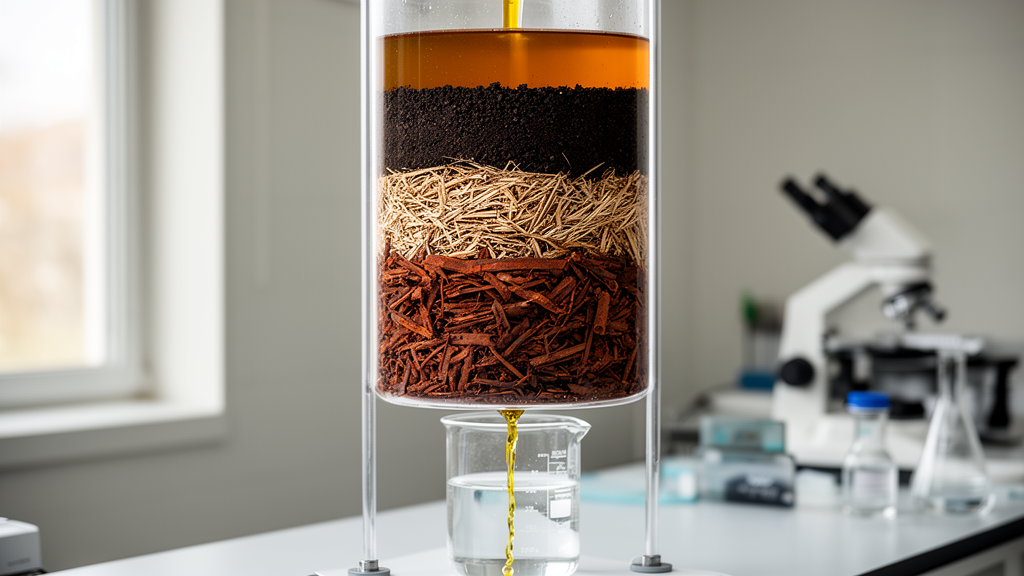
The multi-soil-layering approach, known as MSL, is a decentralized filtration concept in which wastewater percolates through alternating permeable layers and compacted soil mixed blocks, or SMBs. The permeable layers, made here of porous volcanic pozzolan, distribute the flow evenly and keep oxygen moving through the system. The SMBs act as the reactive heart of the filter: each block is a mixture of 70 percent local soil, 10 percent charcoal, 10 percent Phoenix dactylifera—date palm residue—and 10 percent iron debris. As the effluent winds through this sandwich of reactive and permeable materials, nutrients bind to mineral surfaces, phenolic compounds adsorb onto carbon and iron sites, and microbial communities break down organic matter along the way.
What makes this particular configuration new is the combination of amendments. Traditional MSL designs have relied on conventional carbon sources and metal adsorbents that were tested separately, but the Moroccan team blended locally sourced agro-industrial residues with iron-based adsorbents in a single block composition—a combination never before evaluated for OMW treatment. The researchers fed the system a 50 percent diluted OMW, a realistic pretreatment step for small mills, and varied the hydraulic load rate across three levels: 200, 400, and 500 liters per day per square meter. This parameter, abbreviated HLR, determines how fast wastewater moves through the filter and therefore how long the liquid remains in contact with the reactive surfaces.
The results at the lowest loading rate were striking. At 200 liters per day per square meter, the MSL system removed 93.42 percent of ammonium, 99.67 percent of orthophosphates, 96.8 percent of phenolic compounds, and 97.41 percent of chemical oxygen demand, or COD. These removal rates exceed those reported for MSL systems using conventional carbon and iron amendments, suggesting that the unusual SMB recipe—part soil, part charcoal, part date palm, part iron scrap—creates a geochemical environment unusually well suited to capturing OMW pollutants. Orthophosphate removal above 99 percent is particularly notable, since phosphorus is notoriously difficult to strip from wastewater without chemical dosing or specialized adsorbents.
The geochemistry behind these numbers is worth unpacking. Ammonium, a positively charged ion, binds readily to negatively charged clay and soil surfaces through cation exchange. Orthophosphates, by contrast, are captured primarily by iron oxides and hydroxides that form on the iron debris surfaces, where phosphate ions precipitate or adsorb onto ferric sites. Phenolic compounds—the signature pollutants of OMW, responsible for its dark color, antibacterial activity, and ecotoxicity—adsorb onto the charcoal and date palm carbon surfaces, and can also complex with iron. The pozzolan layers, rich in silica and alumina, contribute additional silanol and exchange sites while maintaining the hydraulic conductivity that keeps the system from clogging under high organic loads.
Crucially, the team did not simply report removal percentages. They applied an inferential statistical framework—analysis of variance, Tukey HSD post-hoc testing, and effect-size calculation—that had never before been used to validate MSL-OMW treatment performance. This approach confirmed the robustness of the removal rates and revealed something quantitative and design-relevant: COD was the only parameter significantly sensitive to hydraulic load rate. In other words, ammonium, phosphate, and phenol removal held steady across the tested loading range, but organic matter removal degraded as flow rate increased, providing clear guidance for scale-up. Engineers designing full-scale systems now know that if COD compliance is the binding constraint, the hydraulic load rate must be kept near the 200-liter threshold.
The implications for Mediterranean olive-growing regions are substantial. OMW volumes are enormous—each mill can generate several cubic meters of effluent per ton of olives processed—and the liquid is typically stored in open ponds or spread on land, where it can leach into groundwater, kill soil microorganisms, and contaminate wells. Untreated OMW disposal carries documented human health and ecotoxicological risks, from phenol contamination of drinking water sources to the collapse of aquatic ecosystems downstream. The study’s authors argue that the SMB acts as an efficient barrier controlling these risks, and that the system’s reliance on local, low-cost materials makes it viable for the small, decentralized mills that dominate olive production in Morocco, Tunisia, Greece, and southern Spain.
The choice of date palm residue as a carbon amendment is also a story of circular economy logic. Phoenix dactylifera waste is abundant across North Africa and the Middle East, where millions of tons of palm fronds, seeds, and fibers are discarded annually. Previous research has shown that date palm-derived biochar can adsorb heavy metals, inorganics, and organic pollutants from water. By incorporating raw date palm residue directly into the SMB mixture, the Moroccan team avoided the energy cost of pyrolysis while still providing a carbon surface for phenol adsorption. Iron debris, similarly, is a scrap material that would otherwise require disposal, yet it supplies the reactive ferric sites responsible for phosphate capture. The system thus converts two waste streams into treatment infrastructure.
Compared with alternative OMW treatment approaches—constructed wetlands, sequencing batch reactors, nanofiltration, straw filtration, or land spreading—the MSL system offers a distinctive combination of low energy demand, no chemical dosing, and modular construction. Constructed wetlands require land area and plant management; biological reactors require aeration and skilled operators; membrane systems require electricity and fouling control. The MSL approach, by contrast, is essentially a passive filter that can be built from local soil and scrap materials, operated by mill workers, and maintained by replacing SMBs when they saturate. For rural mills without access to skilled labor or reliable electricity, this simplicity is not a compromise but a design feature.
The study does leave open questions. The researchers tested a 50 percent diluted OMW, so full-strength effluent performance remains to be demonstrated. Long-term saturation of the SMBs, the fate of adsorbed phenols and phosphates over years of operation, and the regeneration or disposal of spent blocks are all areas for future work. The team also notes that the system’s reliance on local materials means performance may vary with soil composition and pozzolan availability in different regions. Nevertheless, the combination of high removal rates, statistical validation, and quantitative design guidance marks this study as a significant step forward for decentralized OMW treatment. If the approach scales successfully, the dark liquid that has plagued Mediterranean mills for generations might finally have an affordable, passive, and locally built solution.
Subject of Research: Multi-soil-layering wastewater treatment
Article Title: A performance evaluation of a multi-soil-layering for the treatment of an olive mill wastewater
Article References: Zine, M., Asli, H., Bamaarouf, M., Touach, N., Tajounte, L., Kara, K., & Lotfi, E. M. (2026). A performance evaluation of a multi-soil-layering for the treatment of an olive mill wastewater. Environmental Geochemistry and Health, 48(16), Article 641. https://doi.org/10.1007/s10653-026-03532-x
Image Credits: AI Generated
DOI: 10.1007/s10653-026-03532-x
Keywords: olive mill wastewater, multi-soil-layering, wastewater treatment, MSL technology, phenolic compounds, Morocco, performance, evaluation, treatment, olive, mill, wastewater
Cite Scienmag News
Sloane Callahan. (October 16, 2026). Soil Layers Built From Date Palm Waste and Iron Scraps Strip Olive Mill Wastewater Clean. Scienmag. https://scienmag.com/soil-layers-built-from-date-palm-waste-and-iron-scraps-strip-olive-mill-wastewater-clean/
Sloane Callahan. "Soil Layers Built From Date Palm Waste and Iron Scraps Strip Olive Mill Wastewater Clean." Scienmag, 16 October 2026, https://scienmag.com/soil-layers-built-from-date-palm-waste-and-iron-scraps-strip-olive-mill-wastewater-clean/. Accessed 16 October 2026.
Sloane Callahan. "Soil Layers Built From Date Palm Waste and Iron Scraps Strip Olive Mill Wastewater Clean." Scienmag. October 16, 2026. https://scienmag.com/soil-layers-built-from-date-palm-waste-and-iron-scraps-strip-olive-mill-wastewater-clean/


