


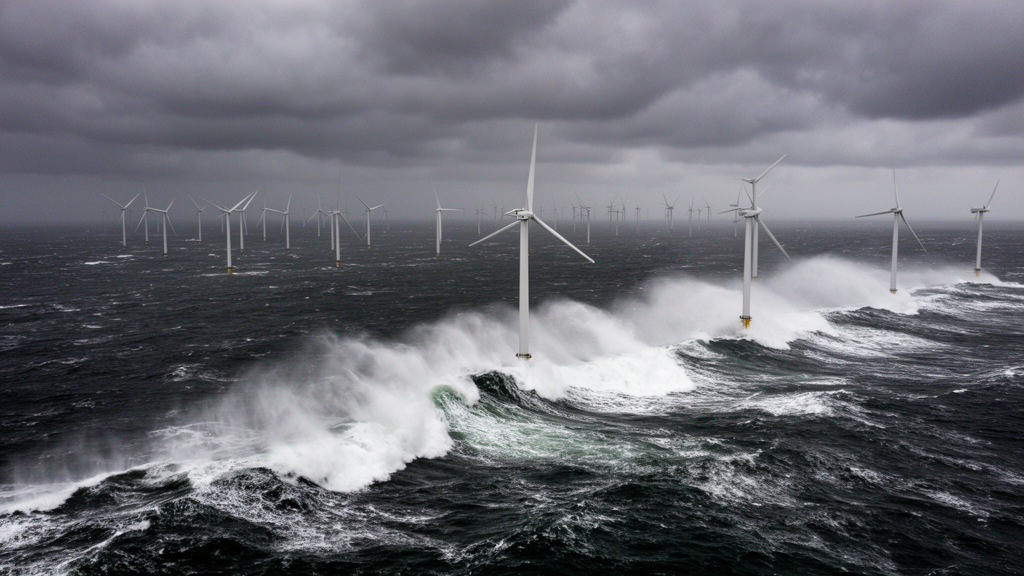
Offshore wind is expanding into some of the most violent weather environments on the planet, including basins regularly struck by tropical cyclones. Designing turbines and foundations for these regions requires reliable estimates of the extreme winds and waves a structure may face over a lifetime of decades. A new study by Jean-François Filipot of France Energies Marines and colleagues, published as a preprint under review at Wind Energy Science, presents a methodology that assesses extreme wind and wave statistics at offshore sites exposed to both tropical and extratropical cyclones, and it addresses a long-standing inconsistency in how engineers have treated these two hazards.
The core problem the researchers identify is that current engineering practice generally relies on stochastic approaches for wind extremes and conventional extreme-value analyses for wave extremes. Because wind and wave assessments are carried out with different methodologies, the resulting design conditions can be physically inconsistent, and in some cases non-physical, meaning the paired wind and wave states used for structural design could not actually occur together in the real ocean and atmosphere. For a turbine tower that must simultaneously resist hurricane-force gusts and the slamming of enormous waves, such mismatches matter enormously.
A second challenge is observational. Tropical cyclones are rare events at any given location, and the relatively limited duration of observational records compared with the occurrence rate of these storms introduces substantial uncertainties when engineers try to estimate extremes with long return periods, such as the 50-year or 100-year conditions that anchor offshore design standards. A few decades of buoy measurements simply cannot capture the full statistical behavior of a hazard that may visit a site only a handful of times per century.
To overcome these limitations, the team turned to a Monte Carlo framework, a computational strategy that generates vast numbers of synthetic scenarios to build statistics that no observational record could provide. The methodology combines synthetic tropical cyclone tracks from the STORM database, developed by Bloemendaal and colleagues, with a parametric wind model from Vinour and colleagues and a tropical-cyclone-adapted configuration of the WAVEWATCH III wave model. Together these components generate large ensembles of tropical-cyclone-induced wind and wave conditions, effectively simulating thousands of storms that never happened but behave according to the physics of those that did.
The framework also incorporates two components that conventional approaches often neglect: the contribution of swells and of extratropical cyclones. Swells are long-period waves generated by distant storms that can arrive at a site independently of local weather, and they can coexist with a passing tropical cyclone, adding to the local wave field. The researchers introduce a statistical approach to account for these remotely generated swell systems, ensuring that the wave conditions paired with cyclone winds reflect what actually reaches the site.
Extratropical cyclones, the powerful mid-latitude storm systems that dominate weather in temperate zones, are handled through annual maxima statistics derived from the ERA5 reanalysis, a comprehensive global atmospheric and oceanic dataset produced by blending observations with numerical weather modeling. By folding these statistics into the same framework, the method produces joint wind and wave extremes that represent the full spectrum of severe storms a site may experience, not just the tropical variety.
The approach was applied at the NDBC 41002 buoy in the western North Atlantic, a location where long-term wind and wave observations are available for comparison. This validation step is critical: a Monte Carlo method is only as trustworthy as its agreement with reality. The results show that the coupled modeling framework agrees reasonably well with the historical tropical cyclone extreme statistics recorded at the buoy, giving the authors confidence that the synthetic storm ensembles reproduce the behavior of real events.
The payoff for the offshore wind industry is that the methodology provides physically consistent joint wind and wave conditions that can be directly used to construct environmental contours. Environmental contours are curves in wind-wave space that enclose combinations of conditions with a given probability of exceedance, and they are a standard tool for identifying offshore design points. Because the contours generated by this method pair winds with waves that genuinely co-occur, engineers can select design load cases that are both conservative and physically plausible, avoiding the non-physical combinations that can emerge when wind and wave extremes are estimated separately.
For regions eyeing offshore wind as a climate solution, from the Gulf of Mexico to the Caribbean and the western Pacific, the implications are significant. Turbines deployed in cyclone-prone waters must survive conditions far beyond those of the North Sea, and underestimating the joint severity of wind and waves could compromise structural integrity, while overestimating it inflates costs. A framework that generates thousands of physically consistent storm scenarios from synthetic tracks, adapted wave modeling, swell statistics, and reanalysis data offers a way to anchor those design decisions in robust statistics rather than sparse observations.
The study, authored by researchers at France Energies Marines and Ifremer in Plouzané, France, is distributed under a Creative Commons Attribution 4.0 license and is currently open for community discussion as part of the peer-review process at Wind Energy Science. As offshore wind farms push into hurricane territory, methods like this one, which treat wind and waves as the coupled physical system they truly are, may become essential tools for building clean energy infrastructure that can weather the storm.
Subject of Research: A Monte Carlo methodology for assessing joint extreme wind and wave statistics at offshore wind farms exposed to tropical and extratropical cyclones
Article Title: A method to assess wind and wave extreme statistics at offshore wind farms exposed to tropical and extratropical cyclones
Article References: Filipot, J.-F., Renaud, P., Prevosto, M., Leckler, F., Pouplin, C., & Raillard, N. (2026). A method to assess wind and wave extreme statistics at offshore wind farms exposed to tropical and extratropical cyclones. https://doi.org/10.5194/wes-2026-162
Image Credits: AI Generated
DOI: 10.5194/wes-2026-162
Keywords: offshore wind energy, tropical cyclones, extratropical cyclones, extreme value statistics, Monte Carlo simulation, WAVEWATCH III, environmental contours, wave modeling, swell, ERA5 reanalysis, structural design, Wind Energy Science
Cite Scienmag News
Denise Maddox. (October 16, 2026). New Monte Carlo method delivers physically consistent wind and wave extremes for cyclone-exposed offshore wind farms. Scienmag. https://scienmag.com/new-monte-carlo-method-delivers-physically-consistent-wind-and-wave-extremes-for-cyclone-exposed-offshore-wind-farms/
Denise Maddox. "New Monte Carlo method delivers physically consistent wind and wave extremes for cyclone-exposed offshore wind farms." Scienmag, 16 October 2026, https://scienmag.com/new-monte-carlo-method-delivers-physically-consistent-wind-and-wave-extremes-for-cyclone-exposed-offshore-wind-farms/. Accessed 16 October 2026.
Denise Maddox. "New Monte Carlo method delivers physically consistent wind and wave extremes for cyclone-exposed offshore wind farms." Scienmag. October 16, 2026. https://scienmag.com/new-monte-carlo-method-delivers-physically-consistent-wind-and-wave-extremes-for-cyclone-exposed-offshore-wind-farms/


