


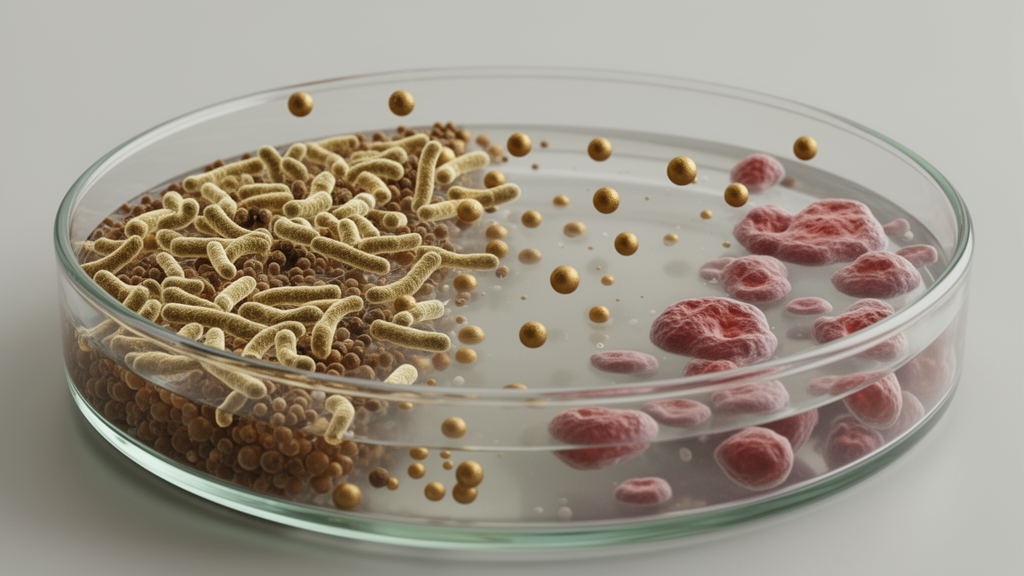
In a finding that could reshape how scientists approach one of medicine’s most stubborn problems, researchers in Iraq and Malaysia have engineered magnesium oxide nanoparticles using nothing more exotic than an extract of common pepper, Capsicum annuum, and turned them against multidrug-resistant Staphylococcus haemolyticus, an opportunistic pathogen increasingly recognized as a serious threat in hospital settings. The study, published in the journal 3 Biotech, also reports that the same nanoparticles reduced the viability of MCF-7 breast cancer cells in the laboratory, hinting at a rare dual antimicrobial and anticancer profile in a single green-synthesized material.
The research team, led by Abeer Hassan Kadhum of Al-Nahrain University in Baghdad, began with fifteen isolates of S. haemolyticus recovered from twenty blood specimens collected at a children’s hospital in Baghdad. Eight of these isolates met the strict definition of multidrug resistance, a category that has become alarmingly common among coagulase-negative staphylococci, the group of bacteria to which S. haemolyticus belongs. What makes these organisms particularly dangerous is not just their resistance to conventional antibiotics but their ability to form biofilms, structured communities of bacteria encased in a self-produced matrix that shields them from both immune attack and drug exposure.
To build their weapon against these biofilms, the researchers turned to green synthesis, a method of nanoparticle production that uses biological extracts rather than harsh chemical reagents. They prepared an aqueous extract from Capsicum annuum and used it to mediate the formation of magnesium oxide nanoparticles. Gas chromatography–mass spectrometry analysis of the extract revealed that phenolic compounds made up roughly 83 percent of its chemical profile, a detail that matters because phenolics are known to interact with metal ions and can influence both the size and surface chemistry of the particles that form.
Characterization of the resulting CAE/MgONPs revealed a population of spherical-to-irregular, partly agglomerated particles. Field-emission scanning electron microscopy put the mean particle or agglomerate size at 95.73 nanometers with a standard deviation of 21.47 nanometers, while atomic force microscopy yielded a mean lateral diameter of 110.6 nanometers. X-ray diffraction analysis indicated a crystallite size of approximately 34 nanometers, suggesting that the individual crystalline domains within each particle were considerably smaller than the agglomerates visible in electron micrographs. The zeta potential, a measure of surface charge that predicts colloidal stability, came in at negative 30.38 millivolts, a value generally associated with moderate electrostatic repulsion between particles in suspension.
When the team tested how well these materials inhibited bacterial growth, they found that the minimum inhibitory concentration of the plain Capsicum annuum extract was 15.62 milligrams per milliliter, while the CAE/MgONPs achieved the same effect at just 31.25 micrograms per milliliter. That dramatic difference, roughly a five-hundredfold reduction in the concentration needed, underscores how conjugating plant-derived compounds onto a metal oxide scaffold can amplify antimicrobial potency far beyond what either component achieves alone.
But the most striking results emerged when the researchers looked specifically at biofilm formation. Among the seven isolates classified as strong or moderate biofilm producers, the largest reductions in biofilm biomass reached 61.2 percent with the extract alone and 68.8 percent with the nanoparticle formulation. However, the picture was not uniformly positive. Some isolate-treatment combinations actually increased biofilm biomass rather than reducing it, a reminder that bacterial responses to antimicrobial agents can be highly strain-specific and that a treatment that works against one clinical isolate may have the opposite effect on another.
To probe the molecular basis of these effects, the team performed exploratory quantitative reverse-transcription PCR on three isolates, measuring changes in the expression of two genes: fbp and luxS. The luxS gene is central to the LuxS/AI-2 quorum-sensing system, a bacterial communication mechanism that coordinates biofilm formation and virulence factor production in staphylococci. The fbp gene encodes a protein involved in iron acquisition, a process critical for bacterial survival in the iron-limited environment of the human body. Fold changes in gene expression ranged from 0.43 to 18.15 relative to untreated controls, meaning that in some cases the nanoparticles suppressed gene expression while in others they dramatically increased it. This isolate-dependent regulation suggests that the nanoparticles do not act through a single uniform mechanism but rather perturb bacterial physiology in ways that vary with each strain’s genetic background and regulatory architecture.
The researchers also evaluated the anticancer potential of their materials using MCF-7 cells, a widely used human breast cancer cell line. Both the Capsicum annuum extract and the CAE/MgONPs reduced cell viability in a concentration-dependent manner, with estimated IC50 values of 190.3 and 189.1 micrograms per milliliter respectively. The near-identical IC50 values suggest that, at least in this cell line, the nanoparticle formulation did not substantially enhance the cytotoxic activity of the plant extract itself, raising questions about whether the observed effect stems from the phenolic compounds, the magnesium oxide particles, or a combination of both.
The study’s authors are careful to frame their findings as preliminary and exploratory rather than definitive. The qRT-PCR analysis covered only three isolates, and the biofilm results showed enough variability across isolate-treatment combinations that broad generalizations about antibiofilm efficacy would be premature. Nevertheless, the work adds to a growing body of literature on green-synthesized metal oxide nanoparticles as potential alternatives to conventional antibiotics, an area of intense interest given the accelerating global crisis of antimicrobial resistance, which a 2022 Lancet analysis estimated was associated with nearly five million deaths worldwide in 2019 alone.
What distinguishes this study from many others in the green synthesis literature is its dual focus on both antimicrobial and anticancer activity within the same material, combined with a molecular-level investigation of gene expression changes rather than relying solely on growth inhibition or biofilm quantification. The finding that some isolate-treatment combinations increased biofilm biomass, rather than being buried as an inconvenient result, is presented openly and serves as a caution against assuming that nanoparticle-based approaches will behave uniformly across diverse clinical strains. As the authors note, these findings support further investigation of CAE/MgONPs while making clear that their antibiofilm and transcriptional effects are strain dependent, a nuance that will be essential for any future effort to translate this chemistry from the bench toward clinical application.
Subject of Research: Green-synthesized Capsicum annuum–mediated magnesium oxide nanoparticles against multidrug-resistant Staphylococcus haemolyticus biofilms and MCF-7 breast cancer cells
Article Title: Green-synthesized Capsicum annuum–MgO nanoparticles modulate biofilm formation and virulence-gene expression in multidrug-resistant Staphylococcus haemolyticus and reduce MCF-7 cell viability
Article References: Kadhum, A. H., Owaif, H. A. A., Al-Saffar, A. Z., Ahmed, M. E., & Al-Obaidi, J. R. (2026). Green-synthesized Capsicum annuum–MgO nanoparticles modulate biofilm formation and virulence-gene expression in multidrug-resistant Staphylococcus haemolyticus and reduce MCF-7 cell viability. 3 Biotech, 16(11), Article 466. https://doi.org/10.1007/s13205-026-05094-2
Image Credits: AI Generated
DOI: 10.1007/s13205-026-05094-2
Keywords: green synthesis, magnesium oxide nanoparticles, Capsicum annuum, Staphylococcus haemolyticus, biofilm, antimicrobial resistance, quorum sensing, luxS, MCF-7, breast cancer, virulence genes, nanotechnology
Cite Scienmag News
Gregory Coleman. (October 16, 2026). Pepper-Powered Nanoparticles Show Antibiofilm and Anticancer Potential in Lab Study. Scienmag. https://scienmag.com/pepper-powered-nanoparticles-show-antibiofilm-and-anticancer-potential-in-lab-study/
Gregory Coleman. "Pepper-Powered Nanoparticles Show Antibiofilm and Anticancer Potential in Lab Study." Scienmag, 16 October 2026, https://scienmag.com/pepper-powered-nanoparticles-show-antibiofilm-and-anticancer-potential-in-lab-study/. Accessed 16 October 2026.
Gregory Coleman. "Pepper-Powered Nanoparticles Show Antibiofilm and Anticancer Potential in Lab Study." Scienmag. October 16, 2026. https://scienmag.com/pepper-powered-nanoparticles-show-antibiofilm-and-anticancer-potential-in-lab-study/


