Deep in the rainforests of two continents, teams of university students with little field experience and nothing more sophisticated than sweep nets, plastic sieves, and jars of propylene glycol have just produced data rigorous enough to reveal a genuine biological difference between the spider faunas of African and Central American lowland rainforest. The finding, published in African Invertebrates, is less about the spiders themselves than about a deceptively simple idea: that standardized, rapid, and cheap sampling can generate statistically valid comparisons of tropical ecosystems that have long resisted them. For conservationists racing against deforestation, the implications could be substantial.
Comparing invertebrate communities across distant regions has always been fraught. Tropical rainforest spiders are poorly known taxonomically, many specimens in ecological samples belong to undescribed species, and the handful of species that do overlap between continents are often widespread invasives of little comparative value. The research team sidestepped much of this taxonomic barrier by working at the family level. Molecular phylogenetics has strengthened confidence that spider families are monophyletic, and with more than 52,000 described species distributed among 134 families, many of which have very broad geographic ranges, the presence and abundance of families offers a practical currency for comparing assemblage structure across the planet.
The deeper obstacle has always been methodology. The species-area relationship, one of ecology’s best-established principles, means that larger plots contain more taxa than smaller ones even when ecologically identical. Sampling intensity distorts diversity estimates in the opposite direction: heavily collected regions appear more diverse than undersampled ones regardless of biological reality. And the sampling methods themselves determine which animals are recorded at all. Existing standardized protocols developed by community ecologists solve these problems but demand intensive effort, typically one-hectare plots that cannot be exhaustively sampled in a tropical forest, plus resources, canopy access, and safe night work that most tropical researchers simply lack. The result is that most tropical sites have never been, and probably never will be, sampled in a way that permits rigorous comparison.
The Rapid Assessment Protocol, or RAP, developed by the first author threads between these extremes. After a site of interest is chosen, a 50-meter transect is run along the nearest trail, serving as an X axis with flags at 0, 12, 24, 36, and 48 meters. A compass determines the perpendicular Y axis running into the forest, beginning 24 meters from the trail to reduce edge effects, with possible plot centers at 24, 36, 48, 60, or 72 meters. Randomly selected coordinate pairs locate three 100-square-meter plots, each flagged out with a weighted rope marked at the 5.64-meter radius. Hazardous features such as streambeds or wasp nests disqualify a point, which is replaced by a new random draw. The entire 0.25-hectare site is thus sampled identically every time, with identical equipment and identical effort.
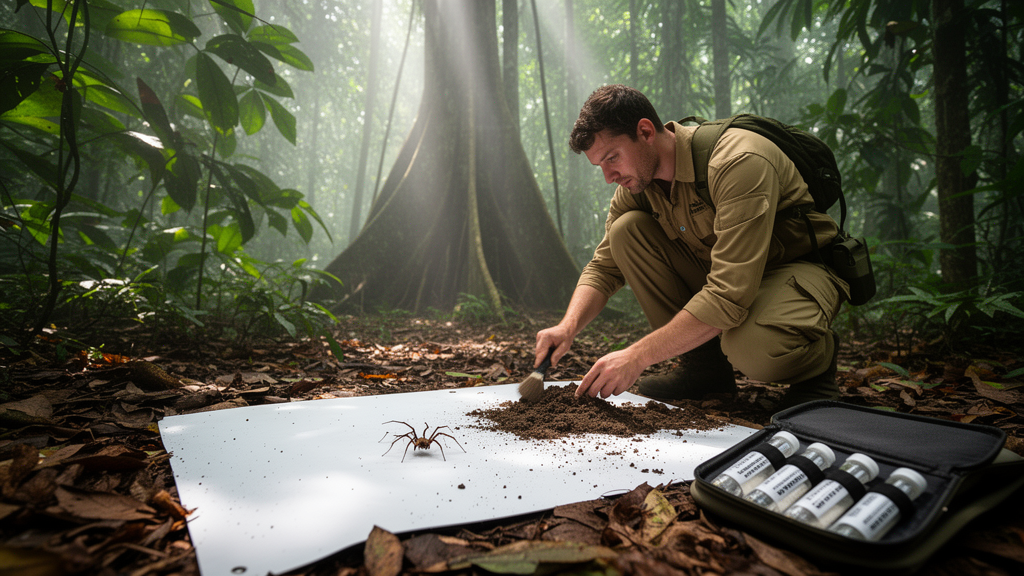
Within each plot, collectors spend one person-hour on aerial sampling, sweeping ground vegetation with canvas nets and beating or brushing trunks and shrubs with a horsehair brush onto one-square-meter sheets, and two person-hours on ground sampling, rapidly filling buckets with leaf litter and shaking it through a 35-centimeter geology sieve onto a sheet while teammates snatch the revealed spiders with aspirators and jars. The deliberate two-to-one bias toward litter sampling proved justified: pooled across all twelve plots, the single hour of aerial effort yielded 184 adult spiders from 20 families while the double ground effort yielded 151 adults from 21 families, meaning litter sieving accesses distinct taxa and roughly optimizes information gained per unit of time. All specimens were preserved in 50 percent propylene glycol, shipped to the Field Museum in Chicago, and identified to family by museum specialists, with only adults analyzed to guarantee accurate identifications.
The protocol was tested at two mature lowland rainforest sites on each continent. In Panama, the sites lay near the Panama Canal at roughly 70 meters elevation, one in Metropolitano National Park and the other in Soberania National Park, sampled by American university students on a travel course under an experienced field arachnologist. In the Democratic Republic of the Congo, both sites sat within the Yoko Forest Reserve near Kisangani, one a monotypic forest dominated by the canopy tree Gilbertiodendron dewevrei and the other a mixed forest with higher canopy diversity, sampled by Congolese students under the same protocol translated into French. Each site was completed in one to two days during dry seasons, with equipment carried in on transcontinental flights or rented canoes and motorcycles.
The samples yielded 350 adult spiders from 29 families, all araneomorphs. Panama dominated numerically, contributing 235 adults and 24 families against Congo’s 115 adults and 14 families. Five families together accounted for two-thirds of all adults: Theridiidae at 24 percent, Salticidae at 15 percent, Linyphiidae at 11 percent, Oonopidae at 10 percent, and Pholcidae at 7 percent, with every remaining family below 5 percent. The regional signatures diverged sharply. Theridiidae dominated Congo samples at over 36 percent, followed by Oonopidae and, notably, Thomisidae, a crab-spider family entirely absent from Panama. In Panama, jumping spiders of the family Salticidae led at 18.7 percent, followed by Theridiidae and Linyphiidae. Fifteen families appeared in Panama samples but not Congo samples, while only four were exclusive to Congo.
The statistical treatment revealed a subtler picture than raw numbers alone. Non-metric multidimensional scaling of the four sites, using pooled aerial and ground data from three replicate plots each, found the overall ordination highly significant but no pairwise difference between any two sites, likely because three replicates per site limited statistical power. When the six plots per continent were pooled, however, the family-level assemblages of Congo and Panama separated significantly, at p equal to 0.0021, with 95 percent confidence ellipses showing little overlap. iChao1 richness estimators, which infer completeness from the ratios of singletons to doubletons and higher abundance classes, produced confidence intervals for the Congo sites of roughly 9 to 12 estimated families against 14 to 21 for Panama, with minimal overlap, lending independent support to the conclusion that the Panamanian sites harbor genuinely higher family-level richness accessible to ground-level sampling.
How much of this reflects biology rather than artifact? The authors treat abundance differences cautiously, since seasonality, humidity, and recent weather can all alter spider activity and catch even within dry seasons. Family richness is more robust but partly confounded by the larger Panamanian catch. Composition, however, is the hardest result to explain away: the proportional dominance of Theridiidae and Thomisidae in Congo and Salticidae in Panama is unlikely to be an artifact of sample size or weather, because dominant taxa drive ordination placement and their relative representation is comparatively stable. The authors also acknowledge the study’s limits. At least nine Panamanian families known from similar habitats, including all mygalomorphs, went unrecorded, and a pitfall study near Kisangani recovered 11 families absent from the Yoko samples, confirming that canopy dwellers, burrowers, and rare species fall outside the RAP’s reach. Of the 29 families sampled, only Anyphaenidae and Mysmenidae are likely absent from one of the two regions.
What the study delivers, above all, is proof of concept. Teams of inexperienced students, briefly trained and minimally equipped, produced replicated samples from randomly located plots of fixed size and fixed effort that supported ordination, richness estimation, and a statistically significant intercontinental comparison, all within days of fieldwork. As far as the authors know, this is the first time spider assemblages, as opposed to national species lists, have been compared between Africa and Central America, and standardized protocols made it possible. A definitive comparison of the two regions’ rainforests would need many more sites, better vegetation and site history data, and ultimately canopy sampling, which the RAP excludes for cost and safety reasons. But for conservation prioritization in a world where rainforest degradation continues apace, a protocol that trades exhaustive surveying for speed, replicability, and affordability may be exactly the tool the moment requires.
Subject of Research: A rapid assessment protocol comparing spider assemblages in lowland tropical forests of Congo and Panama
Article Title: Comparison of lowland tropical forest spider ( Araneae ) assemblages from Congo and Panama using a rapid assessment protocol
Article References: Draney, M. L., Juakaly, M. J.-L., Sierwald, P., & Milne, M. A. (2025). Comparison of lowland tropical forest spider (Araneae) assemblages from Congo and Panama using a rapid assessment protocol. African Invertebrates, 66(1), 133-150. https://doi.org/10.3897/afrinvertebr.66.138414
Image Credits: AI Generated
DOI: 10.3897/afrinvertebr.66.138414
Keywords: spiders, Araneae, tropical rainforest, Congo, Panama, biodiversity, rapid assessment protocol, community ecology, conservation, field methods, Comparison, lowland
Cite Scienmag News
Margaret Porter. (October 16, 2026). Comparison of lowland tropical forest spider (Araneae) assemblages from Congo and Panama using a rapid assessment protocol. Scienmag. https://scienmag.com/comparison-of-lowland-tropical-forest-spider-araneae-assemblages-from-congo-and-panama-using-a-rapid-assessment-protocol/
Margaret Porter. "Comparison of lowland tropical forest spider (Araneae) assemblages from Congo and Panama using a rapid assessment protocol." Scienmag, 16 October 2026, https://scienmag.com/comparison-of-lowland-tropical-forest-spider-araneae-assemblages-from-congo-and-panama-using-a-rapid-assessment-protocol/. Accessed 16 October 2026.
Margaret Porter. "Comparison of lowland tropical forest spider (Araneae) assemblages from Congo and Panama using a rapid assessment protocol." Scienmag. October 16, 2026. https://scienmag.com/comparison-of-lowland-tropical-forest-spider-araneae-assemblages-from-congo-and-panama-using-a-rapid-assessment-protocol/