


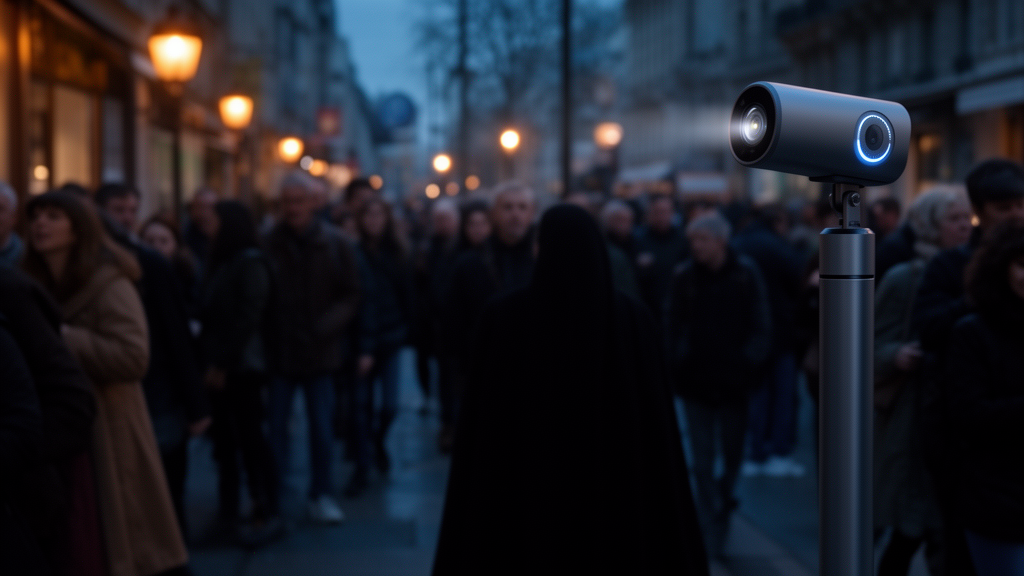
Pedestrian detection has long been one of the most demanding tasks in computer vision, and a new study suggests that a mathematical tool from signal processing, the wavelet transform, may be the key to seeing people that conventional neural networks miss. Researchers at China Three Gorges University have built an object detection model that decomposes image features into different frequency bands before fusing them across scales, and the resulting system outperforms its baseline on crowded-scene benchmarks while using far fewer computational resources.
The challenge the team set out to solve is familiar to anyone who has watched footage of a busy train station or street crossing. In dense crowds, pedestrians constantly overlap and occlude one another, so the visible portion of any given person may shrink to a sliver of a head or shoulder. As visual information passes through the successive layers of a convolutional neural network, this already sparse evidence degrades further, a phenomenon the researchers describe as severe feature information loss. Standard detection architectures, which rely on pyramids of features at different resolutions, tend to blend this degraded information indiscriminately, drowning weak signals from occluded people in redundant background data.
The new model, developed by Rui Ke, Shuzhen Wan and Guoqing Xiao and published in the International Journal of Machine Learning and Cybernetics, attacks the problem in the frequency domain. At its core is the Haar wavelet transform, a classic mathematical operation that splits an image or feature map into low-frequency components, which capture smooth, slowly varying structure, and high-frequency components, which encode sharp edges and fine detail. Instead of the usual downsampling by strided convolution, which discards information as resolution drops, the wavelet decomposition module retains both frequency bands in a lossless manner. That means the fine-grained cues that might reveal an occluded pedestrian, such as the contour of a shoulder or the texture of clothing, are preserved rather than thrown away.
Building on this decomposition, the researchers designed a waveform frequency attention module that learns which frequency bands matter for the task at hand. Attention mechanisms have become a staple of modern deep learning, allowing networks to reweight features adaptively instead of treating all inputs equally. Here, the reweighting happens in the frequency domain: the network can amplify high-frequency responses when fine edges are informative and lean on low-frequency content when broader structure is more reliable. This is particularly useful in crowded scenes, where the discriminative evidence for a partially hidden person often lives in narrow, high-frequency edge fragments.
The team went further by constructing two novel attention mechanisms, a frequency channel attention mechanism and a frequency triplet attention mechanism. The former extends the influential squeeze-and-excitation style of channel attention, which recalibrates the importance of each feature channel, into the frequency domain, inspired by work such as FcaNet, which showed that frequency analysis can produce powerful channel attention without extra parameters. The latter adapts the triplet attention concept, which captures interactions across spatial and channel dimensions, to frequency-decomposed features. Together, these modules reweight features from different frequency bands so that cross-scale fusion combines complementary information rather than redundant noise.
Why does frequency-domain processing make such a difference for dense detection? The authors point to the problem of information redundancy in convolutional networks. Neighboring pixels and adjacent feature channels are highly correlated, so much of what a conventional network computes is repetitive. Frequency transforms decorrelate this information, concentrating the meaningful signal into compact representations. Related research has exploited this insight for image compression, super-resolution, semantic segmentation and even the detection of camouflaged objects, whose concealment often depends on subtle frequency signatures. The new work brings the same principle to the crowded-street problem, where it also confers an unexpected benefit: efficiency.
That efficiency gain is one of the most striking aspects of the study. On the WiderPerson dataset, the model improved mean Average Precision, the standard accuracy metric for detection, by approximately 2.1 percent over the baseline, and on CrowdHuman, a large benchmark for detecting humans in crowds, the gain was roughly 3.9 percent. Meanwhile, the number of parameters fell by 39.7 percent and floating-point operations, a measure of computational cost, dropped by 33.4 percent. In other words, the model is simultaneously more accurate and substantially lighter, a combination that is rare in a field where gains usually come at the price of larger networks. For deployment on edge devices such as surveillance cameras, drones or in-vehicle systems, that lighter footprint matters as much as the accuracy boost.
The implications extend well beyond counting people in crowds. Accurate pedestrian detection underpins autonomous driving systems, smart city surveillance, traffic management and robotics, all settings where occlusion is the norm rather than the exception. A detector that can reliably pick out people obscured by others, at low computational cost, could make real-time safety systems more dependable. The researchers have made their source code publicly available on GitHub, which should allow other teams to integrate the wavelet-based modules into their own detection pipelines and test them on additional scenarios, from nighttime streets to aerial imagery.
The study also fits into a broader movement in machine learning toward thinking beyond the spatial pixel grid. Wavelet-based approaches have recently been unified with transformers for visual representation, used in remote sensing super-resolution and applied to change detection in radar imagery, while other groups have shown that networks can learn directly in the frequency domain to cut inference time. What distinguishes the new model is the way it weaves frequency-domain decomposition through the entire feature fusion process, from the initial wavelet downsampling to the frequency channel and triplet attention mechanisms that guide cross-scale integration.
For a field that has been dominated by ever-larger architectures, the message of this research is refreshingly counterintuitive: sometimes the path to better perception is not more computation, but smarter mathematics. By treating visual features as signals with meaningful frequency structure, the model recovers information that brute-force networks discard, sees people that would otherwise vanish into the crowd, and does so with a fraction of the parameters. As cities grow denser and machines are asked to navigate them, that combination of accuracy, efficiency and mathematical elegance may prove hard to ignore.
Subject of Research: Wavelet-transform-based cross-scale feature fusion for dense pedestrian object detection in occluded scenes
Article Title: Wavelet-transform-based cross-scale dense pedestrian object detection model
Article References: Ke, R., Wan, S., & Xiao, G. (2026). Wavelet-transform-based cross-scale dense pedestrian object detection model. International Journal of Machine Learning and Cybernetics, 17(11), Article 497. https://doi.org/10.1007/s13042-026-03328-6
Image Credits: AI Generated
DOI: 10.1007/s13042-026-03328-6
Keywords: pedestrian detection, wavelet transform, computer vision, object detection, attention mechanism, deep learning, frequency domain, crowded scenes, feature fusion, Haar wavelet, lightweight models, CrowdHuman
Cite Scienmag News
Blake Davidson. (October 16, 2026). Wavelet Transform Helps AI Spot Hidden Pedestrians in Crowded Scenes. Scienmag. https://scienmag.com/wavelet-transform-helps-ai-spot-hidden-pedestrians-in-crowded-scenes/
Blake Davidson. "Wavelet Transform Helps AI Spot Hidden Pedestrians in Crowded Scenes." Scienmag, 16 October 2026, https://scienmag.com/wavelet-transform-helps-ai-spot-hidden-pedestrians-in-crowded-scenes/. Accessed 16 October 2026.
Blake Davidson. "Wavelet Transform Helps AI Spot Hidden Pedestrians in Crowded Scenes." Scienmag. October 16, 2026. https://scienmag.com/wavelet-transform-helps-ai-spot-hidden-pedestrians-in-crowded-scenes/


