


Deep in the mathematics of 1891, David Hilbert described a curve that could pass through every point of a square without ever crossing itself, folding two-dimensional space into a single line while keeping neighboring points close together. More than a century later, that curve is quietly solving one of the most stubborn problems in field robotics: how to teach a team of autonomous robots to systematically survey a forest, wetland, or grassland without wasting energy wandering in circles. A new study published in Frontiers in Robotics and AI shows that injecting this locality-preserving geometric structure into reinforcement learning produces dramatic gains in exploration efficiency, and the approach has already been validated on two Boston Dynamics Spot quadruped robots operating in natural terrain.
The research, conducted by Tamil Selvan Gurunathan and Aryya Gangopadhyay of the Department of Information Systems at the University of Maryland Baltimore County, addresses a fundamental tension in autonomous ecological monitoring. Classical coverage path planning algorithms, including boustrophedon decomposition, spiral traversal, and space-filling curve methods, generate deterministic trajectories that achieve complete coverage with minimal overlap, but only when the environment is static and fully known in advance. When obstacles change, new terrain features appear, or environmental uncertainty enters the picture, precomputed paths become suboptimal or infeasible, forcing expensive replanning or centralized coordination. Reinforcement learning offers the opposite trade-off: robots learn navigation policies directly from interaction with the environment, adapting to unforeseen changes using only local observations, but coverage tasks provide sparse and delayed rewards that make efficient exploration notoriously difficult during training.
The core insight of the new work is that these two paradigms need not be rivals. Rather than replacing reinforcement learning with predetermined trajectories, the researchers treat the Hilbert space-filling curve as a geometric prior, a structured exploration scaffold that biases early learning toward locality-preserving traversal while leaving the learned policy free to deviate whenever accumulated experience indicates that alternative actions produce higher long-term reward. The Hilbert curve possesses a property that makes it uniquely suited to this role: its recursive construction ensures that consecutive indices in the one-dimensional ordering correspond, whenever possible, to spatially adjacent cells in the two-dimensional workspace. This locality preservation minimizes long-distance transitions and naturally produces coherent traversal patterns across multiple spatial scales, unlike simpler alternatives such as Morton Z-order curves or row-major traversals.
Technically, the framework operates through three complementary mechanisms. First, each robot’s current grid position is converted into a normalized Hilbert index using only integer arithmetic, and this single scalar is concatenated with the robot’s local egocentric occupancy map to produce an augmented state, increasing observation dimensionality by just one feature. Second, during training, with a probability that is gradually annealed throughout learning, the robot selects the action that advances it toward the next reachable Hilbert cell rather than sampling from its stochastic policy. Third, potential-based reward shaping is applied, where the modified reward preserves the optimal policy under the original Markov Decision Process while encouraging progression along locality-preserving traversal sequences during early learning. Crucially, the underlying optimization procedures of both Deep Q-Networks and Proximal Policy Optimization remain completely unchanged; the framework modifies only the observation representation, exploration strategy, and reward computation, introducing negligible computational overhead.
The experimental evaluation was extensive. Simulation studies were conducted in discrete two-dimensional occupancy-grid environments of two workspace sizes, with procedurally generated terrain constraints representing features such as dense vegetation, mature trees, rock outcrops, wetlands, streams, and protected habitat zones. Teams of 4, 8, 12, and 16 homogeneous robots were deployed, each operating independently with only local observations and no explicit inter-robot communication. All models were implemented in PyTorch, trained with the Adam optimizer for 300,000 interaction steps, and evaluated across five independent training runs with different random seeds, with statistical comparisons performed using Welch’s two-sample t-test and 95 percent confidence intervals.
The results are striking. With sixteen robots, the average coverage ratio increased from 0.589 for standard DQN to 0.895 for the Hilbert-augmented variant, and from 0.683 for standard PPO to 0.927 for the augmented version. Redundancy, measured as visits per unique cell, dropped from 4.173 to 1.948 for DQN-based methods and from 3.354 to 1.768 for PPO-based methods at the same team size. The Hilbert-augmented methods accumulated reward more rapidly throughout training and satisfied a stability-based convergence criterion, requiring the rolling average reward to remain above 90 percent of the maximum observed reward for ten consecutive evaluation windows, using fewer interaction steps than conventional baselines. All reported coverage and redundancy improvements were statistically significant.
Ablation studies revealed which component matters most. Removing the curve-guided exploration bias produced the largest performance collapse, dropping coverage to levels comparable with baseline PPO while substantially increasing redundancy. Removing Hilbert-based state augmentation, by contrast, produced only small changes within one standard deviation of the complete framework, and removing reward shaping yielded intermediate results. This pattern indicates that the principal benefit arises from structured exploration rather than from the inclusion of the Hilbert index as an additional state feature, though the reduced variability across repeated training runs suggests that state augmentation contributes to learning stability during later optimization stages.
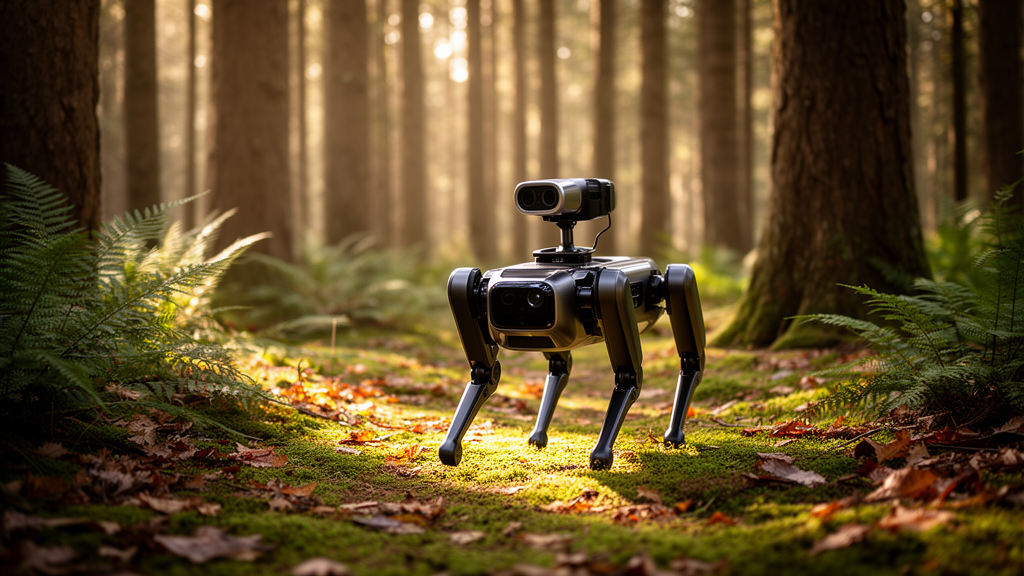
The hardware validation is what elevates this work from simulation to field robotics. Policies trained entirely in simulation were deployed on two Boston Dynamics Spot quadruped robots operating in an outdoor environment containing trees, shrubs, bushes, uneven ground, and other natural vegetation. Policy-generated survey trajectories were converted into executable planar trajectories through a waypoint interface built on the Spot SDK, maintaining lease management, time synchronization, emergency stop protection, and obstacle safety constraints. In field trials, the Hilbert-augmented PPO completed missions 31.9 percent faster than standard PPO, reduced redundancy by 51.6 percent, improved coverage efficiency from 76.4 to 94.1 percent, and lowered path-following error from 0.19 to 0.08 meters, achieving a 100 percent trial success rate compared with 66.7 percent for the baseline.
The practical implications extend across environmental science. Autonomous ecological monitoring requires repeated coverage of forests, wetlands, grasslands, coastal ecosystems, and restoration sites for applications including biodiversity assessment, vegetation mapping, soil monitoring, invasive species detection, and post-restoration evaluation. Because the framework is independent of sensing modality, it can be integrated with RGB cameras, multispectral and hyperspectral imagers, thermal cameras, LiDAR, and environmental sensing payloads. The reduction in redundant traversal directly translates to longer battery life, reduced mechanical wear, and more unique sampling locations per deployment, while the absence of explicit inter-robot communication makes the approach suitable for large natural environments where connectivity is intermittent or unavailable.
The authors acknowledge limitations, including the absence of explicit cooperative planning, the use of occupancy-grid abstractions that do not model heterogeneous terrain traversability or seasonal changes, and the limited scale of hardware validation with only two robots. Future work includes evaluating alternative geometric priors such as Morton and Peano curves, integrating with modern multi-agent reinforcement learning algorithms including MAPPO and QMIX, and deploying larger heterogeneous teams of ground, aerial, and aquatic platforms. But the central contribution stands: lightweight locality-preserving geometric priors, computable with simple integer arithmetic and a single additional scalar, can substantially improve the exploration process that underlies reinforcement learning, combining the systematic spatial organization of classical coverage planning with the adaptability of learned policies.
Subject of Research: Robotics
Article Title: Geometric priors for reinforcement learning-based multi-robot ecological monitoring
Article References: Gurunathan, T. S., & Gangopadhyay, A. (2026). Geometric priors for reinforcement learning-based multi-robot ecological monitoring. Frontiers in Robotics and AI, 13, Article 1934273. https://doi.org/10.3389/frobt.2026.1934273
Image Credits: AI Generated
DOI: 10.3389/frobt.2026.1934273
Keywords: reinforcement learning, Hilbert curves, multi-robot systems, ecological monitoring, Boston Dynamics Spot, coverage path planning, DQN, PPO, Geometric, priors, reinforcement, learning-based
Cite Scienmag News
Denise Maddox. (October 16, 2026). A 130-Year-Old Math Curve Is Teaching Robot Dogs to Explore Forests Like Never Before. Scienmag. https://scienmag.com/a-130-year-old-math-curve-is-teaching-robot-dogs-to-explore-forests-like-never-before/
Denise Maddox. "A 130-Year-Old Math Curve Is Teaching Robot Dogs to Explore Forests Like Never Before." Scienmag, 16 October 2026, https://scienmag.com/a-130-year-old-math-curve-is-teaching-robot-dogs-to-explore-forests-like-never-before/. Accessed 16 October 2026.
Denise Maddox. "A 130-Year-Old Math Curve Is Teaching Robot Dogs to Explore Forests Like Never Before." Scienmag. October 16, 2026. https://scienmag.com/a-130-year-old-math-curve-is-teaching-robot-dogs-to-explore-forests-like-never-before/


