


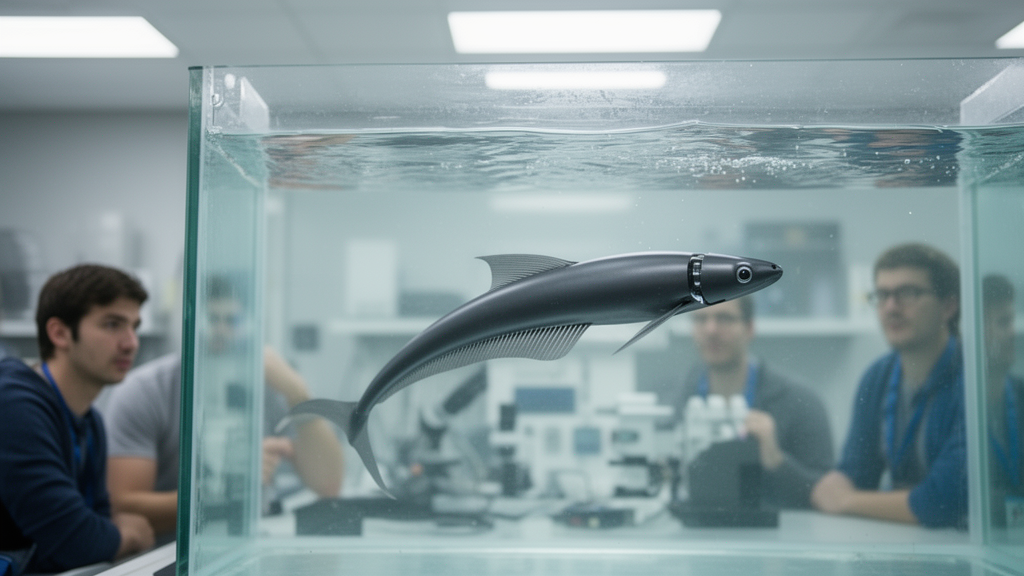
Deep in the Amazon and Guianas river basins lives a fish so strange that it looks like a swimming blade. The black ghost knifefish, Apteronotus albifrons, has no large tail fin to speak of and no pectoral fins for steering. Instead, it propels itself with a long, ribbon-like anal fin that ripples along roughly three-quarters of its belly, allowing it to swim forward, backward, hover in place and rise vertically through water. Now a team of Chinese researchers has translated that remarkable locomotion into a robot called Naiad, and in doing so has shown that the secret of the knifefish’s agility lies not just in its fin but in the coordinated bending of its whole body. The work, published in the journal iScience, could point the way toward underwater robots that can slip through narrow, winding passages that defeat conventional propeller-driven vehicles.
The motivation is practical as much as it is biological. Complex underwater environments remain among the least explored regions on Earth, and they matter enormously for ecological monitoring, scientific discovery and resource exploration. Yet traditional rotor-based propulsion has serious drawbacks in these settings. Propellers are prone to entanglement in dense vegetation, and the acoustic noise and hydrodynamic disturbances they generate can disrupt or harm marine organisms. Navigating narrow and winding passages, meanwhile, demands exceptionally high maneuverability and efficient locomotion. Biomimetics offers a way out, drawing on evolutionarily refined mechanisms to enhance robotic performance, and the field has already produced agile robotic dolphins, acoustically controlled soft robotic fish, and soft robots capable of swimming at hadal depths in the Mariana Trench.
The black ghost knifefish is an exceptional biological model for this kind of engineering. Micro-CT and anatomical observations show that its anal fin comprises approximately 140 to 160 segmented fin rays connected by a thin, flexible membrane. By modulating the direction, frequency, wavelength and speed of the waves traveling along this fin, the fish generates an extraordinary repertoire of movements. Forward and backward swimming arise from unidirectional fin waves propagating in opposite directions, turning involves coordinated body bending together with modulation of fin kinematics, and hovering or vertical heave involves waves that counter-propagate inward from both ends of the fin toward the middle. While researchers have built knifefish-inspired robots before, most have examined fin-only propulsion, often in tethered settings. Integrating an undulatory anal fin with an actively bendable body on a free-swimming platform remained largely unexplored.
Naiad is a deliberate, reduced-order abstraction of the knifefish rather than an anatomical replica. The robot measures 845 millimeters long, 106 millimeters wide and 195 millimeters high, with a 700-millimeter ribbon fin that gives a fin-to-body-length ratio of 0.828, close to the biological template. The fin consists of 11 independently actuated rigid metal rays connected by a continuous membrane cast from Ecoflex 00-30 silicone elastomer. Phase-shifted sinusoidal commands to adjacent rays generate traveling waves along the fin, and reversing the propagation direction switches the robot between forward and backward swimming. The body is divided into four modular segments fabricated by resin-based 3D printing, connected by biaxial servo joints that enable yaw-plane body bending, with a tail that tapers in thickness and rigidity thanks to an embedded manganese steel spring plate. Fourteen servos in total drive the system: three for the multi-jointed body and 11 for the fin.
To evaluate propulsion, the team ran linear locomotion experiments in a 6-meter-long water tank, varying undulation amplitude from 20 to 50 degrees while holding wavelength and frequency fixed. The results revealed an approximately linear increase in swimming speed with amplitude: at 20 degrees the robot averaged 9.08 centimeters per second, whereas at 50 degrees it reached 16.96 centimeters per second, an 86.78 percent improvement. Remarkably, power consumption simultaneously decreased from 33.65 watts to 28.08 watts, a reduction of 16.55 percent, and the dimensionless cost of transport, which reflects the energy required to move a unit mass over a unit distance, fell in parallel. A larger fin sweep, the team found, both pushed harder and wasted less.
The wavelength and frequency experiments produced a subtler and more intriguing picture. Across 20 combinations of four wavelengths and five frequencies, velocity increased approximately linearly with frequency, but the sensitivity of velocity to frequency diminished as wavelength increased. At the low frequency of 0.42 hertz, longer wavelengths produced higher speed; at the high frequency of 0.99 hertz, longer wavelengths reduced speed. A two-way analysis of variance confirmed that frequency exerted a strong main effect on swimming velocity, while wavelength showed no significant overall main effect but significantly modulated the velocity response in a frequency-dependent manner. The maximum velocity recorded was 17.21 centimeters per second, or 0.20 body lengths per second, achieved with a 490-millimeter wavelength at 0.99 hertz. The lowest cost of transport, 3.42, occurred at 630 millimeters and 0.86 hertz, and an exploratory quadratic fit suggested that efficiency peaked at an intermediate fin-wave speed of roughly 0.5 meters per second rather than at either extreme.
Turning is where Naiad’s flexible body earns its keep. The team compared two strategies under identical fin kinematics: a rigid-body approach in which only a posterior section of the fin was asymmetrically biased, and active body bending, in which the whole body adopted a prescribed curved configuration quantified by a body bending coefficient. The rigid-body strategies produced turning rates of just 3.48 and 4.16 degrees per second. Even at the smallest bending coefficient, active bending reached 14.97 degrees per second, and at the largest it hit 23.67 degrees per second, a 6.80-fold improvement over the best rigid control. Turning radii shrank correspondingly, from 0.79 meters for the rigid strategies down to 0.26 meters at the largest curvature, a reduction of more than 67 percent. A reduced-order model based on the time-averaged thrust generated by the ribbon fin reproduced these monotonic trends, supporting the idea that body bending redirects distributed fin thrust and increases its effective moment arm, generating a larger yaw moment and a tighter trajectory than fin biasing alone.
Vertical ascent is the knifefish’s most distinctive gait, and Naiad replicated it by superimposing inward-traveling waves from the anterior and posterior ends of the fin. The two waves converge centrally, canceling the forward and backward thrust components while their interaction produces a downward jet and a corresponding upward heave force. After buoyancy calibration to a near-neutral state, the robot ascended a 70-centimeter tank at speeds in the centimeter-per-second range. Ascent speed rose with frequency, from 1.92 centimeters per second at 0.72 hertz to 3.80 centimeters per second at 1.44 hertz, but showed a non-monotonic relationship with amplitude: the 40-degree setting yielded the highest velocity of 3.08 centimeters per second, while 50 degrees caused pronounced body oscillation that compromised stability and cut the speed nearly in half. The finding suggests an optimal amplitude range exists for vertical locomotion, echoing biological observations that heave and hover behaviors in real knifefish involve differing whole-fin amplitudes.
Field demonstrations pushed the platform beyond the laboratory. An untethered prototype, powered by a 7.4-volt lithium battery and controlled by an Arduino microcontroller with Bluetooth communication, navigated a custom 2-by-3-meter pool configured as a narrow, winding obstacle course, completing multiple transits in 69 to 75 seconds by switching among forward, reverse and turning gaits. On the same untethered platform, the undulating anal-fin drive achieved a higher average turning rate of 29.2 degrees per second and a smaller turning radius of 0.64 meters than a body-and-caudal-fin mode, which managed 17.4 degrees per second and 1.32 meters. The robot was also deployed in a natural lake, where an onboard underwater camera captured video from the robot’s perspective during operator-selected gait commands, providing qualitative evidence that the distributed fin and flexible body can support stable commanded locomotion and imaging in an outdoor aquatic environment.
The authors are candid about limitations. Naiad’s straight-line speed of 0.20 body lengths per second trails some earlier ribbon-fin platforms, likely because of its relatively low undulation frequency range and unoptimized fin-body hydrodynamics, and its Strouhal numbers exceeded the canonical efficient range of 0.2 to 0.4, indicating room for improvement in converting fin motion into forward speed. The experiments used prescribed open-loop gait commands rather than closed-loop control, so the demonstrations validate commanded multi-gait maneuverability but not autonomous navigation. Still, the core result stands: replicating the knifefish’s integrated body-fin coordination, rather than fin undulation alone, delivers a robot that turns faster, tighter and more efficiently, and that can thread narrow passages while leaving the ecology largely undisturbed. For underwater robots destined for confined, ecologically sensitive waters, the ghost of the Amazon may prove an unexpectedly apt teacher.
Subject of Research: Biorobotics
Article Title: Knifefish-inspired robotic fish enhances locomotion performance by undulatory anal fin propulsion and flexible body
Article References: Zheng, W., Yang, Z., Chen, Z., Yang, S., Lin, Z., Zhang, Y., Zhang, J., Wu, H., Peng, X., & Zhang, Y. (2026). Knifefish-inspired robotic fish enhances locomotion performance by undulatory anal fin propulsion and flexible body. iScience, 29(11), Article 117819. https://doi.org/10.1016/j.isci.2026.117819
Image Credits: AI Generated
DOI: 10.1016/j.isci.2026.117819
Keywords: knifefish, robotic fish, biomimetics, underwater robotics, ribbon fin propulsion, soft robotics, Knifefish-inspired, robotic, fish, enhances, locomotion, performance
Cite Scienmag News
Denise Maddox. (October 16, 2026). Knifefish-inspired robot Naiad swims like the real thing using a rippling fin and a bendable body. Scienmag. https://scienmag.com/knifefish-inspired-robot-naiad-swims-like-the-real-thing-using-a-rippling-fin-and-a-bendable-body/
Denise Maddox. "Knifefish-inspired robot Naiad swims like the real thing using a rippling fin and a bendable body." Scienmag, 16 October 2026, https://scienmag.com/knifefish-inspired-robot-naiad-swims-like-the-real-thing-using-a-rippling-fin-and-a-bendable-body/. Accessed 16 October 2026.
Denise Maddox. "Knifefish-inspired robot Naiad swims like the real thing using a rippling fin and a bendable body." Scienmag. October 16, 2026. https://scienmag.com/knifefish-inspired-robot-naiad-swims-like-the-real-thing-using-a-rippling-fin-and-a-bendable-body/


