


Stereolithography has long been the darling of rapid prototyping, churning out parts with dimensional accuracy, fine feature resolution, smooth surfaces, and complex internal geometries that would be difficult or expensive to machine from glass or metal. But for chemical engineers hoping to 3D-print laboratory distillation columns that actually touch hot solvents, one question has always loomed: can a printed acrylate network survive methanol at 120 degrees Celsius? A new study from researchers Neha Kumari, Vignesh Jayavelu, and Christoph Klahn, published in Results in Engineering, answers with a carefully qualified yes — not by inventing a new resin, but by systematically tuning every step of the SLA manufacturing chain, from per-layer exposure time to the timing of support removal, and then running a printed column through 72 hours of continuous methanol-water reflux without visible structural failure.
The team’s target material was Formlabs High Temperature resin, a photopolymer the manufacturer says reaches a heat-deflection temperature of up to 238 degrees Celsius after post-curing, comfortably above the operating range of methanol-water distillation. All specimens and columns were printed on an Original Prusa SL1S Speed masked stereolithography system with a 405 nm UV LED array, chosen for its open-material platform that allowed direct user control over the two most fundamental printing variables: per-layer exposure time and layer thickness. The researchers printed hollow tube specimens with 12 mm outer diameter and 15 mm height, wall thicknesses between 0.5 and 3.0 mm, as the main test geometry because thin-walled features are exactly what printed distillation internals demand.
The core insight driving the work is that the final material performance of an SLA part is not determined by the resin formulation alone. Commercial SLA resins are built on multifunctional acrylate or methacrylate monomers and oligomers that form crosslinked networks during photopolymerisation, but as the resin transforms from liquid to rubbery and then glassy network, the curing reaction becomes increasingly mobility-limited. Complete conversion of all reactive groups is therefore never achieved in highly crosslinked SLA parts, leaving residual monomers, oligomers, additives, and photoinitiator-derived fragments trapped inside the printed network. When methanol — a small, polar solvent that interacts strongly with acrylate networks — enters the part, it swells the polymer and simultaneously facilitates the extraction of those residual low-molecular-weight species into the contacting liquid, a diffusion-controlled process that can compromise mechanical integrity and thermomechanical properties at elevated temperatures.
Gravimetric methanol uptake served as the main quantitative indicator throughout the study, measured with an analytical balance readable to 0.0001 g following the principles of ISO 175, ISO 62, and ASTM D570 with modifications for hot methanol exposure. Specimens were placed in sealed glass vessels on heating plates, removed at defined intervals from 15 minutes to 28 days, blotted with lint-free tissue, and weighed within 60 seconds to minimise evaporative losses. Most accelerated tests ran in pure methanol at 75 degrees Celsius, while selected tests and the column-level compatibility experiment used a 50:50 mol% methanol-water mixture at temperatures up to 120 degrees Celsius to represent the realistic distillation environment. The researchers acknowledge that leaching of residual species was not analytically quantified, deferring targeted leachate identification and mechanical characterisation to future work, but they argue that solvent uptake dominates the measured mass change and correlates with leaching behaviour reported in the literature.
The printing-parameter study revealed that per-layer exposure time directly controls methanol resistance. After 6 hours in methanol, specimens printed at 8 seconds exposure reached 2.267 wt% uptake, while those printed at 12 seconds reached 1.960 wt% — a reduction of 0.307 wt% attributable to improved layer curing, stronger interlayer bonding, and a lower amount of residual reactive material. Layer thickness played a smaller but measurable role: after 28 days at room temperature, specimens printed at 0.100 mm layer thickness reached 4.46 wt% uptake compared with 4.01 wt% for 0.025 mm specimens, suggesting thicker layers introduce more pronounced interlayer regions where local bonding is less complete. Wall thickness, meanwhile, governed the time-dependent uptake behaviour — thinner walls gained mass rapidly in the first hours of exposure, while thicker walls delayed the process and extended the useful operating window before large dimensional changes occurred.
Post-processing proved even more decisive than printing parameters. Among the variables tested, UV post-cure duration ranked first in the parameter hierarchy, with the difference between 1 hour and 2 hours of UV curing at 80 degrees Celsius producing up to a 2.30 wt% reduction in methanol uptake. Raising the UV post-cure temperature from 60 to 80 degrees Celsius was more effective than simply extending cure duration at 60 degrees Celsius, because the higher temperature gives the polymer network greater molecular mobility, allowing additional curing of restricted reactive groups to proceed more effectively. Thermal post-curing at 160 degrees Celsius for 3 hours — below the resin’s heat-deflection temperature but high enough to promote additional network stabilisation — produced a consistent mass loss of approximately 0.44 to 0.47 wt%, attributed mainly to removal of residual volatile or low-molecular-weight species rather than structural degradation.
Perhaps the most surprising finding concerned support-removal timing, a step usually treated as routine handling. Specimens cured with supports still attached and removed only after post-curing showed higher methanol uptake than specimens whose supports were removed after washing and before UV curing. At 5 hours of exposure, the largest difference occurred for 1.0 mm wall specimens, where delayed support removal increased uptake by approximately 1.94 wt%. The most likely explanation is local surface damage at support contact points: once the part is fully cured, the resin is stiffer and more brittle, so removing supports can leave small cracks, fractured regions, or roughened surfaces that provide easier entry points for methanol. For very thin 0.5 mm walls, both conditions showed high uptake because the whole wall saturates rapidly, masking the support effect.
The washing protocol, by contrast, had a negligible influence once sufficient isopropyl alcohol contact had been achieved. Three IPA-based protocols — 10 minutes soaking followed by 20 minutes washing, 10 minutes soaking followed by 10 minutes washing, and 10 minutes washing followed by 10 minutes thermal drying — differed by less than 0.05 wt% in methanol uptake, well within the practical uncertainty of the gravimetric method. The researchers conclude that a minimum of 10 minutes fresh IPA contact is sufficient for HT resin parts of the type studied, though they note that manual IPA flushing through internal channels remains essential for column prototypes where uncured resin can remain trapped in enclosed regions.
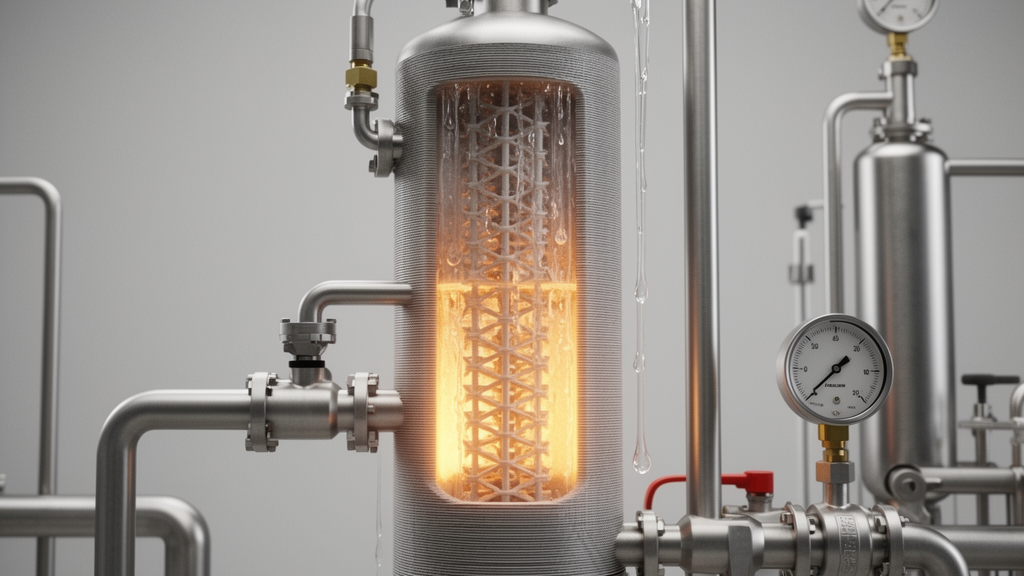
With the optimised process chain — IPA washing for at least 10 minutes, support removal before UV curing, UV post-curing at 80 degrees Celsius for 2 to 3 hours, and thermal post-curing at 160 degrees Celsius for 3 hours — the team applied their findings to a full SLA-printed distillation column containing gyroid-type internal features designed to increase vapour-liquid contact area. During methanol-water reflux at temperatures up to 120 degrees Celsius, the printed column retained its shape and macroscopic integrity. After 24 hours of operation, the column gained 2.1 wt%; after 72 hours under the same conditions, the mass gain reached 5.72 wt%. No visible deformation, cracking, fracture, flooding, or leaking was observed after the 72-hour test, though the researchers stress that the reported mass gain includes both solvent uptake and leaching of residual species, and the result should be interpreted strictly as short-term survival without visible failure.
The long-term exposure data also carried an encouraging practical message for real distillation operation. Some experiments included heating periods followed by room-temperature soaking and later reheating to represent start-up and shut-down cycles. Once specimens had already gained mass during the initial methanol exposure, cooling and reheating caused only small additional changes in measured mass, suggesting most of the rapid uptake occurs during the first exposure period. Comparing the two exposure conditions, pure methanol at 75 degrees Celsius reached approximately 42% higher uptake than the 50:50 mol% methanol-water mixture after 28 days, showing that exposure severity is determined not by temperature alone but by solvent composition and duration — and that pure methanol can serve as the more conservative screening condition for methanol-water distillation prototypes. The authors are careful to position SLA photopolymers not as permanent replacements for glass or metal distillation equipment, but as a route to screening chemically exposed process equipment before designs are transferred to more durable materials. The trends observed for HT resin may be relevant to similar acrylate or methacrylate SLA resins, but the numerical values should not be transferred directly to other resin chemistries — each system will require its own process window when exposed to hot polar solvents.
Subject of Research: Materials Science
Article Title: Process-chain optimisation of SLA-printed high-temperature resin for short-term methanol compatibility in distillation prototypes
Article References: Kumari, N., Jayavelu, V., & Klahn, C. (2026). Process-chain optimisation of SLA-printed high-temperature resin for short-term methanol compatibility in distillation prototypes. Results in Engineering, 32, Article 113491. https://doi.org/10.1016/j.rineng.2026.113491
Image Credits: AI Generated
DOI: 10.1016/j.rineng.2026.113491
Keywords: 3D printing, stereolithography, distillation, methanol, photopolymer, additive manufacturing, chemical engineering, post-processing, Process-chain, optimisation, SLA-printed, high-temperature
Cite Scienmag News
Denise Maddox. (October 16, 2026). 3D-Printed Distillation Columns Survive 72 Hours of Hot Methanol After Process-Chain Tune-Up. Scienmag. https://scienmag.com/3d-printed-distillation-columns-survive-72-hours-of-hot-methanol-after-process-chain-tune-up/
Denise Maddox. "3D-Printed Distillation Columns Survive 72 Hours of Hot Methanol After Process-Chain Tune-Up." Scienmag, 16 October 2026, https://scienmag.com/3d-printed-distillation-columns-survive-72-hours-of-hot-methanol-after-process-chain-tune-up/. Accessed 16 October 2026.
Denise Maddox. "3D-Printed Distillation Columns Survive 72 Hours of Hot Methanol After Process-Chain Tune-Up." Scienmag. October 16, 2026. https://scienmag.com/3d-printed-distillation-columns-survive-72-hours-of-hot-methanol-after-process-chain-tune-up/


