


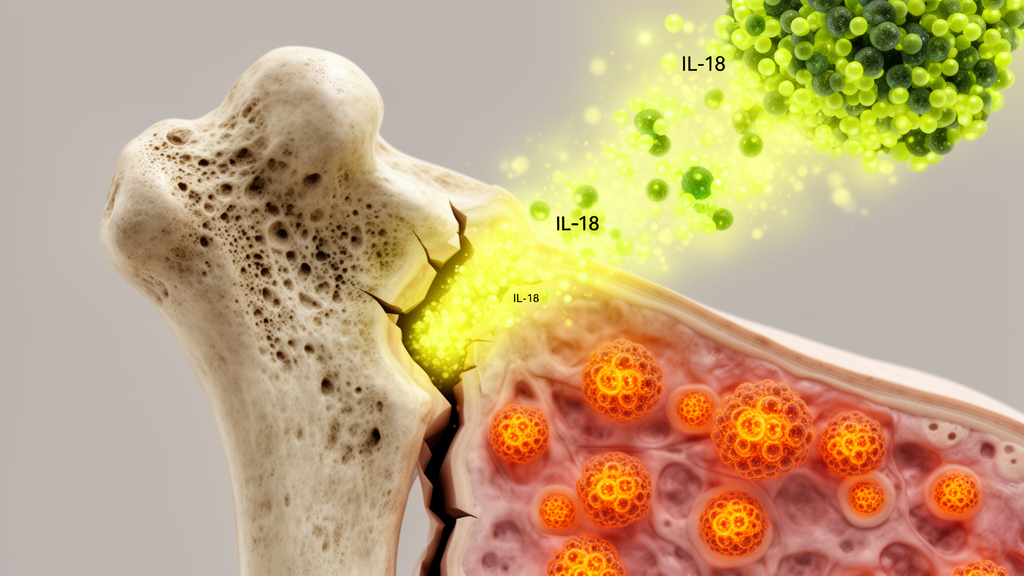
For hundreds of thousands of people each year, a broken bone simply refuses to heal. The fracture line persists as a nonunion, a gap that neither surgery nor time can close, and the promise of stem cell therapies designed to bridge such large skeletal defects has repeatedly collided with a stubborn obstacle: the inflamed, hostile environment of the wound itself. Now a research team spanning institutions in China, the United States and Hong Kong has identified a specific molecular culprit behind that hostility, and their findings, published in Nature Communications, point to an unexpected immune switch that may be quietly sabotaging regenerative medicine’s most ambitious skeletal applications.
The culprit is interleukin-18, or IL-18, a signaling protein long celebrated for its role in mobilizing the immune system against infection and cancer. In the new study, led by Yangshuai Gao, Liang Wang and Jiajia Xu of Southern Medical University together with Xiaochun Bai and Zhongmin Zhang, IL-18 emerges instead as a saboteur of repair. The researchers found that macrophages, the versatile immune cells that swarm into any injured tissue, secrete IL-18 at elevated levels in mouse models of non-healing bone defects and, crucially, in tissue samples from human patients whose fractures failed to unite. That translational anchor, the overlap between mouse and human data, is what elevates the finding from an interesting mechanism to a potential therapeutic target.
At the heart of the discovery is a concept the authors call inflammatory senescence. Senescence, the state of permanent growth arrest that cells enter under stress, is usually discussed in the context of aging or tumor suppression. Here, the team shows that IL-18 pushes macrophages into a senescent, pro-inflammatory identity, a state often labeled M1 polarization, in which the cells churn out inflammatory signals rather than resolving damage. The trigger for this transformation is remarkably specific: IL-18 induces the transcription of a gene called Serpina3f, which acts as an upstream amplifier of the inflammatory program. Once switched on, the process feeds itself. Senescent macrophages produce more inflammatory mediators, which in turn reinforce the senescent state, creating a feed-forward cascade that locks the wound environment into a chronic, regenerative-hostile configuration.
The consequences for stem cells are direct and measurable. Using single-cell RNA sequencing, a technique that profiles gene expression in thousands of individual cells at once, the researchers mapped how mesenchymal stem and stromal cells, the progenitors responsible for building new bone, respond to an IL-18-rich environment. The results were unambiguous. IL-18 suppresses the proliferation of these progenitors, erodes their clonogenic capacity, the ability of a single cell to found a colony of descendants, and damages their mitochondrial fitness, the energy-generating machinery that fuels differentiation into bone-forming osteoblasts. In functional assays, mesenchymal cells exposed to IL-18 lost their capacity to undergo osteogenesis, the process by which they mature into bone-producing cells.
What makes the finding particularly compelling is the genetic and pharmacological evidence that IL-18 is not merely a correlate of failed healing but a causal driver. When the researchers deleted the IL-18 gene in mice, the animals recovered regenerative potential that non-healing models had lost. More striking still, the team tested two pharmacological strategies in parallel: neutralizing antibodies that bind IL-18 directly, and IL-18 binding protein, a natural decoy that sequesters the cytokine before it can reach its receptor. Both interventions reversed the dysfunctional macrophage state and promoted bone healing in experimental models. The convergence of genetic deletion and two independent blockade approaches on the same outcome strengthens the case that IL-18 sits at a controlling node in the regenerative failure pathway.
The study also clarifies the cellular conversation that goes wrong in chronic wounds. Skeletal repair depends on a delicate dialogue between immune cells and mesenchymal progenitors, with macrophages normally orchestrating the transition from inflammation to reconstruction. IL-18, the authors argue, functions as an immune switch that disrupts this immune-mesenchymal crosstalk. By locking macrophages into a senescent, inflammatory identity, the cytokine transforms what should be a supportive niche into a hostile one, and the mesenchymal stem cells, deprived of proper signals and bombarded by inflammatory mediators, simply fail to build bone. The feed-forward nature of the cascade means that even transient IL-18 elevation early in the healing process could have lasting consequences, a possibility that the temporal dynamics of the mouse models appear to support.
For the field of stem cell-based skeletal regeneration, the implications are substantial. Large bone defects, whether from trauma, tumor resection, or failed spinal fusion surgery, remain one of orthopedic medicine’s most intractable challenges, and cell therapies have struggled in part because transplanted or resident progenitors encounter an environment that suppresses their function rather than supporting it. The new work suggests that the environment itself can be reengineered. Rather than trying to boost stem cell potency or transplant ever-larger numbers of cells, clinicians could in principle target the inflammatory switch that renders the niche hostile, allowing existing regenerative machinery to resume function. The patent application filed by the team related to these findings signals that the translational pathway is already under active development.
Several caveats temper the enthusiasm. The mouse models, while informative, do not fully recapitulate the complexity of human nonunion, and the human tissue samples, though consistent with the mouse data, represent association rather than proof of causation. The Serpina3f gene, central to the mechanism in mice, has a human ortholog whose role in the equivalent pathway will need direct confirmation. And while IL-18 binding protein is already in clinical development for other inflammatory conditions, its safety and efficacy profile in the context of bone repair, where immune signaling also plays constructive roles in the early phases of healing, remains to be established. Blocking IL-18 too aggressively or at the wrong time could theoretically impair the immune functions that initiate repair, making the timing and dosing of any future intervention a critical variable.
Nevertheless, the study represents a significant step toward understanding why inflammation and regeneration so often pull in opposite directions. By identifying IL-18 as an upstream amplifier that drives macrophage senescence and suppresses mesenchymal stem cell osteogenesis through a feed-forward inflammatory cascade, the researchers have provided both a mechanistic explanation for regenerative failure and a concrete molecular target. As the population ages and the burden of complex fractures and spinal surgeries grows, the prospect of converting a non-healing wound into a regenerative one by neutralizing a single cytokine is a proposition that will be watched closely by regenerative medicine researchers and orthopedic surgeons alike. The next phase of this work, moving from experimental models toward clinical evaluation, will determine whether IL-18 blockade can fulfill the promise that the current data so strongly suggest.
Subject of Research: Immune-stimulatory cytokine IL-18 induces inflammatory senescence and impairs stem cell-mediated experimental skeletal regeneration
Article Title: Immune-stimulatory cytokine IL-18 induces inflammatory senescence and impairs stem cell-mediated experimental skeletal regeneration
Article References: Gao, Y., Wang, L., Gan, Y., Lin, Q., Chen, S., Li, M., Chen, J., Shen, H., Zheng, Q., Sokolowskei, D., Tower, R. J., Huang, M., Xu, J., James, A. W., Bai, X., Zhang, Z., & Xu, J. (2026). Immune-stimulatory cytokine IL-18 induces inflammatory senescence and impairs stem cell-mediated experimental skeletal regeneration. Nature Communications. https://doi.org/10.1038/s41467-026-78662-y
Image Credits: AI Generated
DOI: 10.1038/s41467-026-78662-y
Keywords: IL-18, macrophages, mesenchymal stem cells, senescence, bone regeneration, bone nonunion, inflammation, cytokine, osteogenesis, Serpina3f, IL-18 binding protein, Nature Communications
Cite Scienmag News
Beatrice Stafford. (October 16, 2026). IL-18 Cytokine Drives Inflammatory Senescence and Blocks Skeletal Regeneration. Scienmag. https://scienmag.com/il-18-cytokine-drives-inflammatory-senescence-and-blocks-skeletal-regeneration/
Beatrice Stafford. "IL-18 Cytokine Drives Inflammatory Senescence and Blocks Skeletal Regeneration." Scienmag, 16 October 2026, https://scienmag.com/il-18-cytokine-drives-inflammatory-senescence-and-blocks-skeletal-regeneration/. Accessed 16 October 2026.
Beatrice Stafford. "IL-18 Cytokine Drives Inflammatory Senescence and Blocks Skeletal Regeneration." Scienmag. October 16, 2026. https://scienmag.com/il-18-cytokine-drives-inflammatory-senescence-and-blocks-skeletal-regeneration/


