


Along the northern coast of Central Java, the village of Bedono is slowly disappearing beneath the sea. Tidal floods known locally as “Rob” now inundate up to 12.7 square kilometers of coastal land between April and June, with floodwaters reaching 50 to 110 centimeters in height. Roughly 30 houses are lost each year as land subsidence and tidal intrusion combine to swallow the shoreline. Yet amid this steady retreat, a new study published in Estuarine Management and Technologies documents a quiet counteroffensive: mangrove restoration paired with low-cost bamboo engineering that is rebuilding land, one centimeter of sediment at a time.
The research, conducted between 2022 and 2025 in Bedono Village in Demak Regency, examined how Nature-based Solutions, or NbS, can be integrated into estuary management in one of Indonesia’s most vulnerable coastal zones. The International Union for Conservation of Nature defines NbS as actions that protect, manage, and restore natural ecosystems to address societal challenges while supporting biodiversity and human well-being. In Bedono, that translates into mangrove rehabilitation supported by permeable brushwood barriers, sustainable silvofishery aquaculture, and community-driven conservation, all deployed against a backdrop of erosion, flooding, and land subsidence driven in part by groundwater extraction.
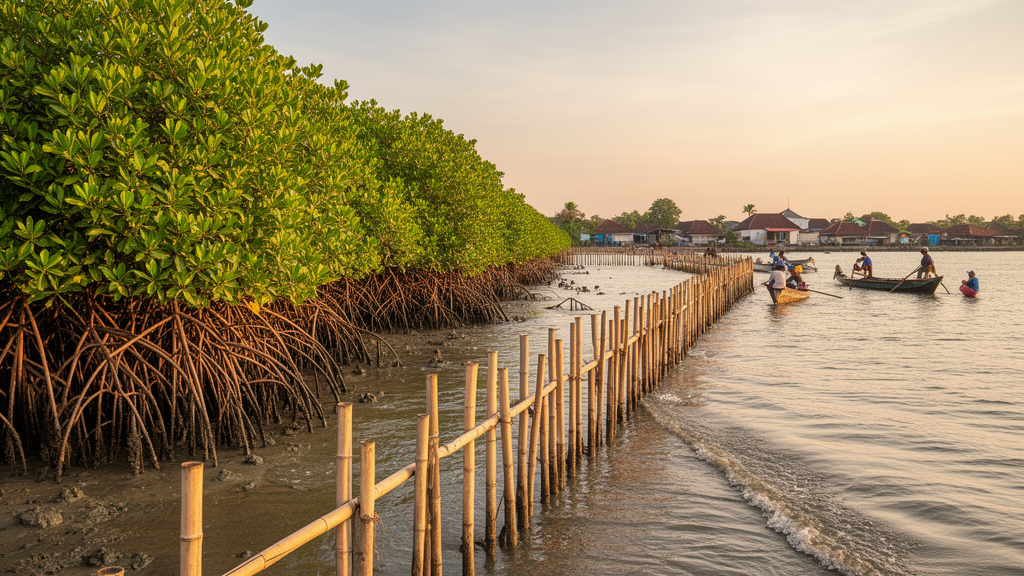
The technical core of the approach lies in hybrid engineering. Permeable brushwood barriers constructed from bamboo and mangrove branches are installed along the shoreline to attenuate wave energy and slow water flow. As turbulent energy drops, suspended sediment settles out of the water column and accumulates behind the structures. Field measurements using 1.5-meter PVC stakes and marker horizon techniques recorded sediment accretion rates of 5 to 15 centimeters per year in areas protected by these barriers. That vertical buildup is critical in a landscape where the land itself is sinking, because it allows the marsh surface to keep pace with rising water levels. The calmer water behind the barriers also creates favorable conditions for the natural recruitment of Avicennia and Rhizophora mangrove seedlings, which then trap even more sediment with their root systems, creating a reinforcing feedback loop between vegetation structure and geomorphic stability.
The quantitative evidence for this feedback is striking. Across five monitoring plots, mangrove stem density ranged from 3.8 to 5.2 stems per square meter, and sediment accretion rose in lockstep from 1.4 to 2.3 centimeters per year. The correlation between the two variables was exceptionally strong, with a Pearson coefficient of 0.91 and a p-value of 0.012, providing rare direct statistical support for the idea that denser mangrove stands actively build and stabilize coastal land. Seasonal monitoring revealed additional dynamics: salinity dropped from 29.34 parts per thousand in the dry season to 23.18 in the wet season, while sediment texture shifted from 64.3 percent sand before NbS implementation to 56.7 percent afterward, with silt and clay fractions increasing. This fining of the substrate indicates improved sediment trapping by restored mangrove canopies, which slow water flow and promote the deposition of fine, organic-rich particles that enhance nutrient retention and carbon burial.
The ecological recovery of the mangrove forest itself has been equally measurable. Total mangrove density in monitoring quadrats doubled from 75 to 149 individuals per 100 square meters following restoration. Avicennia marina, a species with high tolerance for salinity and periodic inundation, remained the dominant colonizer, increasing from 35 to 68 individuals per 100 square meters with a seedling survival rate of 72 percent. Rhizophora mucronata nearly doubled from 28 to 59 individuals, achieving 68 percent seedling survival in sheltered areas, while Sonneratia alba, which is more sensitive to wave exposure, showed a lower survival rate of 54 percent. The Shannon diversity index climbed from 0.83 to 1.47, reflecting improved habitat heterogeneity and structural complexity. These survival figures align with community-led restoration results elsewhere in Indonesia and the region, from Demak’s permeable dam projects reporting 70 to 85 percent survival to Bangladesh’s Sundarbans at 50 to 85 percent.
What sets Bedono apart from many restoration projects is the depth of community involvement. Semi-structured interviews with 20 respondents representing fishpond owners, women’s cooperatives, youth associations, and village officials revealed that more than 90 percent perceived worsening tidal inundation over the past decade, yet also acknowledged that mangrove planting has helped reduce flooding impacts. Participation has been remarkably high: 76 percent of respondents have been involved in mangrove planting since 2020, and 67 percent of women have engaged in NbS-based enterprise training. Among 45 workshop participants, 85 percent reported reduced erosion and improved fish catch following restoration, observations that triangulated closely with the measured ecological data, including salinity ranges of 20.47 to 31.62 parts per thousand and acidic pH values of 2.5 to 4.4 suitable for mangrove growth.
The socio-economic dimension of the project extends well beyond planting trees. Women’s empowerment initiatives have diversified household livelihoods through mangrove-derived products including syrups, cookies, batik dyes, herbal preparations, and handicrafts. Students and young people participate through thematic internships, field courses, and community service programs that strengthen environmental literacy and create two-way knowledge exchange between universities and coastal residents. Seedling nurseries generate modest but meaningful income, while improved fish and crab availability supports food security. The mean Likert score of 3.9 out of 5 for the statement that NbS activities have improved household income suggests moderate but positive perceived economic benefit. These social outcomes reinforce the ecological ones, because communities that derive tangible value from restored ecosystems are far more likely to protect them over the long term.
The urgency of this work is underscored by what has already been lost. In 2022, the last remaining house closest to the shoreline in one section of Bedono was still inhabited by a long-term resident named Mrs. Paijah, accessible only via a narrow bamboo bridge because seawater had already flooded the ground beneath it. By 2023, the house had been completely lost to coastal inundation, marking the disappearance of the final habitable structure in that part of the village. Measurements in 2024 and 2025 confirmed continued rising water levels at the site. This pattern of physical and socio-economic displacement, with households forced to relocate inland or migrate to neighboring areas, illustrates the human cost of inaction in subsiding deltaic environments.
The Bedono model carries significant policy implications for Indonesia and beyond. The study’s authors argue that NbS should be mainstreamed into coastal planning instruments such as RZWP3K, Indonesia’s coastal zoning framework, and integrated into national adaptation and disaster risk reduction strategies including RAN-API and RAN-PRB. Such integration would reinforce Indonesia’s commitments under the Paris Agreement and advance Sustainable Development Goals 13, 14, and 15 covering climate action, life below water, and life on land. The findings also align with Indonesia’s FOLU Net Sink 2030 roadmap, which targets the forestry and land-use sector as a net carbon sink. Mangrove ecosystems are among the most carbon-dense on Earth, and the sediment carbon recovery trajectory observed in Bedono fits within regional blue-carbon ranges reported for Southeast Asia, suggesting that properly situated mangrove restoration can meaningfully contribute to climate mitigation even in subsiding coastal systems.
Indonesia holds approximately 22.6 percent of the world’s mangrove area and harbors more than 50 mangrove species, predominantly of the genus Rhizophora, yet the country also ranks among those with the highest mangrove deforestation rates, contributing significantly to greenhouse gas emissions and biodiversity loss. Against this backdrop, the Bedono experience offers a replicable template for vulnerable coastlines across Indonesia and the Global South. The key transferable elements include community-based mangrove nurseries, participatory monitoring, and permeable brushwood barriers adapted to local geomorphic conditions. Policy mechanisms such as incentives for silvofishery adoption, support for village-led restoration enterprises, and alignment with provincial coastal zoning plans can amplify these gains. The researchers acknowledge limitations, including reliance on self-reported community perceptions and a monitoring window of only three years, and they call for continued long-term observation to capture interannual variability and the cumulative effects of subsidence and sea-level rise. Still, the convergence of hard biophysical measurements with community knowledge demonstrates that when ecological engineering and local stewardship are combined, even a sinking shoreline can begin to hold its ground.
Subject of Research: Nature-based solutions for estuary management and coastal climate mitigation in Demak, Central Java
Article Title: Integrating nature-based solutions in estuary management: A climate mitigation perspective from Demak, Central Java
Article References: Soeprobowati, T. R., Khotimperwati, L., Jumari, J., & Helmy, M. (2025). Integrating nature-based solutions in estuary management: A climate mitigation perspective from Demak, Central Java. Estuarine Management and Technologies, 2, 119-140. https://doi.org/10.3897/emt.2.172938
Image Credits: AI Generated
DOI: 10.3897/emt.2.172938
Keywords: mangrove restoration, nature-based solutions, estuary management, coastal erosion, land subsidence, blue carbon, sediment accretion, Indonesia, community conservation, climate adaptation, silvofishery, tidal flooding
Cite Scienmag News
Gavin Prescott. (October 16, 2026). Mangroves and Bamboo Barriers Help a Sinking Indonesian Estuary Fight Back Against the Sea. Scienmag. https://scienmag.com/mangroves-and-bamboo-barriers-help-a-sinking-indonesian-estuary-fight-back-against-the-sea/
Gavin Prescott. "Mangroves and Bamboo Barriers Help a Sinking Indonesian Estuary Fight Back Against the Sea." Scienmag, 16 October 2026, https://scienmag.com/mangroves-and-bamboo-barriers-help-a-sinking-indonesian-estuary-fight-back-against-the-sea/. Accessed 16 October 2026.
Gavin Prescott. "Mangroves and Bamboo Barriers Help a Sinking Indonesian Estuary Fight Back Against the Sea." Scienmag. October 16, 2026. https://scienmag.com/mangroves-and-bamboo-barriers-help-a-sinking-indonesian-estuary-fight-back-against-the-sea/


