


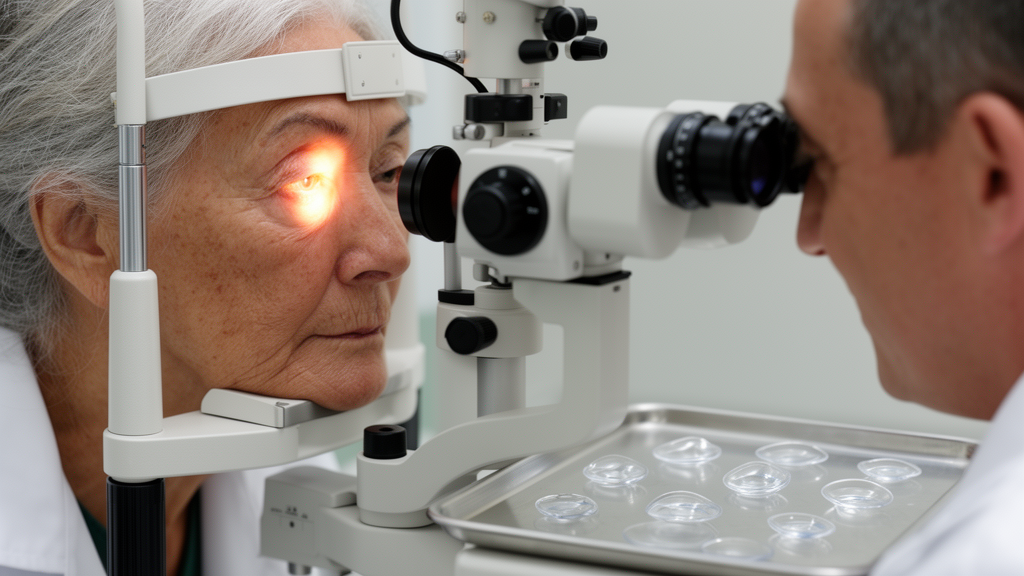
Cataract surgery is the most frequently performed operation in ophthalmology, and for most of its history the choice of replacement lens was simple: a standard monofocal intraocular lens that restored clear distance vision and left patients reaching for reading glasses. That simplicity no longer satisfies a generation of patients whose daily lives revolve around smartphones, tablets, and computer screens, all of which sit squarely in the intermediate zone between 60 centimeters and one meter. A new comparative study published in Pharmacia suggests that a relatively new category of lens, the enhanced monofocal, may offer a clinically meaningful compromise between the limited range of conventional monofocal lenses and the optical trade-offs that come with extended depth of focus designs.
The retrospective study, conducted at Alexandrovska University Hospital in Sofia, evaluated 56 patients representing 67 eyes who underwent uncomplicated phacoemulsification cataract surgery with implantation of the lens into the capsular bag. All operations were performed by a single experienced surgeon, and patients were divided into three groups according to the lens they chose after preoperative counseling. Twenty-five patients received a standard monofocal lens drawn from several commercially available models, 17 patients received the Evolux™ enhanced monofocal lens, and 14 patients received an extended depth of focus, or EDOF, lens. Patients with corneal astigmatism of 0.50 diopters or more and those with toric lenses were excluded, keeping the comparison as clean as the retrospective design allowed.
The Evolux™ lens, developed by AffaMed Therapeutics and SIFI S.p.A., is made from a hydrophobic material and carries a non-diffractive optical profile. Unlike multifocal lenses, which split incoming light between multiple focal points, and unlike diffractive EDOF designs, which redistribute light to stretch the focal range, the enhanced monofocal profile is engineered to sharpen intermediate vision while preserving distance clarity equivalent to a traditional monofocal lens. Its optical technology is reported to show very low dependence on pupil diameter at far and intermediate distances, similar image contrast across different pupil sizes, and good tolerance to residual refractive errors, with a low reported incidence of tilt, decentration, and photic phenomena.
Visual acuity was measured before surgery and again on the seventh and thirtieth postoperative days, using a Snellen chart calibrated at six meters for distance vision and an intermediate chart calibrated at 66 centimeters. Before surgery, the three groups were closely matched: mean best-corrected distance acuity ranged from 0.18 in the monofocal group to 0.21 in the EDOF group, and mean intermediate acuity ranged from 0.25 to 0.30. On the thirtieth postoperative day, distance acuity had converged across all groups, with mean uncorrected values of 0.80 for the monofocal group, 0.83 for the Evolux™ group, and 0.84 for the EDOF group. The researchers emphasize that this convergence is clinically relevant, because any gain in intermediate vision should ideally not come at the expense of distance clarity.
The real separation appeared at 66 centimeters. The monofocal group averaged 0.54 uncorrected intermediate acuity, meaning most patients still needed glasses for computer-distance tasks, and the best individual result in that group was 0.8. The Evolux™ group averaged 0.79, with six eyes reaching 1.0, or 20/20, at the intermediate distance. The EDOF group led with a mean of 0.93, and post hoc analysis confirmed that its intermediate acuity was significantly better than both the Evolux™ lens and the monofocal lenses. Expressed relative to preoperative values, intermediate acuity improved by 116 percent in the monofocal group, 182 percent in the Evolux™ group, and 210 percent in the EDOF group, a hierarchy the authors note is consistent with the intended optical characteristics of each lens category.
Acuity alone, however, does not capture the full quality of vision. Optical strategies that extend the depth of focus necessarily alter how light is distributed across the retina, which can reduce the ability to distinguish objects of similar luminance, particularly under dim or unfavorable conditions. To probe this, the team measured contrast sensitivity on the thirtieth postoperative day using the Pelli-Robson chart at one meter, a logarithmic test on which scores near 2.00 indicate normal contrast sensitivity. The results were striking. In the monofocal group, 79.31 percent of eyes recorded 2.00 log units, and in the Evolux™ group 68.18 percent did so. In the EDOF group, only 25 percent of eyes reached 2.00, while 56.25 percent recorded 1.85 log units. Although the sample size limits definitive conclusions, the distribution suggests that the broader visual range of EDOF optics is accompanied by a measurable reduction in contrast sensitivity, a finding consistent with earlier work by Kohnen and colleagues.
Patient-reported outcomes added a subjective dimension to the objective measurements. On a satisfaction scale from 0 to 10, nearly all patients in every group reported their distance vision as excellent, with only isolated scores of 9 or lower. The differences emerged in the frequency of photic phenomena: one patient in the monofocal group reported halos with nighttime driving difficulties, one reported diplopia, and another reported glare. In the Evolux™ group, only a single patient reported glare, and no one reported halos. In the EDOF group, three patients, or 18.75 percent, reported photic phenomena such as glare or halos around light sources. The authors attribute the low frequency of complaints in the Evolux™ group to its non-diffractive design, which avoids the light splitting that generates halos and glare in diffractive optics.
The pattern that emerges across the three groups is essentially a trade-off between range and quality. Conventional monofocal lenses delivered good distance vision and preserved contrast sensitivity but left patients dependent on spectacles for anything closer than arm’s length. EDOF lenses delivered the highest intermediate acuity and the greatest spectacle independence but showed reduced contrast sensitivity and the most frequent photic symptoms. The Evolux™ enhanced monofocal occupied the middle ground, delivering a substantial gain in intermediate vision over conventional monofocal lenses, comparable distance acuity, preserved contrast sensitivity, and a low incidence of halos and glare. The authors also point to an economic dimension, noting that enhanced monofocal lenses may be an attractive option for patients for whom the premium price of EDOF or multifocal lenses is a limiting factor.
For clinical counseling, the findings suggest that not every patient requires maximal spectacle independence at all distances. Some prioritize excellent distance vision, good intermediate vision for screens, and minimal photic phenomena over the highest possible near acuity, and for these patients an enhanced monofocal lens may represent an appealing alternative. The study’s strengths include its direct three-group comparison in a single clinical setting, the combination of objective acuity and contrast sensitivity with patient-reported satisfaction, and the standardization offered by a single surgeon and uniform postoperative treatment. The authors caution that the retrospective design and modest sample size are real limitations, and they call for larger prospective studies with standardized patient-reported outcome measures and longer follow-up to confirm the position of enhanced monofocal lenses in the cataract surgery landscape.
Subject of Research: Ophthalmology
Article Title: A comparative study of visual outcomes and patient satisfaction with Evolux™, monofocal, and extended depth of focus intraocular lenses
Article References: Zdravkov, Y., Dzhambazov, R., Veleva, N., Haykin, V., & Oscar, A. (2026). A comparative study of visual outcomes and patient satisfaction with Evolux™, monofocal, and extended depth of focus intraocular lenses. Pharmacia, 73, Article e200063. https://doi.org/10.3897/pharmacia.73.e200063
Image Credits: AI Generated
DOI: 10.3897/pharmacia.73.e200063
Keywords: cataract surgery, intraocular lenses, enhanced monofocal IOL, Evolux, EDOF lens, contrast sensitivity, patient satisfaction, intermediate vision, ophthalmology, vision correction, comparative, visual
Cite Scienmag News
Ophelia Keating. (October 16, 2026). Enhanced monofocal lens offers a middle path between clarity and range after cataract surgery. Scienmag. https://scienmag.com/enhanced-monofocal-lens-offers-a-middle-path-between-clarity-and-range-after-cataract-surgery/
Ophelia Keating. "Enhanced monofocal lens offers a middle path between clarity and range after cataract surgery." Scienmag, 16 October 2026, https://scienmag.com/enhanced-monofocal-lens-offers-a-middle-path-between-clarity-and-range-after-cataract-surgery/. Accessed 16 October 2026.
Ophelia Keating. "Enhanced monofocal lens offers a middle path between clarity and range after cataract surgery." Scienmag. October 16, 2026. https://scienmag.com/enhanced-monofocal-lens-offers-a-middle-path-between-clarity-and-range-after-cataract-surgery/


