


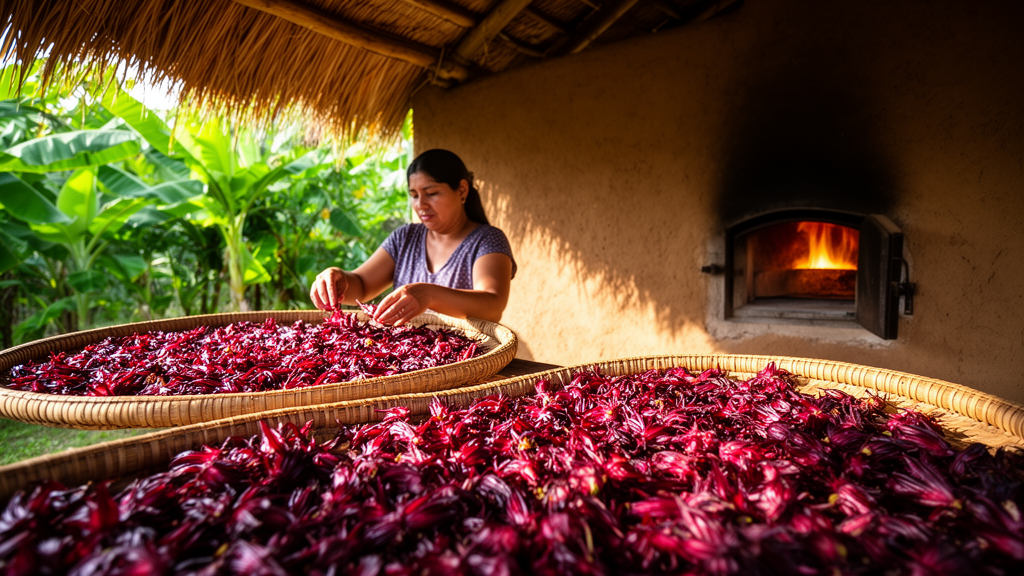
A simple sheet of shade netting stretched over a wooden raised bed may do more for the deep crimson pigments in roselle calyces than an electric oven or the full force of the tropical sun. That is the central finding of a new field study from Chiapas, Mexico, where researchers dried calyces from a farmer-maintained roselle population three different ways and then measured what survived the process. The work, published in Frontiers in Conservation Science, offers a rare chemical look at how postharvest choices shape the value of a crop that smallholder farmers have kept alive for roughly a decade through their own seed and management practices.
Roselle, Hibiscus sabdariffa L., is a member of the Malvaceae family whose fleshy, acid calyces are the raw material for hibiscus tea, jams, sauces, and infusions consumed worldwide. The calyces are chemically rich: they carry organic acids, a broad suite of phenolic compounds, and anthocyanins, the water-soluble pigments responsible for the drink’s signature ruby color. Those same anthocyanins are notoriously fragile, degraded by light, heat, oxygen, shifts in pH, and enzymatic activity. Because drying is the essential step that makes roselle storable and marketable beyond the harvest window, the conditions under which water is removed can directly determine how much of the crop’s bioactive chemistry reaches the cup.
The research team, led by Teresa Avelina Trujillo-Robles of El Colegio de la Frontera Sur, worked with a roselle population cultivated in the community of Guadalupe Victoria, in the municipality of Villaflores, Chiapas. The producer had maintained the population for about ten years within a diversified tropical polyculture, making it a genuine example of farmer-managed agrobiodiversity rather than a commercial variety. On November 20, 2022, the team harvested fifteen plants at random, cutting each roughly five centimeters above the soil. The calyces were manually separated from the capsules, pooled into a single batch, and then randomly divided among three drying treatments, a design intended to equalize the starting material across methods.
The three treatments represented a gradient of technology and cost. The first, labeled JASI, involved 832 grams of fresh calyces dried in an electric oven at 40 degrees Celsius for 33 hours until constant mass, a controlled but energy-dependent method. The second, JAST, was the traditional approach: 3,740 grams spread on wooden boards and left in direct sunlight for five days, or 120 hours. The third, JASCE, used the same mass of calyces arranged on raised wooden mesh beds about 30 centimeters above the soil, covered with 50 percent shade netting, and dried for the same five days. Outdoor samples were turned four times daily and moved under a roofed, ventilated area at night; no rain fell during the drying period. A commercially purchased Sudan-type roselle was oven-dried and included purely as a descriptive external reference, excluded from statistical testing because its production and handling history differed and was not fully documented.
After drying, the calyces reached an overall moisture content of 11.0 plus or minus 0.5 percent, about 89 percent dry matter, a level consistent with Mexican Official Standard NOM-116-SSA1-1994. The team then prepared aqueous extracts the way a tea drinker would: 0.5 grams of ground, sieved material steeped in 10 milliliters of water at 98 degrees Celsius for 20 minutes. From these infusions they measured total phenolic content by the Folin-Ciocalteu method, total monomeric anthocyanins by differential pH spectrophotometry, and four antioxidant responses: DPPH and ABTS radical scavenging, ferric reducing activity, and cupric reducing activity. Each assay ran in technical triplicate, and the triplicates were averaged to yield one value per calyx portion, so the statistics rested on three portion-level observations per treatment.
The headline result concerned anthocyanins. Total monomeric anthocyanin concentrations differed significantly among the three local drying treatments, with the shade-covered raised beds delivering the highest mean at 72.2 plus or minus 6.2 milligrams of delphinidin-3-glucoside equivalents per gram of dry calyces. Direct sun drying produced an intermediate 62.8 plus or minus 9.2, while the oven treatment yielded the lowest local mean at 49.3 plus or minus 8.5. A Games-Howell post hoc comparison pinpointed the significant difference as lying between the shade-bed and oven treatments, with the sun-dried group not statistically distinguishable from either. Total phenolic content, by contrast, ranged only from 23.7 to 27.1 milligrams of gallic acid equivalents per gram across the local treatments, and the analysis of variance found no significant differences among them, although the shade-bed group again posted the highest numerical mean. The commercial reference sample sat well below the local material on both measures, at 19.3 for both phenolics and anthocyanins.
Perhaps the most striking chemical outcome was what did not change. None of the four antioxidant assays detected significant differences among the local drying treatments. DPPH values clustered around 12 to 13 milligrams of Trolox equivalents per gram, ABTS values ranged from roughly 118 to 128, and ferric and cupric reducing activities hovered in the high 70s to low 90s in percentage terms regardless of drying method. The authors are careful about what this means: with only three observations per treatment and incomplete replication of the drying units, the absence of detected differences is not evidence of equivalence. It simply means the design could not resolve differences if they existed. The divergence between the anthocyanin results and the antioxidant results is chemically plausible, since DPPH and ABTS measure radical-scavenging behavior while the ferric and cupric assays probe reducing capacity, and each responds differently to extract composition and interactions among metabolites.
The study’s limitations are candidly acknowledged and matter for interpretation. The three oven-dried portions shared a single oven chamber, so they were not independent at the drying-device level, while the sun and shade treatments each used three separate physical units, an asymmetry that forces cautious reading of any comparison involving the oven treatment. The outdoor drying environment was not instrumented for temperature, humidity, solar radiation, or air velocity, drying kinetics were never recorded, and the two outdoor treatments ran for a fixed 120 hours while the oven ran to constant mass, meaning the treatments ended on different operational criteria. Because no fresh-calyx baseline was analyzed, the findings describe final concentrations only and cannot demonstrate retention, preservation, or improvement relative to the undried material. Only one population, one production cycle, one locality, and one drying campaign were studied, and pooling calyces from fifteen plants erased plant-to-plant variation as an experimental level.
Within those constraints, the practical signal is clear enough to justify further work. Shade-covered raised-bed drying requires no electricity during the outdoor phase, uses simple physical infrastructure, and lifts the crop away from soil contact while cutting direct solar exposure, a combination compatible with the hypothesis that reduced heat and radiation load preserves anthocyanins. The authors frame this as postharvest valorization in a deliberately narrow sense: accessible processing that yields favorable measured chemical attributes, without claiming demonstrated gains in farmer income, consumer acceptance, market performance, or conservation outcomes. From a conservation-through-use perspective, the logic is that if locally maintained crops can be processed cheaply into products with strong chemical profiles, farmers have more reason to keep growing them, which in turn keeps diverse local populations in production.
What happens next depends on replication. The authors call for future studies with independently replicated drying units for every treatment, repeated across production cycles and locations, and with direct environmental monitoring, drying curves, water activity measurements, instrumental color data, microbiological stability testing, sensory evaluation, and detailed profiles of individual phenolics and anthocyanins. Economic and adoption indicators would complete the picture, since a technically superior drying method matters little if it is too costly or labor-intensive for the smallholders it is meant to serve. For now, the study stands as a measured argument that the cheapest technology on the farm, a raised bed and a sheet of shade cloth, deserves a place in the conversation about how tropical crops keep their chemistry, and their value, after the harvest.
Subject of Research: Effects of postharvest drying methods on bioactive compounds and antioxidant capacity in a farmer-maintained roselle population in Chiapas, Mexico
Article Title: Postharvest drying of a farmer-maintained roselle population in Chiapas, Mexico: bioactive compounds and antioxidant capacity
Article References: Trujillo-Robles, T. A., Jiménez-Martínez, C., Sánchez Chino, X. M., Martínez-Herrera, J., León-Martínez, N. S., Castellanos-Albores, J., & Olivo-Vidal, Z. E. (2026). Postharvest drying of a farmer-maintained roselle population in Chiapas, Mexico: bioactive compounds and antioxidant capacity. Frontiers in Conservation Science, 7, Article 1978755. https://doi.org/10.3389/fcosc.2026.1978755
Image Credits: AI Generated
DOI: 10.3389/fcosc.2026.1978755
Keywords: roselle, Hibiscus sabdariffa, postharvest drying, anthocyanins, antioxidant capacity, agrobiodiversity, smallholder agriculture, Chiapas, phenolic compounds, shade drying, food chemistry, crop conservation
Cite Scienmag News
Alan Morgan. (October 16, 2026). Shade-Dried Roselle Keeps More Anthocyanins Than Sun or Oven Drying in Chiapas Study. Scienmag. https://scienmag.com/shade-dried-roselle-keeps-more-anthocyanins-than-sun-or-oven-drying-in-chiapas-study/
Alan Morgan. "Shade-Dried Roselle Keeps More Anthocyanins Than Sun or Oven Drying in Chiapas Study." Scienmag, 16 October 2026, https://scienmag.com/shade-dried-roselle-keeps-more-anthocyanins-than-sun-or-oven-drying-in-chiapas-study/. Accessed 16 October 2026.
Alan Morgan. "Shade-Dried Roselle Keeps More Anthocyanins Than Sun or Oven Drying in Chiapas Study." Scienmag. October 16, 2026. https://scienmag.com/shade-dried-roselle-keeps-more-anthocyanins-than-sun-or-oven-drying-in-chiapas-study/


