


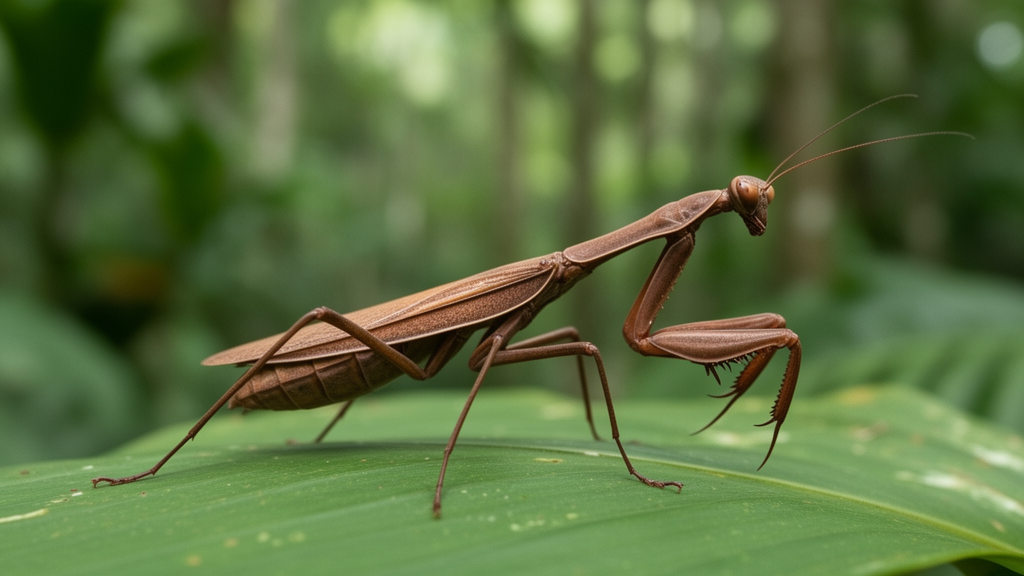
A small, ant-mimicking praying mantis from Southeast Asia has quietly established itself in two Brazilian cities, and almost nobody in the scientific community saw it coming. The genus Odontomantis, a group of tiny green mantids native to tropical Asia, has now been documented for the first time in South America, with confirmed records from Boa Vista in Roraima state and Manaus in Amazonas state. What makes the discovery remarkable is not just the geographic leap across an ocean, but the fact that every single record came from ordinary citizens armed with smartphones rather than from professional field surveys.
The new documentation, published in the Journal of Orthoptera Research, draws on photographic evidence submitted through platforms such as iNaturalist and GBIF, as well as entomology groups on Facebook and Instagram. The author cross-checked citizen submissions against reference specimens to confirm the morphological identity of adult males and females. The first verifiable Brazilian record dates to July 2023, when a live adult male was photographed at Boa Vista International Airport, a location that may prove critical to understanding how the insects arrived. Unpublished observations suggest the mantis may have been present in Manaus even earlier, though those records lack the photographic quality needed for formal confirmation.
Over the following months, records multiplied across Boa Vista, from central districts to peripheral neighborhoods, with independent observers documenting adult males, adult females, and nymphs at nearly every developmental stage. By 2024, the species had also been confirmed in Manaus, one of the largest urban centers in the Amazon. The most complete sequence came from the Cidade Nova neighborhood, where an adult female was photographed depositing an ootheca, the foamy egg case characteristic of mantises, on the plastic frame of an irrigation system. Weeks later, the same ootheca was photographed hatching, with at least 25 first-instar nymphs emerging. These images represent the first confirmed documentation of reproduction by Odontomantis in Brazil, and they suggest the population is not merely surviving but actively proliferating.
What is particularly striking about the observational record is its temporal consistency. Specimens were documented in every month of the year, with no seasonal gaps, indicating either overlapping generations or continuous breeding throughout the annual cycle. Adults and nymphs coexisted across seasons, and the insects were found on a wide variety of microhabitats, including ornamental shrubs, broad-leaved garden plants, exterior house walls, metal fences, ornamental pots, and railings. In at least two records from Boa Vista, individuals were observed on low-growing vegetation between 0.5 and 1.2 meters above the ground, a height range consistent with the shrub-level niche the genus occupies in its native range.
The life cycle of these mantids follows a pattern of dramatic color transformation across developmental stages. First-instar nymphs are black with green bands along the thoracic segments, giving them a striking resemblance to ants, a defensive adaptation that likely deters visually hunting predators. By the second instar, the raptorial legs take on brownish or reddish hues, and by the third instar the legs shift to yellow or green. Sexual differences become apparent by the fourth instar, with males bearing eight abdominal segments and females six. Subadults turn green and develop prominent wing buds, and adults of both sexes retain green coloration with differentiated wings. This developmental sequence closely mirrors what has been documented for Odontomantis planiceps in Asia, though the author notes that the current taxonomy of the genus is inadequate for species-level identification, meaning the exact species or species complex introduced to Brazil remains uncertain.
Natural dispersal across the vast distances separating Southeast Asia from South America is considered highly improbable. Wind-borne transport, rafting on vegetation mats, or hitchhiking on migratory birds cannot plausibly explain the arrival of these small insects. Instead, the evidence points strongly to human-mediated introduction, a pathway repeatedly documented for other mantid species worldwide. Brazil’s trade relationship with Asian nations provides a plausible conduit. China, Brazil’s leading commercial partner, is home to at least twelve described Odontomantis species, while India harbors at least four. The volume of goods flowing between these regions, from ornamental plants and cut flowers to wooden products and agricultural materials, creates ample opportunity for accidental transport of live insects or viable oothecae.
The location of the first confirmed record is telling. Boa Vista International Airport serves as a logistical hub for air cargo, potentially including shipments from Asian countries where Odontomantis is abundant in both natural and anthropized habitats. A single ootheca containing viable eggs or a gravid female is sufficient to establish a founding population, and mantis oothecae are notoriously resilient to environmental stressors during long-distance transport. From this entry point, the insects could have been moved overland to Manaus via the BR-174 highway, the sole terrestrial connection between Roraima and the rest of Brazil, a corridor whose role in facilitating biological invasions in the Amazon is well documented.
Once established in urban environments, Odontomantis faces a landscape that may actively favor its persistence. Gardens, ornamental vegetation, and fragmented green areas provide suitable microhabitats with reduced predation pressure and abundant resources. The genus also shares remarkable ecological parallels with native Neotropical mantids, particularly species of the genus Tithrone, which occupy similar shrub-level niches, display comparable green coloration, and even exhibit ant-mimicking first-instar nymphs. This convergent evolution between unrelated lineages on different continents raises serious questions about potential interspecific competition. If Odontomantis populations expand beyond urban boundaries, competitive exclusion, niche displacement, and shifts in local prey dynamics could ripple through the arthropod community and associated trophic networks.
The apparent rarity of mantid introductions in tropical regions may be more a reflection of detection bias than genuine absence. Many tropical areas suffer from limited monitoring networks, logistical constraints, and fewer researchers, meaning introductions may occur without being documented. The tropics are increasingly recognized as vulnerable to biological invasions, particularly from species originating in climatically similar regions where pre-adaptations facilitate rapid acclimatization. The case of Odontomantis in Brazil underscores this vulnerability and highlights citizen science as an essential early-warning tool for detecting non-native invertebrates before they spread into natural ecosystems.
Addressing this emerging invasion will require a coordinated response combining field surveys to determine whether the mantis remains restricted to urban centers or has penetrated surrounding forests, taxonomic resolution to identify the exact species involved, ecological assessment of habitat overlap with native mantids, and inspection of imported goods at entry points. Public engagement will be equally critical, as citizen scientists proved instrumental in detecting the invasion in the first place. Awareness campaigns can reduce unintentional human-assisted spread within national borders, while continued monitoring through platforms like iNaturalist can track the distribution and habitat use of Odontomantis in real time. The author emphasizes the urgent need for an integrated research and management program to mitigate potential ecological impacts before the invasion expands beyond its current range in Roraima and Amazonas.
Subject of Research: First record of the Asian mantid genus Odontomantis in Brazil documented through citizen science
Article Title: First records of Odontomantis ( Mantodea , Hymenopodidae ) in Brazil, a new allochthonous species revealed by citizen science, with notes on possible adaptation and ecological interactions
Article References: Fasano, A. (2026). First records of Odontomantis (Mantodea, Hymenopodidae) in Brazil, a new allochthonous species revealed by citizen science, with notes on possible adaptation and ecological interactions. Journal of Orthoptera Research, 35(1), 203-208. https://doi.org/10.3897/jor.35.168918
Image Credits: AI Generated
Keywords: Odontomantis, praying mantis, Brazil, invasive species, citizen science, Manaus, Boa Vista, Amazon, ant mimicry, biological invasion, Mantodea, urban ecology
Cite Scienmag News
Patricia Pace. (October 16, 2026). Ant-mimicking Asian mantis slips into Brazil, spotted first by citizen scientists. Scienmag. https://scienmag.com/ant-mimicking-asian-mantis-slips-into-brazil-spotted-first-by-citizen-scientists/
Patricia Pace. "Ant-mimicking Asian mantis slips into Brazil, spotted first by citizen scientists." Scienmag, 16 October 2026, https://scienmag.com/ant-mimicking-asian-mantis-slips-into-brazil-spotted-first-by-citizen-scientists/. Accessed 16 October 2026.
Patricia Pace. "Ant-mimicking Asian mantis slips into Brazil, spotted first by citizen scientists." Scienmag. October 16, 2026. https://scienmag.com/ant-mimicking-asian-mantis-slips-into-brazil-spotted-first-by-citizen-scientists/


