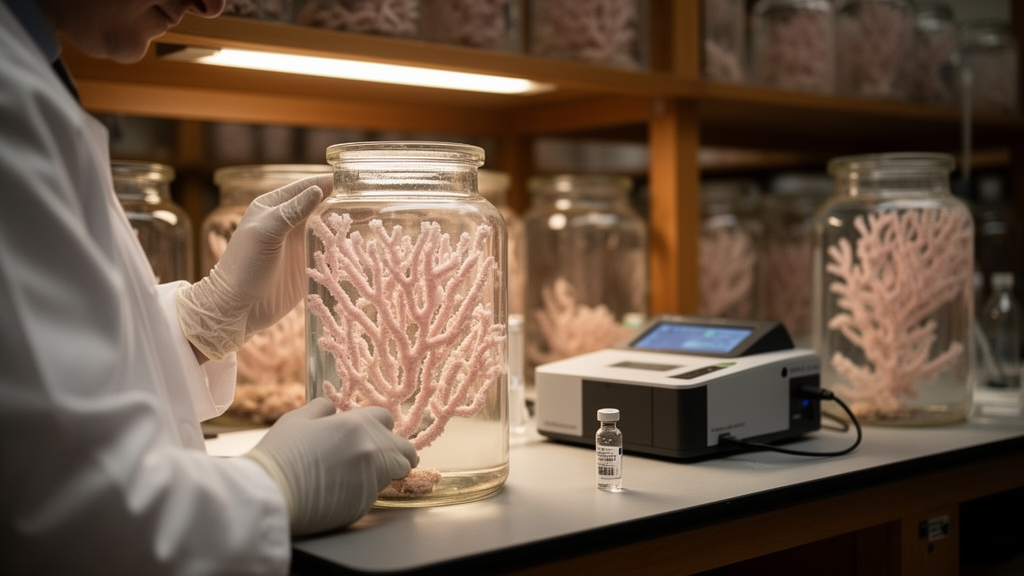
Deep inside the Okinawa Churaumi Aquarium, Japan’s largest aquarium, a zoological collection holds hundreds of octocoral specimens gathered from Okinawan waters over four decades. Most of these soft corals, sea fans, and sea pens carry labels identifying them only to genus, a frustrating limitation for researchers hoping to mine the collection for taxonomic and biodiversity insights. A new study published in Natural History Collections and Museomics demonstrates that DNA mini barcoding, using newly designed octocoral-specific primers, can extract usable genetic data from these aging specimens far more effectively than conventional full-length barcoding, recovering molecular information from more than 92 percent of tested material and revealing mislabeled specimens that may even belong to undescribed genera.
Octocorals, members of the class Octocorallia within the phylum Anthozoa, comprise more than 3,500 described species and rank among the most abundant macro-benthic animal groups on Indo-Pacific coral reefs after stony corals. They provide critical habitat for economically valuable fish and serve as a source of marine natural products with potential pharmaceutical applications. Yet identifying octocoral species based on morphology alone is notoriously difficult, often requiring expert examination of microscopic calcareous structures called sclerites. As a result, many museum specimens sit in drawers and jars with only generic labels, waiting for tools that can accelerate their classification.
The challenge is compounded by the nature of museum preservation itself. Specimens stored for decades in ethanol, or fixed in formalin before transfer to ethanol, suffer progressive DNA degradation. Environmental conditions in storage rooms, including temperature and humidity fluctuations, further erode molecular integrity. For older material, obtaining polymerase chain reaction amplicons longer than about 250 base pairs is often impossible, and DNA quality is the primary limiting factor in PCR success. DNA mini barcoding addresses this problem by targeting a shorter subset of the standard barcode region, typically up to 200 nucleotides, which amplifies more readily even when the template DNA is fragmented.
The research team, working with specimens from the Okinawa Churaumi Aquarium Zoological Collection, focused on the mitochondrial MutS-like protein gene, known as mtMutS. This gene is unique to octocorals among cnidarians and represents the most rapidly evolving protein-coding region in their otherwise slowly evolving mitogenome, a slowness attributed to a DNA mismatch repair mechanism. The team had previously developed a primer set for metabarcoding all octocorals, and in this study they tested whether the same primers could serve as mini barcodes for museum specimens dating back to 1982.
Before touching any specimens, the researchers conducted in silico evaluations using 380 mtMutS sequences from GenBank, spanning 11 genera and 160 octocoral species across families including Acanthogorgiidae, Cladiellidae, Melithaeidae, Nephtheidae, Sarcophytidae, Sinulariidae, and Subergorgiidae. They aligned the full 685-base-pair sequences and generated truncated 215-base-pair alignments to simulate mini barcodes. Statistical comparisons using Wilcoxon tests showed no significant differences in nucleotide variation proportions within species between the two barcode types for individual genera, though combined within-species variation was slightly higher for full-length barcodes. Species delimitation analyses using four methods, two distance-based approaches called Assemble Species by Automatic Partitioning and Automatic Barcode Gap Discovery, and two tree-based methods called Generalized Mixed Yule Coalescent and Bayesian Poisson Tree Processes, confirmed that mini barcodes performed comparably to full-length barcodes in matching species delimitation results to annotated taxonomy.
With computational validation complete, the team turned to 166 actual museum specimens representing eight putative genera, collected from shallow waters around 2 meters deep to depths of approximately 350 meters. DNA was extracted using a commercial kit with extended lysis, and amplification targeted a 215-base-pair fragment of mtMutS. The results were striking. Mini barcoding primers successfully amplified 92.7 percent of specimens, while the initial full-length primer pair managed only 4.8 percent. Even a semi-nested full-length approach reached just 45.8 percent. Notably, the full-length primers failed entirely on the oldest specimen, collected in 1982, while the mini barcode approach worked on many samples from that era and from 2004.
Sequencing the recovered mini barcodes allowed the researchers to delimit 67 distinct operational taxonomic units using the ASAP method with a threshold distance of approximately 0.23 percent. The same number of unique sequences was identified independently, providing convergent support for this estimate. More importantly, the mini barcodes validated or corrected generic identifications across the collection. Specimens labeled as Klyxum, Melithaea, Dendronephthya, Sarcophyton, and Subergorgia were confirmed as belonging to those genera. However, specimens labeled as Acanthogorgia revealed themselves to represent four different genera, and most specimens labeled as Sinularia were reassigned to Sclerophytum, a genus that has recently absorbed many former Sinularia species following taxonomic revision.
To resolve discrepancies between molecular results and museum labels, the team examined sclerite morphology using scanning electron microscopy. Two specimens labeled as Lobophytum were confirmed as Sclerophytum based on characteristic spindle and club-shaped sclerites. One Acanthogorgia specimen was validated as Villogorgia based on its calicular thornscales and bow-shaped spindles. Four other specimens initially labeled as Acanthogorgia showed sclerite characters that did not match any described genus in the family Acanthogorgiidae, leading the researchers to suspect these specimens may represent one or more undescribed genera, potentially harboring up to four undescribed species. Final taxonomic determinations will require deeper morphological and genetic investigation.
The study’s authors acknowledge that mini barcodes, being shorter, carry inherent limitations. Single-locus barcodes in anthozoans may not always distinguish closely related species because sequences can be identical or nearly identical among sister taxa. The match ratio between species delimitation results and annotated taxonomy remained below 30 percent for both barcode types, reflecting the difficulty of species-level resolution in octocorals using mitochondrial markers alone. Nevertheless, the researchers emphasize that mini barcodes are a promising tool for genus-level identification and initial sorting, which is precisely what large museum collections need before specimens can proceed to formal species description.
Looking forward, the team suggests that metabarcoding primers, which are already field-tested and target short regions, offer a practical pathway for mini barcoding studies across other taxonomic groups. For octocorals specifically, they recommend using octocoral-specific primers rather than universal metabarcoding primers targeting COI or 16S rRNA, which often fail to amplify in this group. The approach could also extend to formalin-preserved and dry specimens, where DNA degradation is even more severe. As museum specimens continue to age and accumulate DNA damage, this mini barcoding strategy offers a cheap, rapid means of unlocking molecular data from historical collections, supporting future taxonomy, biodiversity monitoring, and conservation of a group that remains comparatively understudied across the world’s oceans.
Subject of Research: DNA mini barcoding of octocoral museum specimens using novel mtMutS primers
Article Title: DNA mini barcodes vs full-length barcodes of octocoral museum specimens: a case study of the Okinawa Churaumi Aquarium Zoological Collection
Article References: Hakim, A. A., Ilechukwu, I., Fourreau, C. J. L., Nonaka, M., Gösser, F., Kajita, T., & Reimer, J. D. (2026). DNA mini barcodes vs full-length barcodes of octocoral museum specimens: a case study of the Okinawa Churaumi Aquarium Zoological Collection. Natural History Collections and Museomics, 3, Article e188052. https://doi.org/10.3897/nhcm.3.188052
Image Credits: AI Generated
Keywords: octocorals, DNA mini barcoding, mtMutS, museum specimens, Okinawa Churaumi Aquarium, species delimitation, ASAP, sclerites, natural history collections, taxonomic revision, Sclerophytum, Acanthogorgiidae
Cite Scienmag News
Margaret Porter. (October 16, 2026). Short DNA Barcodes Unlock Decades-Old Octocoral Specimens in Japanese Museum Collection. Scienmag. https://scienmag.com/short-dna-barcodes-unlock-decades-old-octocoral-specimens-in-japanese-museum-collection/
Margaret Porter. "Short DNA Barcodes Unlock Decades-Old Octocoral Specimens in Japanese Museum Collection." Scienmag, 16 October 2026, https://scienmag.com/short-dna-barcodes-unlock-decades-old-octocoral-specimens-in-japanese-museum-collection/. Accessed 16 October 2026.
Margaret Porter. "Short DNA Barcodes Unlock Decades-Old Octocoral Specimens in Japanese Museum Collection." Scienmag. October 16, 2026. https://scienmag.com/short-dna-barcodes-unlock-decades-old-octocoral-specimens-in-japanese-museum-collection/