


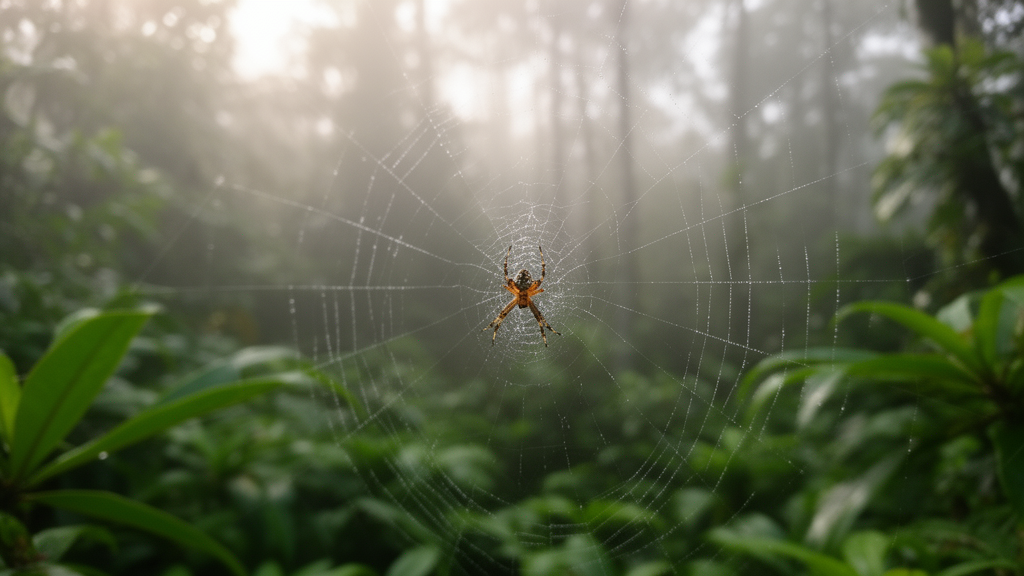
Deep in the rainforests of Maui and Hawaii Island, a group of closely related spiders is quietly rewriting what biologists thought they knew about the speed of evolution. The Hawaiian Tetragnatha spiders, a young lineage that has been diversifying for only about 1.2 million years, have long fascinated researchers because closely related species living side by side on the same island spin orb webs with strikingly different architectures. Now, a team at the University of Akron has shown that the silk itself, not just the shape of the webs, is evolving measurably among these species, providing the first evidence that the raw materials of a biological structure can diversify over such short evolutionary timescales.
The study, published in Frontiers in Arachnid Science, examined the mechanical and chemical properties of silk from four populations of Hawaiian Tetragnatha orb weavers. Led by Angela M. Alicea-Serrano, with Dharamdeep Jain, Ali Dhinojwala, and Todd A. Blackledge, the team collected webs from Tetragnatha stelarobusta, Tetragnatha trituberculata, and Tetragnatha hawaiensis at the Waikamoi Nature Conservancy Preserve on Maui, and from T. hawaiensis at the Upper Waiakea Forest Reserve on Hawaii Island. Because the two populations of T. hawaiensis are assumed to have no gene flow between islands, the researchers treated them as distinct groups, yielding four populations for comparison.
Orb webs are built from two functionally distinct silks. Major ampullate silk forms the outer frame and the radial spokes, absorbing the kinetic energy of flying insects as they strike the web. Flagelliform silk, coated in aggregate glue, forms the adhesive capture spiral that must hold struggling prey long enough for the spider to subdue it. Major ampullate silk is prized for its toughness and energy damping, while flagelliform silk is weaker but extraordinarily extensible, stretching to more than 500 percent of its original length. The glue droplets coating the capture spiral contain glycoproteins and hygroscopic low molecular weight compounds that pull water from the air, tune viscosity, and govern how the droplets spread and deform during detachment.
To test whether these materials had diverged during the radiation, the researchers collected whole webs at night using plastic frames covered in double-sided tape, preserving the natural tension of the threads. Back at the laboratory, radial threads were stretched to failure in a Nano Bionix test system at a controlled strain rate, generating stress-strain curves from which the team calculated tensile strength, extensibility, toughness, and stiffness. Capture spirals were pressed against a clean glass surface at 85 percent relative humidity, mimicking the spiders’ natural habitat, and then pulled away to measure the work and peak force of adhesion. Glue droplet volume, spacing, and glue volume per millimeter of thread were quantified under a polarized light microscope.
The results revealed clear differences among the four populations. Radial silk stiffness differed significantly, with T. stelarobusta producing silk roughly twice as stiff as that of T. hawaiensis from Hawaii Island, at 21.75 gigapascals versus 10.42 gigapascals. Although strength, extensibility, and toughness did not reach statistical significance, they varied nearly twofold among species, with T. trituberculata spinning the strongest, stretchiest, and toughest radial silk at 785.58 megapascals of strength, while T. hawaiensis from the Big Island produced the weakest at 523.85 megapascals. Extensibility, notably, remained essentially unchanged across all populations, suggesting that some properties of the material are more evolutionarily constrained than others.
The adhesive capture spiral told an even more dramatic story. Stickiness varied threefold among the four populations, with T. trituberculata achieving the highest work of adhesion at 0.79 microjoules and a peak force of 170.9 micronewtons, while T. hawaiensis from the Big Island managed only 0.27 microjoules and 77.89 micronewtons. Glue droplet morphology also differed significantly. T. stelarobusta packed the most glue into the largest droplets spaced farthest apart, whereas T. hawaiensis from the Big Island produced the smallest droplets with the least glue volume per millimeter of thread. Because capture thread stickiness depends on how many droplets can simultaneously deform during pull-off, these structural differences in droplet size and spacing directly shape adhesive performance.
To probe the chemistry behind these differences, the team used proton solution-state nuclear magnetic resonance spectroscopy to compare the low molecular weight compounds in the glue of each population. The major components, including betaine, choline, glycine, and alanine, were largely similar across all four Hawaiian populations and closely matched the profile of the mainland species Tetragnatha laboriosa from Ohio. The one conspicuous exception was N-acetyl taurine, a compound clearly present in mainland Tetragnatha glue but absent from the well-resolved spectrum of T. stelarobusta. This finding suggests that the threefold differences in stickiness among the Hawaiian spiders arise not from changes in glue chemistry but from the amount and arrangement of glue droplets on the capture threads.
The absence of N-acetyl taurine in T. stelarobusta hints at something more intriguing. This species primarily preys on moths, which are notoriously difficult for orb weavers to capture because their scales rub off easily and allow them to escape. Other moth-specialist spiders, such as Cyrtarachne and Mastophora, deploy exceptionally large glue droplets and divergent glue chemistry to overcome this defense. The authors speculate that the oversized droplets and missing N-acetyl taurine in T. stelarobusta may represent a convergent set of moth-specialist traits that would be invisible if researchers looked only at web architecture, a possibility that future work with higher-field NMR and mass spectrometry could confirm.
The broader significance of the study lies in its timescale. Major shifts in how spiders capture prey have mostly been documented deep in the spider family tree, over tens of millions of years. The Hawaiian Tetragnatha radiation is young, roughly 1.2 million years old, yet silk properties have already diverged measurably among closely related species sharing the same forests. This parallels the classic adaptive radiations of Caribbean Anolis lizards, African cichlid fishes, and Darwin’s finches, where skeletal and external traits diversify rapidly. What makes this finding remarkable is that it extends that pattern to the internal biomaterials themselves, showing that the molecular machinery of silk production can evolve alongside behavior and web design.
The mechanisms behind this rapid divergence remain open questions. Differences in silk properties could stem from changes in silk gene sequences, shifts in gene expression, or altered spinning conditions such as reeling speed and shear during silk production. The authors acknowledge that their sampling was modest and that field conditions, including dry weather that reduced spider abundance, limited the number of species they could include. Even so, the data provide the first evidence that silk, one of nature’s most celebrated high-performance materials, is not frozen in place over short evolutionary timescales but can be reshaped by natural selection as spiders partition their environment, one droplet and one fiber at a time.
Subject of Research: Diversification of silk mechanical and adhesive properties during the adaptive radiation of Hawaiian Tetragnatha orb-weaving spiders
Article Title: Diversification of spider silk properties in an adaptive radiation of Hawaiian orb-weaving spiders
Article References: Alicea-Serrano, A. M., Jain, D., Dhinojwala, A., & Blackledge, T. A. (2024). Diversification of spider silk properties in an adaptive radiation of Hawaiian orb-weaving spiders. Frontiers in Arachnid Science, 3, Article 1386353. https://doi.org/10.3389/frchs.2024.1386353
Image Credits: AI Generated
DOI: 10.3389/frchs.2024.1386353
Keywords: spider silk, Hawaiian Tetragnatha, adaptive radiation, orb webs, major ampullate silk, capture spiral, aggregate glue, adhesion, NMR spectroscopy, biomaterials, evolution, character displacement
Cite Scienmag News
Matthew Wilson. (October 16, 2026). Hawaiian Spiders Show Silk Materials Evolving Fast Within a Young Adaptive Radiation. Scienmag. https://scienmag.com/hawaiian-spiders-show-silk-materials-evolving-fast-within-a-young-adaptive-radiation/
Matthew Wilson. "Hawaiian Spiders Show Silk Materials Evolving Fast Within a Young Adaptive Radiation." Scienmag, 16 October 2026, https://scienmag.com/hawaiian-spiders-show-silk-materials-evolving-fast-within-a-young-adaptive-radiation/. Accessed 16 October 2026.
Matthew Wilson. "Hawaiian Spiders Show Silk Materials Evolving Fast Within a Young Adaptive Radiation." Scienmag. October 16, 2026. https://scienmag.com/hawaiian-spiders-show-silk-materials-evolving-fast-within-a-young-adaptive-radiation/


