


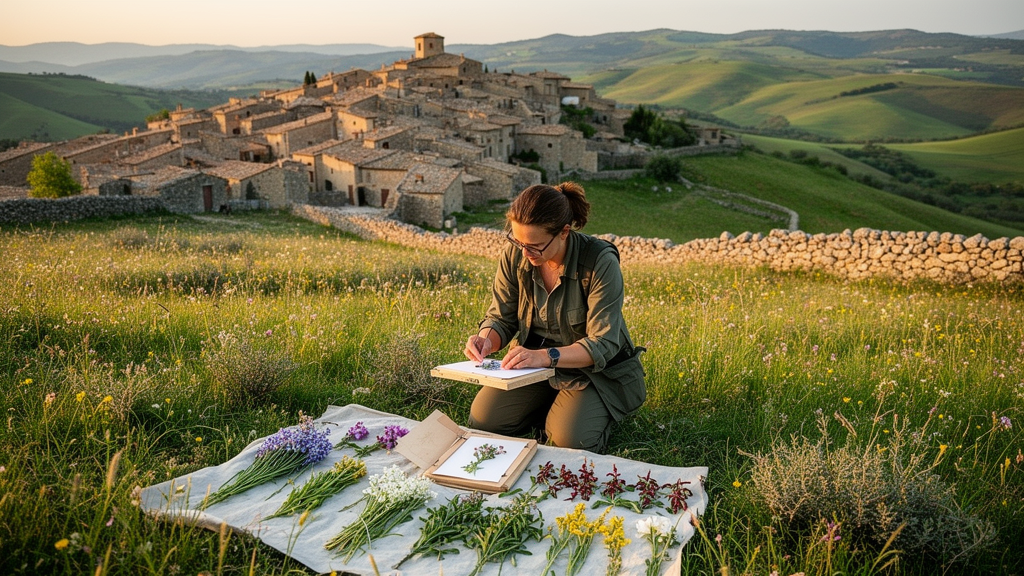
In the lower Crati Valley of northern Calabria, the municipality of Tarsia covers just 48.28 square kilometers of olive groves, vineyards and scattered urban ground, wedged between the Crati River and the shores of an artificial lake created in 1959. For decades, botanists largely looked elsewhere: only 41 floristic records had ever been published for the area, and regional assessments flagged it as a zone of low floristic knowledge. A new inventory, published in Italian Botanist, changes that picture dramatically. Drawing on two decades of fieldwork intensified between 2018 and 2025, together with herbarium material and archival records, researchers documented 618 spontaneous species and subspecies, including 64 alien taxa, plus 35 cultivated plants, belonging to 401 genera and 99 families.
The scale of the effort is best captured by the numbers behind the list. The team assembled 6,821 records for the municipality, more than 95 percent of them based on direct field observations, with the remainder supported by 148 herbarium specimens and 135 photographic records. All field observations were archived in the open-access database Wikiplantbase #Italia, making the dataset freely verifiable and reusable. For the most significant taxa, herbarium specimens were prepared and deposited, and seeds of some species were stored in the seed bank of the Botanic Garden and Museum of the University of Pisa, an insurance policy against local losses.
Two species turned out to be entirely new records for the region of Calabria: Chenopodium ficifolium, a goosefoot of disturbed ground, and Orobanche cernua, a parasitic broomrape. In a country whose flora has been catalogued for centuries, finding regional novelties in a heavily farmed lowland valley underscores how much basic distributional knowledge remains incomplete even in well-studied European territories.
The inventory also carries a conservation warning. Four species documented only by historical herbarium specimens could not be rediscovered and may now be locally extinct, including Visnaga crinita, last seen in the area in 1827 and assessed as Critically Endangered (Possibly Extinct) on the Italian Red List. Euphorbia aleppica, Lotus angustissimus and Trifolium ligusticum likewise await confirmation. In total, 34 taxa recorded in Tarsia appear on the Red List of the Italian Flora: 21 as Least Concern, 8 as Data Deficient, 4 as Near Threatened, one as Vulnerable (Dracunculus vulgaris), one as Endangered (Fritillaria messanensis subsp. messanensis) and the possibly extinct Visnaga crinita.
Among the most significant finds are 17 Italian endemics, species found nowhere else in the world, including Artemisia campestris subsp. variabilis, Crocus biflorus, Daucus broteroi, Euphorbia corallioides, Euphorbia meuselii, Gypsophila arrostoi subsp. arrostoi, Micromeria consentina, Ophrys incubacea subsp. brutia, Ornithogalum exscapum, Salvia haematodes, Silene echinata, Stipa austroitalica, Thalictrum calabricum and Picris scaberrima, the last of which was originally described from the Tarsia area itself. Endemics account for 2.8 percent of the recorded flora, a modest but meaningful share for a landscape dominated by agriculture.
The statistical profile of the flora tells a clear biogeographical story. Mediterranean taxa dominate at 43 percent, followed by widely distributed species at 18.5 percent and Eurosiberian species at 15.5 percent, with about 10 percent spanning both regions. Life-form analysis shows therophytes, short-lived plants that survive unfavorable seasons as seeds, leading at 39.2 percent, followed by hemicryptophytes at 28.6 percent, geophytes at 14.7 percent, phanerophytes at 12.8 percent, chamaephytes at 3.1 percent and hydrophytes at 1.6 percent. The most species-rich families are Asteraceae with 90 taxa, Poaceae with 66 and Fabaceae with 61, while the richest genera are Trifolium with 18 taxa, Euphorbia with 10, Silene with 8, and Ophrys and Plantago with 7 each.
Notably, the established flora falls short of statistical expectations. Using Arrhenius’ species-area relationship, calibrated with coefficients derived from Italy’s floristic richness, the researchers predicted 803 species and subspecies for an area of this size, including 38 aliens. The observed totals of 618 species and 64 aliens represent a 25 percent shortfall for the established flora and an 11 percent shortfall for aliens. The authors attribute this deficit to low environmental variability and a high degree of human disturbance: spontaneous vegetation survives mainly in relict patches between olive groves, vineyards, citrus orchards and roadsides.
Alien species deserve particular scrutiny. Of the 64 non-native taxa, 21 are casual, 25 naturalized and 18 invasive. Among the invasive species, two appear on the list of invasive alien species of Union concern under European Regulation 1143/2014 and its implementing regulations: Ailanthus altissima, the tree of heaven, and Reynoutria japonica, Japanese knotweed, the latter so far known in Tarsia only in cultivation. The most frequently recorded aliens in the field were Erigeron canadensis, Arundo donax, Opuntia ficus-indica, Sorghum halepense and Robinia pseudoacacia, a familiar cast of Mediterranean and global invaders thriving on disturbance.
The most commonly observed native species paint a portrait of the working landscape: Oloptum thomasii with 162 records, Artemisia campestris subsp. variabilis with 155, wild carrot with 140, slender wild oat with 139 and sticky fleabane with 127, alongside oleander, downy oak and giant fennel. The team also noted rarities unusual for Calabria, such as Isoetes durieui, Myosurus minimus and Spirodela polyrhiza, and two coastal-affinity species, Artemisia arborescens and Atriplex halimus, growing on cliffs below the town itself, a reminder that even urban edges can harbor unexpected ecological refuges.
Perhaps the most methodologically interesting output is the Map of Relative Floristic Ignorance, computed from all 10,726 floristic records available for the province of Cosenza using a 1-kilometer grid and a 20-year temporal coefficient. The map assigns each cell an Index of Relative Floristic Ignorance, ranging from blue for well-known areas to red for poorly known ones, and reveals that the cells near the northern and south-western borders of the municipality remain the least explored. Targeted surveys there could push the documented flora closer to its expected richness and refine the conservation picture. For a landscape once dismissed as botanically unremarkable, Tarsia now offers a benchmark: a complete, openly accessible inventory showing what intensive fieldwork can recover from even the most ordinary Mediterranean farmland, and a template for closing the knowledge gaps that still riddle the floristic map of Italy.
Subject of Research: Floristic inventory of the vascular plants of Tarsia, Calabria, southern Italy
Article Title: The vascular flora of Tarsia (Calabria, southern Italy)
Article References: Peruzzi, L. (2026). The vascular flora of Tarsia (Calabria, southern Italy). Italian Botanist, 21, 35-46. https://doi.org/10.3897/italianbotanist.21.184523
Image Credits: AI Generated
DOI: 10.3897/italianbotanist.21.184523
Keywords: floristic inventory, Tarsia, Calabria, vascular flora, Italian endemics, invasive alien species, biodiversity conservation, Mediterranean flora, species-area relationship, Red List, Crati Valley, botanical survey
Cite Scienmag News
Margaret Porter. (October 16, 2026). A Small Italian Municipality Reveals 618 Plant Species After Centuries of Botanical Neglect. Scienmag. https://scienmag.com/a-small-italian-municipality-reveals-618-plant-species-after-centuries-of-botanical-neglect/
Margaret Porter. "A Small Italian Municipality Reveals 618 Plant Species After Centuries of Botanical Neglect." Scienmag, 16 October 2026, https://scienmag.com/a-small-italian-municipality-reveals-618-plant-species-after-centuries-of-botanical-neglect/. Accessed 16 October 2026.
Margaret Porter. "A Small Italian Municipality Reveals 618 Plant Species After Centuries of Botanical Neglect." Scienmag. October 16, 2026. https://scienmag.com/a-small-italian-municipality-reveals-618-plant-species-after-centuries-of-botanical-neglect/


