


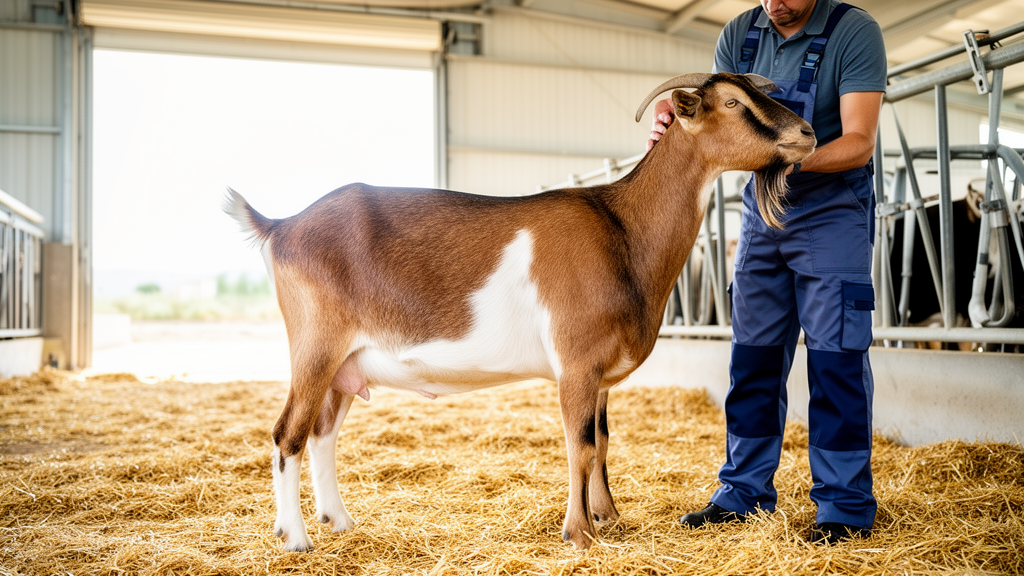
In a finding that could reshape how dairy goat breeders pick their sires, researchers in Spain have shown that the body shape of Murciano-Granadina bucks — the measurements that judges score at linear appraisal — tracks closely with the quality of the semen those animals produce. The study, published in Frontiers in Animal Science, analyzed 1,901 ejaculates from 77 bucks and found that cubic regression models explained up to 72 percent of the variance in ejaculate volume, with chest width and rump width emerging as the strongest morphometric correlates of reproductive output.
The Murciano-Granadina is Spain’s most prominent dairy goat breed, prized for its adaptability to climates ranging from extensive Mediterranean systems to intensive management. Selection within the breed has traditionally relied on the Linear Appraisal System (LAS), a structured framework in which trained evaluators score conformation traits such as stature, chest width, body depth, rump width, rump angle, angularity, bone quality, rear legs, and mobility. In bucks, ten linear traits are scored on a nine-point scale, weighted toward structure and capacity at 50 percent, dairy structure at 20 percent, and legs and feet at 30 percent. What has remained insufficiently explored, the researchers note, is whether these dairy-oriented scores say anything meaningful about male reproductive performance.
To answer that question, the team drew on a decade of routine breeding records collected between January 2010 and December 2019 at official semen collection and genetic evaluation centers in Granada, Spain. From a registry of 6,868 routinely collected ejaculates, 1,901 samples from 77 bucks with complete LAS data were included in the analysis. The sample was nearly balanced by age — 53.25 percent of bucks were two years old or younger, and 46.75 percent were older — allowing age-stratified inference. Ten morphometric traits were evaluated alongside six semen parameters: ejaculate volume, sperm concentration, total motility, progressive motility, acrosome integrity, and endosmosis resistance, the latter assessed by the hypo-osmotic swelling test that infers plasma membrane functionality from tail coiling.
The methodological centerpiece was the fitting of cubic regression models independently for each buck, treating the resulting coefficients — intercept, linear, quadratic, and cubic terms — as derived phenotypic descriptors of each animal’s seminal trajectory. The intercept captures baseline semen quality, the linear term reflects the initial directional trend with age, the quadratic coefficient accounts for acceleration or plateauing, and the cubic term introduces inflection points that represent complex, asymmetric temporal patterns. Multicollinearity diagnostics confirmed independence among explanatory variables, with all variance inflation factors below 5. Model selection followed an information-theoretic framework using the Akaike Information Criterion corrected for small samples, the Bayesian Information Criterion, and a combined index that ranked candidates on curve-fitting success, residual sum of squares, cross-validated prediction error, adjusted R-squared, and overfitting resistance. The cubic polynomial consistently achieved the highest combined index scores across seminal quality parameters.
The results were striking. Cubic regression models explained up to 72 percent of the variance in ejaculate volume, which showed strong positive correlations with chest width (r = 0.61, p < 0.01) and rump width (r = 0.58, p < 0.01). Sperm concentration was positively associated with stature (r = 0.55, p < 0.05) and chest width (r = 0.49, p < 0.05). Motility parameters exhibited dynamic patterns, with progressive motility primarily explained by quadratic effects and total motility by cubic trends, particularly influenced by chest width and rump depth (r = 0.46 to 0.52, p < 0.05). Acrosome integrity showed strong baseline and cubic effects, while endosmosis followed a predominantly linear trend (R-squared = 0.41), consistent with a progressive, age-driven decline in sperm membrane integrity rather than a curvilinear pattern.
Regularized generalized canonical correlation analysis was then used to explore multivariate associations between the LAS-derived morphometric traits and the seminal quality curve parameters. The first canonical function explained on average 50.7 percent of the variance, and the first two functions together accounted for 83.5 percent, indicating that most of the morphology–semen signal is concentrated in the first two dimensions. Pillai’s trace indicated a statistically significant multivariate effect (V = 3.63, p = 0.031). The highest canonical loadings were observed for total motility (0.653), acrosome integrity (0.628), endosmosis (0.699), and real doses (0.565), suggesting these traits drive most of the shared variance between variable sets. Redundancy coefficients remained modest, however, meaning the morphometric variables explain only a fraction of the overall variability in semen quality — a situation the authors describe as expected in complex biological systems where multiple partially independent processes contribute to phenotypic variation.
The correlation structure itself revealed biologically interpretable patterns. Body size traits — stature, chest width, body depth, and rump width — formed a cohesive block of positive correlations, with values ranging from 0.504 to 0.833, reflecting coherent growth and proportionality. Bone quality clustered with pelvic traits and aligned positively with mobility, while angularity showed a strong negative correlation with mobility (r = –0.456), suggesting a trade-off between angular conformation and sperm motility. For ejaculate volume, the cubic term showed consistent positive correlations with linear size measures, indicating that nonlinear curvature in volume dynamics is more pronounced in larger animals. Sperm concentration trajectories aligned with larger thoracic development and angular conformation, while acrosome integrity was strongly influenced by quadratic terms that were consistently negative with size but positive with bone quality, implying that skeletal robustness may mitigate curvature associated with abnormalities.
The researchers also found that how semen variables are processed matters. Processed semen traits such as total estimated volume and total doses showed weaker associations with morphology, reflecting their technical derivation rather than biological origin. Total estimated volume exhibited a homogenization effect that obscured slope and trend dynamics, whereas total real added volume — the real doses — preserved variability and was therefore more informative. This distinction suggests that breeding programs relying on processed semen metrics may inadvertently discard biologically meaningful differences that raw measurements retain.
The study was conducted under highly standardized conditions designed to minimize confounding. All bucks were housed at official breeding, semen collection, and genetic evaluation facilities operating under the same regulatory framework and quality assurance system established by CAPRIGRAN, the entity legally recognized by the Spanish Ministry of Agriculture for managing the breed’s herdbook and genetic improvement program. When animals were transferred between facilities in 2014, standardized operating procedures for semen collection, processing, storage, and laboratory assessment were maintained without interruption, ensuring methodological continuity. The daily diet consisted of 0.5 kilograms of commercial concentrate per animal with unrestricted hay access, and fresh water and mineral blocks were provided ad libitum. The environment — a continental Mediterranean climate in the Vega de Granada with daily thermal oscillations often exceeding 20 degrees Celsius — introduced natural variability that the authors acknowledge may influence reproductive physiology.
The authors caution that the observed associations, while consistent and biologically meaningful, carry moderate effect sizes and should be interpreted as exploratory and hypothesis-generating rather than predictive. Hormonal concentrations were not measured, and morphometric traits were not repeatedly assessed within defined rutting cycles, so the dynamics are interpreted strictly as age-related variation rather than endocrine or seasonal mechanisms. Nevertheless, the findings highlight the potential of integrating morphometric evaluation with reproductive assessment to enhance both dairy and reproductive performance in Murciano-Granadina goats. Incorporating reproductive indicators into LAS-based selection frameworks, the researchers argue, could improve breeding efficiency and genetic progress — a proposition that, if validated by future studies incorporating endocrine and seasonal variables, would move sire selection in dairy goats beyond static visual appraisal toward a dynamic, functionally informed science.
Subject of Research: Animal Science
Article Title: From cubic semen profiles to body form: linking seminal dynamics with LAS-derived zoometrics in Murciano-Granadina bucks
Article References: Peláez Caro, M. P., Arando Arbulu, A., Delgado Bermejo, J. V., León Jurado, J. M., Fernández Álvarez, J., & Navas González, F. J. (2026). From cubic semen profiles to body form: linking seminal dynamics with LAS-derived zoometrics in Murciano-Granadina bucks. Frontiers in Animal Science, 7, Article 1738803. https://doi.org/10.3389/fanim.2026.1738803
Image Credits: AI Generated
DOI: 10.3389/fanim.2026.1738803
Keywords: Murciano-Granadina goats, semen quality, linear appraisal, morphometrics, cubic regression, dairy goat breeding, reproductive efficiency, animal science, cubic, semen, profiles, body
Cite Scienmag News
Drew Townsend. (October 16, 2026). Chest Width and Rump Shape Predict Semen Quality in Murciano-Granadina Bucks, Study Finds. Scienmag. https://scienmag.com/chest-width-and-rump-shape-predict-semen-quality-in-murciano-granadina-bucks-study-finds/
Drew Townsend. "Chest Width and Rump Shape Predict Semen Quality in Murciano-Granadina Bucks, Study Finds." Scienmag, 16 October 2026, https://scienmag.com/chest-width-and-rump-shape-predict-semen-quality-in-murciano-granadina-bucks-study-finds/. Accessed 16 October 2026.
Drew Townsend. "Chest Width and Rump Shape Predict Semen Quality in Murciano-Granadina Bucks, Study Finds." Scienmag. October 16, 2026. https://scienmag.com/chest-width-and-rump-shape-predict-semen-quality-in-murciano-granadina-bucks-study-finds/


