


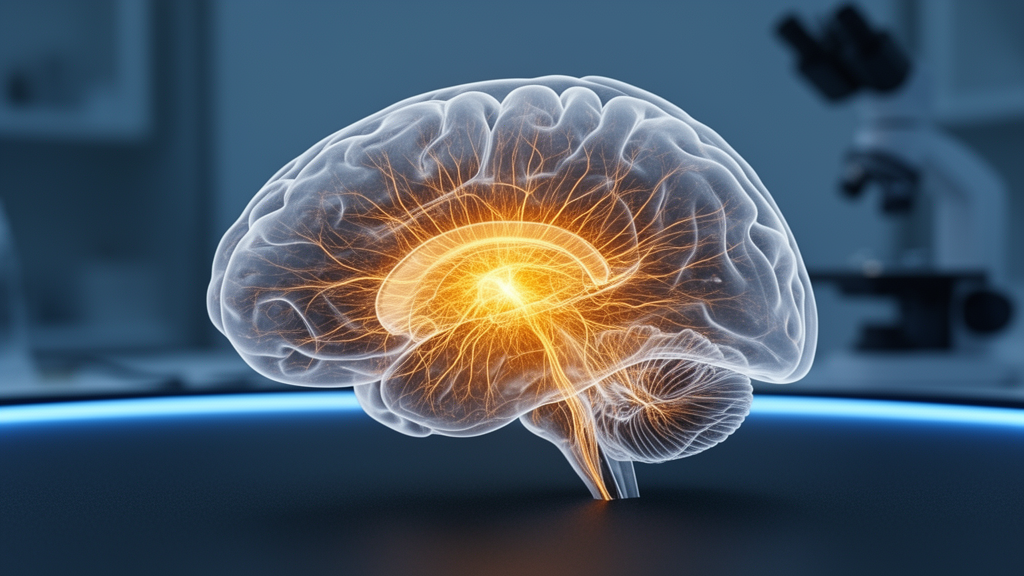
Deep in the center of the mammalian brain, a small, pencil-shaped structure called the nucleus reuniens has long been suspected of serving as a telephone exchange between two of the brain’s most important memory centers: the hippocampus and the prefrontal cortex. A new study in rats, published in Frontiers in Behavioral Neuroscience, now shows that during spatial learning this tiny thalamic nucleus behaves less like a passive switchboard and more like an active participant, selectively strengthening its reception of hippocampal signals while its dialogue with the prefrontal cortex actually fades as navigation becomes efficient.
The research, conducted by Tristan Baumann and Oxana Eschenko at the Max Planck Institute for Biological Cybernetics in Tübingen, Germany, tackled a long-standing puzzle in systems neuroscience. The hippocampus and prefrontal cortex cooperate closely during spatial navigation, spatial working memory, and memory consolidation, yet their direct anatomical wiring is strikingly asymmetric. The prefrontal cortex sends substantial projections into the hippocampal formation, but the hippocampus receives only limited direct input from the prefrontal cortex. This imbalance has led scientists to ask how bidirectional communication between the two regions is achieved, and which intermediary structures carry the traffic.
The nucleus reuniens, a midline nucleus of the thalamus, is anatomically well positioned to fill this role. It receives input from the deep layers of the prelimbic and infralimbic cortices, projects back to both superficial and deep cortical layers, and is densely innervated by the ventral hippocampus and subiculum, from which it projects to the distal dendritic layer of ventral CA1. Some reuniens neurons even send branching axons, or collaterals, to both the hippocampus and the prefrontal cortex, providing a plausible substrate for simultaneously modulating both regions. Decades of lesion and inactivation studies have shown that disrupting the reuniens impairs spatial working memory, memory consolidation, and memory retrieval, while leaving tasks that depend on the hippocampus or prefrontal cortex alone largely intact, suggesting it is specifically required when the two regions must coordinate.
What remained unclear was whether the reuniens acts as a passive relay, simply forwarding signals between hippocampus and cortex, or as an active integrator that transforms information. The two hypotheses make different predictions. If the nucleus were a simple relay, learning-related changes should propagate symmetrically across both the hippocampus-to-reuniens and reuniens-to-prefrontal pathways. An active integrator, by contrast, would show asymmetric directional coupling, pathway-selective modulation, and dynamics that depend on behavioral state. To distinguish these possibilities, the researchers recorded local field potentials simultaneously from the deep layers of the prelimbic cortex, from CA1 of the dorsal hippocampus, and from the nucleus reuniens itself while six adult male rats learned to navigate a complex elevated maze across seven days.
The maze was deliberately demanding. Built as a crossword-like lattice with multiple intersections and dead ends, it offered two starting points equidistant from a single reward port, with salient visual cues providing an allocentric reference frame. The optimal path required six navigational decisions from one start and four from the other, and training was capped at seven sessions of ten trials each to minimize reliance on procedural memory. All rats located the reward within the first one or two sessions, and performance improved steadily across days, with trial duration, running velocity, and navigation errors all showing strong learning effects. The researchers then analyzed 364 artifact-free trials using spectral power, coherence, and Granger causality measures, embedding each in linear mixed-effects models that controlled for running speed, since locomotion is known to modulate neural oscillations.
The first surprise came from the theta band, the 6 to 11 Hz rhythm long considered the workhorse of hippocampal-prefrontal communication. As expected, velocity strongly predicted theta power in the hippocampus and, more weakly, in the reuniens, but not in the prefrontal cortex. Yet after statistically removing the contribution of speed, theta power decreased across learning in all three regions, even though the animals ran faster as they improved. In other words, the rats’ brains became less theta-dominant precisely as their navigation became more skilled, a dissociation the authors interpret as evidence that local network dynamics reorganize with learning independently of changes in movement.
The beta band, roughly 15 to 30 Hz, told an even more intriguing story. Both the hippocampus and reuniens displayed a narrow peak around 16 to 16.5 Hz, which the authors acknowledge could partly be a harmonic, an integer multiple, of the dominant theta rhythm produced by Fourier decomposition of non-sinusoidal signals. But the two regions’ beta signals behaved differently: reuniens beta declined across learning in parallel with theta, whereas hippocampal beta showed a transient increase early in training that dissociated it from theta dynamics. Cross-regional coherence added a further twist. Beta synchrony between hippocampus and reuniens, and between hippocampus and prefrontal cortex, increased with learning, while beta synchrony between reuniens and prefrontal cortex decreased. Control analyses using the volume-conduction-resistant weighted phase-lag index confirmed that these couplings reflected genuine interactions rather than electrical field spread across tissue.
The decisive evidence came from Granger causality, a technique that estimates the direction of information flow between simultaneously recorded signals. Learning selectively strengthened the flow of information from hippocampus to reuniens in the theta, beta, and low-gamma bands, while influences in the opposite direction, from reuniens back to hippocampus, decreased. Direct hippocampal-prefrontal interactions, by contrast, remained comparatively stable throughout learning, with hippocampus-to-prefrontal theta flow driven mainly by running speed rather than by task mastery. Because Granger causality estimates can be inflated by differences in oscillatory power between regions, the authors also computed time-reversed Granger causality, a control that preserves relative power but reverses directionality. The learning-related increase in hippocampus-to-reuniens flow survived this test, confirming that spatial learning genuinely boosted hippocampal influence on the thalamic nucleus rather than merely reflecting the hippocampus’s stronger theta signal.
Taken together, the findings paint a picture of dynamic network reconfiguration driven primarily by the hippocampal, not prefrontal, side of the circuit. The authors propose that theta synchrony may provide a stable communication scaffold linking the three regions, while beta and gamma interactions carry task-specific demands and learning processes. The early rise in hippocampus-to-reuniens beta coupling coincides with the phase of training when behavior is changing most rapidly, consistent with recent proposals that reuniens beta synchrony acts as a neurobiological memory buffer holding task-relevant information during navigation. Meanwhile, the decline in prefrontal-reuniens beta coherence, alongside a transient increase in prefrontal-to-reuniens low-gamma flow, may reflect a shift from novelty-driven prefrontal engagement toward more hippocampus-dominated interactions as spatial representations consolidate.
The authors caution that several questions remain open. Disentangling velocity from learning is inherently difficult when running speed rises with performance, and field-potential connectivity cannot by itself distinguish genuine cross-regional interactions from shared inputs from a third region, nor reveal what information the reuniens neurons actually encode. Pathway-specific causal manipulations will be needed to pin down the cellular mechanisms. Nevertheless, the directional asymmetry the study uncovered, with hippocampal influence on the reuniens strengthening while reuniens output to cortex weakened or held steady, is difficult to reconcile with any simple relay account. Instead, the nucleus reuniens emerges as an active node that receives, transforms, and likely redistributes hippocampal input across its extensive connectivity, a conclusion that reshapes how neuroscientists think about the thalamic contribution to spatial cognition and memory.
Subject of Research: How spatial learning reconfigures information flow within the hippocampus–nucleus reuniens–prefrontal cortex circuit in rats
Article Title: Spatial learning strengthens hippocampal but not prefrontal influence on nucleus reuniens in rats
Article References: Baumann, T., & Eschenko, O. (2026). Spatial learning strengthens hippocampal but not prefrontal influence on nucleus reuniens in rats. Frontiers in Behavioral Neuroscience, 20, Article 1939794. https://doi.org/10.3389/fnbeh.2026.1939794
Image Credits: AI Generated
DOI: 10.3389/fnbeh.2026.1939794
Keywords: nucleus reuniens, hippocampus, prefrontal cortex, spatial learning, theta oscillations, beta oscillations, Granger causality, local field potentials, thalamus, spatial navigation, neural oscillations, memory
Cite Scienmag News
Cassandra Pierce. (October 16, 2026). Rat Study Reveals the Thalamic Nucleus Reuniens as an Active Hub in Spatial Learning. Scienmag. https://scienmag.com/rat-study-reveals-the-thalamic-nucleus-reuniens-as-an-active-hub-in-spatial-learning/
Cassandra Pierce. "Rat Study Reveals the Thalamic Nucleus Reuniens as an Active Hub in Spatial Learning." Scienmag, 16 October 2026, https://scienmag.com/rat-study-reveals-the-thalamic-nucleus-reuniens-as-an-active-hub-in-spatial-learning/. Accessed 16 October 2026.
Cassandra Pierce. "Rat Study Reveals the Thalamic Nucleus Reuniens as an Active Hub in Spatial Learning." Scienmag. October 16, 2026. https://scienmag.com/rat-study-reveals-the-thalamic-nucleus-reuniens-as-an-active-hub-in-spatial-learning/


