


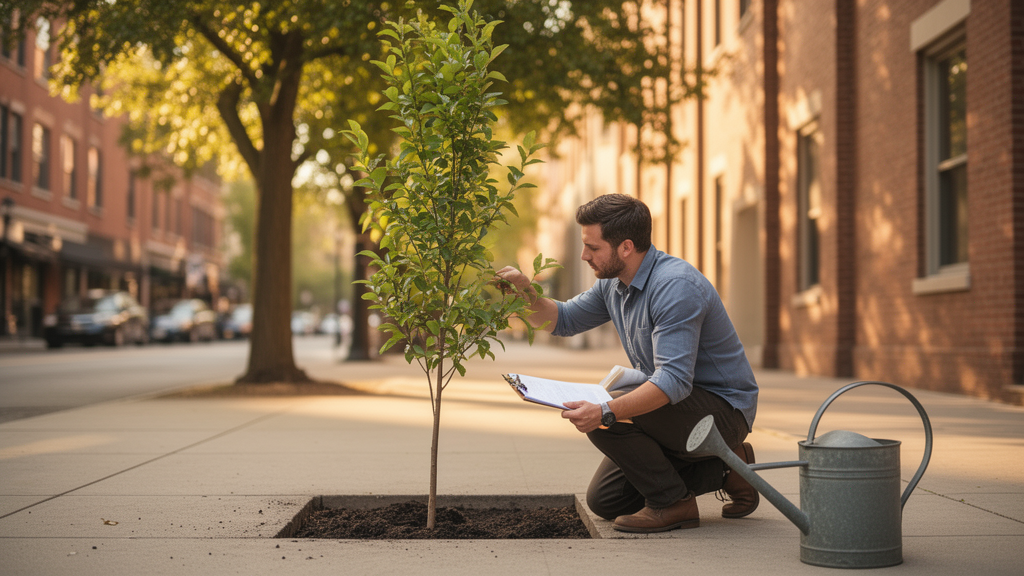
Cities around the world have embraced ambitious tree canopy targets as a visible, measurable way to fight urban heat, air pollution, biodiversity loss, and stormwater runoff. The logic seems simple: more canopy means more cooling, cleaner air, and greener neighborhoods. But a new opinion article published in Frontiers in Sustainable Cities argues that this obsession with canopy quantity may be quietly undermining the very goals urban forestry is meant to achieve. Researchers Kamlesh Verma, Rajiv Pandey, and Prashant Sharma propose a performance- and risk-aware framework for urban tree species selection that shifts the focus from how many trees a city plants to how well those trees actually perform over decades.
The core problem, the authors explain, is that canopy cover is fundamentally a quantitative measure. It tells planners nothing about whether trees survive, whether they deliver the intended ecosystem functions under changing climatic conditions, or whether they generate sustained net benefits for residents. A city can hit a 30 percent canopy target on paper while its urban forest quietly succumbs to drought, pests, infrastructure conflicts, and allergenic pollen storms. Canopy expansion alone does not ensure appropriate species composition or adaptation to local environmental conditions, and the authors contend that the next frontier of urban forestry must be a transition from canopy quantity to urban forest performance.
The framework rests on three propositions for new urban forestry. First, urban greening should progress from quantifying canopy to qualitatively assessing canopy with long-term performance in mind. Second, selecting suitable individual trees does not necessarily produce a resilient urban forest, because repeatedly choosing locally optimal species can promote taxonomic and functional homogenization at the city scale. Third, tree selection should be embedded within an adaptive management process that continuously monitors performance and emerging risks. The authors emphasize that their contribution is not the individual consideration of these established concepts, which are well recognized in the literature, but their integration into an explicit sequential and adaptive decision process.
At the heart of the framework are five interconnected dimensions: space, traits, function, risk, and time. Site conditions constrain the candidate pool of species. Traits inform expected performance. Functions establish the priorities a planting is meant to achieve. Risks filter out unsuitable alternatives. City-scale diversity and shared vulnerability modify site-level choices. And monitoring feeds information back into management, replacement decisions, and future species selection. The framework distinguishes sharply between exclusionary criteria and comparative preferences. Fundamental site incompatibility, severe infrastructure conflicts, unacceptable health or safety risks, and unsuitable water requirements may exclude candidates outright. Among the feasible survivors, traits, expected ecosystem functions, maintenance requirements, and contributions to diversity are compared according to local conditions and management objectives rather than a universal weighting scheme.
The distinction between traits, functions, and risks is more than semantic, and it is where the framework reveals its technical sophistication. Pollution tolerance, for example, is a species attribute, whereas pollution removal and air quality improvement are intended ecosystem functions influenced by traits such as leaf area and physiological characteristics. Allergenicity and biogenic volatile organic compound emissions are species attributes whose significance as disservices or risks depends on abundance, environmental conditions, atmospheric interactions, and the exposure of susceptible populations. A high-BVOC-emitting species may be harmless in one atmospheric context yet contribute to ozone formation in another. This context-dependence is precisely what simple suitability lists fail to capture.
The framework also operates across three nested decision contexts. The site is the immediate planting location, with its environmental and physical constraints including rooting space, soil, microclimate, water availability, and infrastructure. The land-use context is the broader setting in which planting objectives and environmental conditions influence selection, encompassing streets, healthcare facilities, residential areas, schools, and parks. The city context refers to the cumulative urban tree portfolio, where species composition, functional diversity, and shared vulnerability are considered across all planting decisions. Site-level choices contribute to land-use assemblages and, cumulatively, to the city-wide portfolio, while information on existing diversity and vulnerability can guide subsequent site-level selection. A species that performs brilliantly at an individual site may therefore be deprioritized when repeated use would increase city-scale vulnerability, provided suitable alternatives exist.
The authors illustrate the sequence with a hypothetical scenario that captures the framework’s counterintuitive logic. Consider drought-prone urban streets with restricted rooting space, where thermal comfort is the priority. Tree-A has high drought tolerance and strong cooling potential but is already widely planted across the city. Tree-B has adequate drought tolerance, lower infrastructure conflict potential, and a distinct functional profile. Although Tree-A performs well at the site scale, Tree-B is preferred because it meets the site requirements while reducing city-scale concentration. After planting, survival, growth, health, and emerging risks are monitored, and poor performance or unacceptable risks can trigger management adjustments or species replacement, feeding directly into subsequent planting decisions.
Uncertainty about future climate, pest pressure, and species performance is treated as a central design constraint rather than an afterthought. The authors argue that selection should consider tolerance across plausible environmental conditions rather than a single expected future state. This climate-ready approach acknowledges that a species thriving today may falter under the hotter, drier, or more pest-ridden conditions of mid-century. Monitoring survival, growth, health, and emerging risks can inform management adjustments and species replacement, making the urban forest a living experiment that is continuously recalibrated rather than a one-time installation.
Importantly, the framework is conceptual rather than a fully operational decision-support model. Implementation would require locally appropriate species and performance data, quantitative thresholds for exclusion and trade-offs, and context-specific information on site conditions, exposure, and city-scale species composition. These parameters cannot be prescribed universally because they depend on local conditions and management objectives. The authors also stress that the framework should complement, rather than substitute, the retention and protection of existing mature trees and the effective long-term management of urban forests, noting that remote sensing offers promising avenues for measuring performance at scale.
The broader message is a challenge to the planting-campaign culture that has swept through cities from Los Angeles to Beijing. Ambitious targets are attractive policy instruments because they are measurable, reportable, verifiable, and easily communicated, but they can create perverse incentives where numbers matter more than outcomes. By linking individual planting choices to land-use priorities, city-scale diversity and vulnerability, and long-term adaptive performance, the performance- and risk-aware framework offers urban planners a way to build forests that do not merely exist on satellite imagery but genuinely deliver cooling, clean air, and resilience for generations. As climate change tightens its grip on cities, the difference between a canopy that survives and one that thrives may come down to exactly this kind of systematic, humble, and adaptive thinking about which tree goes where, and why.
Subject of Research: A framework for performance- and risk-aware urban tree species selection in cities
Article Title: Beyond canopy targets: a performance- and risk-aware framework for urban tree species selection
Article References: Verma, K., Pandey, R., & Sharma, P. (2026). Beyond canopy targets: a performance- and risk-aware framework for urban tree species selection. Frontiers in Sustainable Cities, 8, Article 1861981. https://doi.org/10.3389/frsc.2026.1861981
Image Credits: AI Generated
DOI: 10.3389/frsc.2026.1861981
Keywords: urban forestry, tree canopy targets, species selection, ecosystem services, adaptive management, functional diversity, climate resilience, urban heat, ecosystem disservices, biodiversity, risk assessment, sustainable cities
Cite Scienmag News
Gavin Prescott. (October 16, 2026). Why Planting More Trees Is Not Enough: A New Framework Rethinks Urban Tree Selection. Scienmag. https://scienmag.com/why-planting-more-trees-is-not-enough-a-new-framework-rethinks-urban-tree-selection/
Gavin Prescott. "Why Planting More Trees Is Not Enough: A New Framework Rethinks Urban Tree Selection." Scienmag, 16 October 2026, https://scienmag.com/why-planting-more-trees-is-not-enough-a-new-framework-rethinks-urban-tree-selection/. Accessed 16 October 2026.
Gavin Prescott. "Why Planting More Trees Is Not Enough: A New Framework Rethinks Urban Tree Selection." Scienmag. October 16, 2026. https://scienmag.com/why-planting-more-trees-is-not-enough-a-new-framework-rethinks-urban-tree-selection/


