


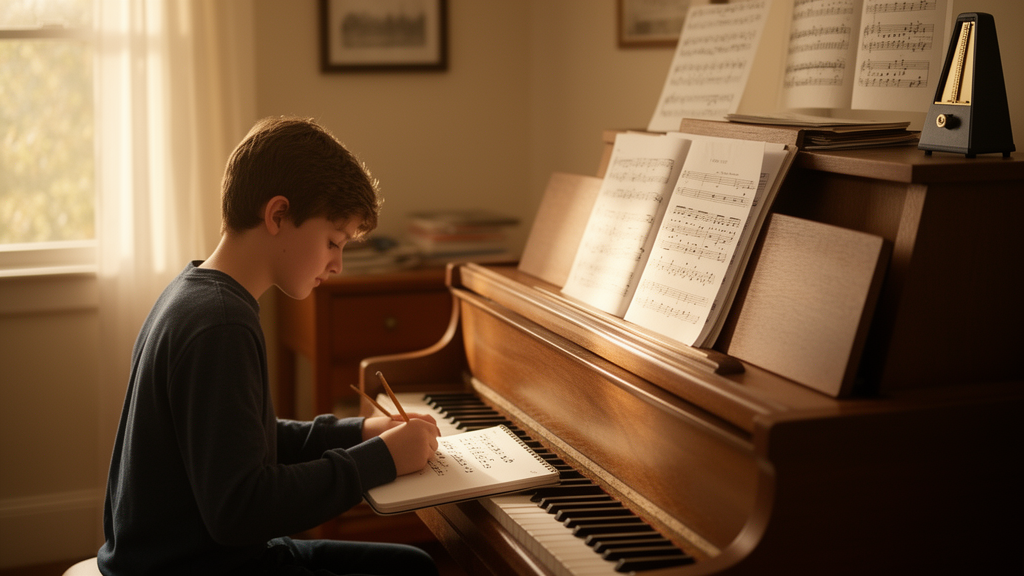
What makes a teenage piano student capable of writing music rather than merely reproducing it? A new study published in Frontiers in Psychology suggests that the answer may lie less in the number of composition exercises a teacher assigns and more in how those exercises are designed—specifically, whether students are given genuine decision-making power over their musical material and whether they are guided to scrutinize and explain their own creative choices.
The research, conducted by Xiaodong Yan of the Conservatory of Music at Northwest Normal University in Lanzhou, China, surveyed 723 piano teachers with experience teaching adolescents. Using a cross-sectional questionnaire distributed through music education institutions, professional teacher communities, and school networks across Gansu, Northwest China, and beyond, the study examined how two distinct teaching approaches—constructivist practices and reflective guidance—relate to teachers’ evaluations of their students’ piano composition skills. The statistical analysis employed multivariate regression and Bootstrap resampling with 5,000 iterations to test direct and indirect pathways between teaching practices, student psychology, and creative output.
Constructivist practices, rooted in the learning theory associated with Vygotsky’s sociocultural framework, refer to classroom conditions in which students actively choose composition themes, styles, and expressive methods while applying music theory knowledge to concrete problems. Rather than transmitting fixed content, the teacher acts as a designer of tasks and a provider of scaffolding—posing questions, offering feedback, and gradually releasing responsibility as the learner demonstrates capability. Reflective guidance, by contrast, centers on the metacognitive dimension of composition: prompting students to explain why they handled a harmony or texture in a particular way, compare alternative versions of a work, and participate in peer assessment. The study framed these as complementary but distinct dimensions—one concerning the learning context and autonomy, the other concerning process scrutiny and revision.
The results showed that both teaching dimensions were significantly and positively associated with teacher-evaluated composition skills, which were measured across five indicators: fluency and novelty of musical ideas, melodic and harmonic organization, structural coherence, revision ability, and expressive completeness. After controlling for teaching setting, years of experience, education level, composition teaching frequency, and students’ primary learning purpose, constructivist practices showed a standardized coefficient of 0.210 and reflective guidance 0.177 in predicting composition skill ratings. The full models explained 27.3 percent of variance in creative self-efficacy, 23.2 percent in intrinsic motivation, and 37.8 percent in composition skills.
Crucially, the study identified two psychological variables that operated as parallel indirect pathways linking teaching practices to skill outcomes. Creative self-efficacy—students’ belief in their own capacity to generate and complete original musical ideas—drew on Bandura’s self-efficacy theory and Tierney and Farmer’s construct of creative self-efficacy. Intrinsic motivation for composition, grounded in self-determination theory, captured students’ tendency to engage in composition out of interest rather than external pressure. Both variables showed significant indirect effects: for constructivist practices, the combined indirect effect through these two channels was 0.124, and for reflective guidance it was 0.102, with all 95 percent confidence intervals excluding zero. Notably, direct effects remained significant even after accounting for these indirect pathways, suggesting that teaching practices and psychological states each carry independent explanatory weight.
One of the more provocative findings concerned the role of learning purpose. Teachers reported that students primarily oriented toward grading tests or competitions scored significantly lower than hobby-oriented students on every core construct measured—including constructivist practices, reflective guidance, creative self-efficacy, intrinsic motivation, and composition skills. The mean differences ranged from 0.18 to 0.24 on a five-point scale, all statistically significant after Bonferroni correction. The author cautions against reading this as a simple indictment of examination culture, noting instead that when prescribed repertoire and performance accuracy dominate curriculum planning, opportunities for experimentation, multi-scheme comparison, and revision may be structurally squeezed out of the lesson.
Perhaps the most counterintuitive result was the failure of the frequency hypothesis. The study predicted that the positive association between constructivist practices and intrinsic motivation would strengthen as composition teaching became more frequent, reasoning that regular exposure to open tasks would provide stable carriers for autonomous choice. The data did not support this. The interaction term between teaching frequency and constructivist practices was not statistically significant, and the conditional slopes actually ran in the opposite direction to that predicted—0.361 at lower frequency versus 0.271 at higher frequency—though this difference did not reach significance. The author interprets this as evidence that sheer activity count cannot substitute for task openness, feedback quality, or depth of reflection. A teacher who schedules composition weekly but prescribes every harmonic move may foster less intrinsic engagement than one who assigns composition monthly but genuinely hands over creative decisions.
The study is not without limitations, and the author is explicit about them. All data derive from teacher self-reports, meaning that psychological states such as self-efficacy and motivation were inferred by teachers for their student groups as a whole rather than measured at the individual student level. This raises the possibility of halo effects, in which teachers who perceive themselves as autonomy-supportive may also be more inclined to rate their students as motivated and creative. Statistical diagnostics—including Harman’s single-factor test and an unmeasured latent method construct in confirmatory factor analysis—suggested that common method variance did not dominate the results, but the cross-sectional design precludes any causal inference. The author also notes that the average variance extracted for three of the five constructs fell slightly below the conventional 0.50 threshold, indicating room for improvement in the contextualized measurement scales.
For practitioners, the study offers a concrete reframing of priorities. Rather than maximizing the number of improvisation or composition sessions in a curriculum, the findings point toward improving the design quality of open and reflective tasks. The author suggests that teachers can embed composition within existing technical training—asking students to continue a motif from a prescribed piece, substitute harmonies, or reconstruct textures—thereby integrating creative work with repertoire study rather than treating it as a separate activity. Feedback, the study suggests, should distinguish between the current state of a draft and the student’s underlying capability, avoiding premature single-answer corrections that foreclose the comparison of alternatives. Reflection, whether through recorded listening, composition logs, or peer discussion, is most productive when it targets specific relationships between musical materials and expressive intent rather than generic quality judgments.
As adolescent piano education continues to grapple with the tension between technical mastery and creative development, this study contributes a quantified, theory-grounded map of how teaching practices, psychological states, and creative outcomes may covary. Its central message—that the architecture of autonomy and reflection within a lesson may matter more than the raw frequency of creative activity—offers a testable proposition for future longitudinal and multi-source research, and a practical prompt for teachers reconsidering how composition fits into the studio.
Subject of Research: Associations between constructivist teaching practices, reflective guidance, student psychology, and adolescent piano composition skills
Article Title: Teaching and psychological associations of adolescent piano composition skills: a study on constructivist practices and reflective guidance based on teacher reports
Article References: Yan, X. (2026). Teaching and psychological associations of adolescent piano composition skills: a study on constructivist practices and reflective guidance based on teacher reports. Frontiers in Psychology, 17, Article 1963250. https://doi.org/10.3389/fpsyg.2026.1963250
Image Credits: AI Generated
DOI: 10.3389/fpsyg.2026.1963250
Keywords: piano education, adolescent creativity, constructivist teaching, reflective guidance, creative self-efficacy, intrinsic motivation, music composition, self-determination theory, teacher reports, educational psychology, music pedagogy, Frontiers in Psychology
Cite Scienmag News
Glenn Wilkins. (October 16, 2026). When Piano Students Compose: Autonomy and Reflection in the Studio May Shape Teenage Musical Creativity. Scienmag. https://scienmag.com/when-piano-students-compose-autonomy-and-reflection-in-the-studio-may-shape-teenage-musical-creativity/
Glenn Wilkins. "When Piano Students Compose: Autonomy and Reflection in the Studio May Shape Teenage Musical Creativity." Scienmag, 16 October 2026, https://scienmag.com/when-piano-students-compose-autonomy-and-reflection-in-the-studio-may-shape-teenage-musical-creativity/. Accessed 16 October 2026.
Glenn Wilkins. "When Piano Students Compose: Autonomy and Reflection in the Studio May Shape Teenage Musical Creativity." Scienmag. October 16, 2026. https://scienmag.com/when-piano-students-compose-autonomy-and-reflection-in-the-studio-may-shape-teenage-musical-creativity/


