

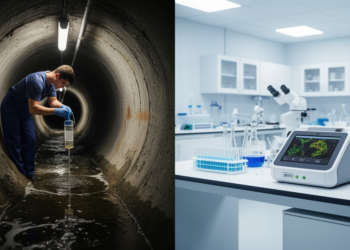
Wastewater DNA mapping improves corrosion-risk screening in sewer network
A residential-network study found that wastewater bacterial DNA, ecological modeling and machine learning improved screening for severely corroded sewer pipes.
A residential-network study found that wastewater bacterial DNA, ecological modeling and machine learning improved screening for severely corroded sewer pipes.

A new study reveals that treated wastewater from the Samokov plant leaves measurable chemical and microbial signatures in the upper ...
A new review warns that nano-enabled water treatment systems generate their own pollution—secondary nanowaste—whose environmental fate, toxicity, and monitoring remain ...
Researchers report that a magnesium-substituted zinc aluminate spinel prepared by a simple urea-assisted gel route removes 76 percent of tetracycline ...
Deep in the rubber-producing heartland of southern India, small factories churn out slabs of processed latex every day, and the ...
The choice of barley as the test crop for this study is not incidental. Brazil has been expanding its barley ...
A comprehensive source investigation reveals the Colorado River supplies 65 percent of PFAS loading to Lake Mead, while domestic wastewater—driven ...
Moroccan researchers built a layered soil filter from date palm waste, charcoal, and iron scraps that removed over 97 percent ...
Researchers in Germany have characterized a carbapenem-resistant Citrobacter braakii strain from hospital sewage and a lytic Kayfunavirus phage from the ...
Researchers in Türkiye have isolated and fully characterized a lytic bacteriophage, KBU_SV1, that kills carbapenem-resistant E. coli, disrupts biofilms and ...

Embark on a thrilling journey of discovery with Scienmag.com—your ultimate source for cutting-edge breakthroughs. Immerse yourself in a world where curiosity knows no limits and tomorrow’s possibilities become today’s reality!