


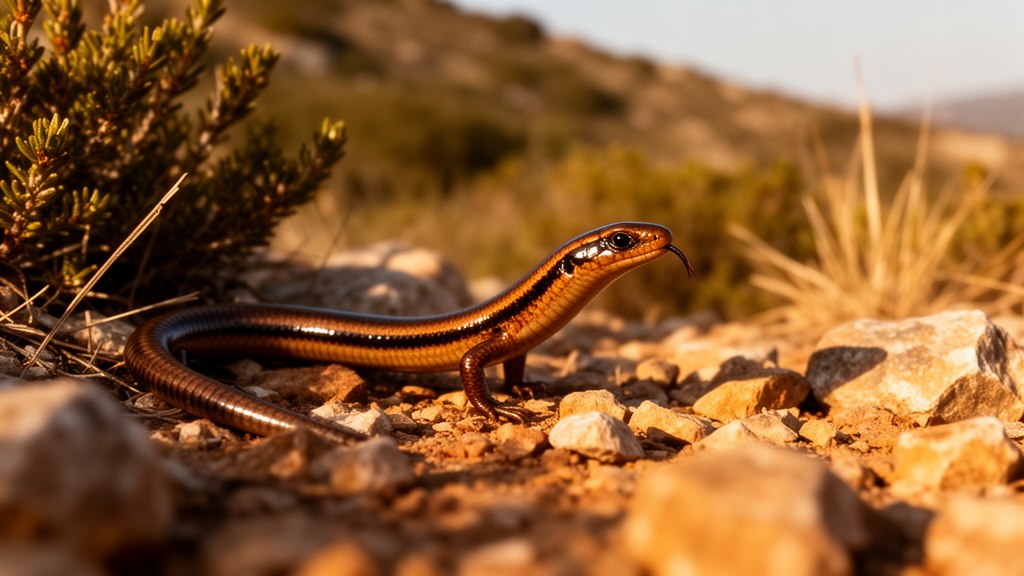
A single-population animal field study of the slow worm (Anguis fragilis) in Tarragona, Spain, recorded 151 captures and recaptures of 118 distinct individuals from March 2015 through October 2016. The study documented seasonal activity, reproductive injuries among males and pregnancy among females, and used capture–recapture modeling to estimate population size, capture probability and apparent survival over the 557-day study period.
The research focused on one 2.9-hectare site in the Muntanyes ENP de Prades, at an altitude of 990 m. The area has an oro-mediterranean climate with cold winters, dry summers and annual rainfall of 600–800 mm. Its mosaic of wet grassland, meadows, shrubs, forest, stone walls and ground-level shelters supported the population examined by the researchers, who established 16 sampling stations to cover the available habitats and microhabitats.
Investigators systematically checked 182 shelters during each visit, generally every two weeks from 2 March 2015 to 28 October 2016 under favorable weather conditions. Sampling was suspended from November 2015 through February 2016 because of the animals’ local winter rest. The 32 campaigns required about 60 hours of effort and produced an average yield of 2.55 captures per hour. Animals were captured manually around dusk, and their sex, age class, weight, snout-vent length, tail length, tail condition, reproductive marks and recapture identity were recorded.
The 118 distinct animals comprised 21 juveniles, 10 subadults and 87 adults. Among adults, 39 were male and 48 female, giving an observed male proportion of 0.44 that did not differ significantly from parity (chi-square = 0.9310, P = 0.3346). MARK software with a POPAN capture–recapture model was used for population estimation, and R was used for statistical comparisons with alpha set at 0.05. The selected model estimated 46.69 immatures, 128.73 males and 185.84 females, with respective 95% confidence intervals of 22.56–131.73, 88.12–210.46 and 102.52–376.79.
The model’s estimated male proportion was 0.41, which differed significantly from parity (chi-square = 10.368, P = 0.0012). The lower confidence bound, however, did not differ from parity (P = 0.2950), while the upper bound did (P < 0.0001). Estimated capture probabilities were 0.13 for immatures, 0.15 for males and 0.05 for females. Apparent survival estimates were 0.7522 for immatures, 0.7803 for males and 0.8335 for females, with wide uncertainty intervals. The statistical comparison found no significant difference among the three groups (Kruskal–Wallis H(2, 87) = 3.4763, P = 0.1758).
Biometric measurements also showed limited differences between the sexes. Mean snout-vent length across the population was 149.50 mm, while mean tail length among individuals with intact tails was 163.09 mm. Adult males and females did not differ significantly in snout-vent length (P = 0.8021) or tail length (P = 0.0613). After excluding animals with damaged tails and gravid females from the weight calculation, mean weight was 13.72 g. Weight differed among the four size-and-sex groups (P < 0.0001), but not between males and females (P = 0.6543). Nearly half of the captured animals—49.67%—had cut, regenerated or regenerating tails.
Activity was recorded mainly from March through October, with isolated observations in February and a peak in May and June. Males generally emerged earlier than females and peaked in May, whereas female activity peaked in June. Detection declined during the hot, dry summer, especially among males. Recent wounds and scars consistent with fighting occurred in 41.18% of captured males, and 61.90% of those injuries were recorded in May. The authors placed male combat between mid-April and mid-June. Of 66 captured females, 41, or 62.12%, were pregnant. Pregnancy observations extended from mid-May to early September, with a June incidence of 69.79%. No female shorter than 149 mm snout-vent length was found pregnant, while all females longer than 180 mm were pregnant between May and July.
Juvenile and subadult capture rates were low, which the authors said could reflect either genuinely low abundance or limited detection. Sampling may not have reached deeper ground cracks and other smaller refuges used by younger animals. No reliable evidence established the timing of parturition or recruitment, and the two smallest juveniles, each measuring 56 mm, could not be confirmed as hatchlings. The population estimates and survival estimates apply to the monitored population and period rather than to slow worms throughout southern Catalonia or elsewhere in the species’ range. The restriction to one 2.9-hectare population, the broad uncertainty intervals and the possible undercount of younger animals limit broader conclusions from the study.
Subject of Research: Single-population field study of slow worm ecology, demography and phenology in Tarragona, Spain
Article Title: Phenological, ecological, and demographic data of the slow worm ( Anguis fragilis ) population from southern Catalonia (Spain)
Article References: Giner, G., Montori, A., & Franch, M. (2024). Phenological, ecological, and demographic data of the slow worm (Anguis fragilis) population from southern Catalonia (Spain). Herpetozoa, 37, 269-280. https://doi.org/10.3897/herpetozoa.37.e130731
Image Credits: AI Generated
DOI: 10.3897/herpetozoa.37.e130731
Keywords: slow worm, Anguis fragilis, field study, capture-recapture, population ecology, phenology, reproduction, Catalonia, Spain, Tarragona, Phenological, ecological
Cite Scienmag News
Drew Townsend. (October 21, 2026). Single-population animal field study of slow worms in southern Catalonia finds female-biased model estimates and seasonal reproduction. Scienmag. https://scienmag.com/single-population-animal-field-study-of-slow-worms-in-southern-catalonia-finds-female-biased-model-estimates-and-seasonal-reproduction/
Drew Townsend. "Single-population animal field study of slow worms in southern Catalonia finds female-biased model estimates and seasonal reproduction." Scienmag, 21 October 2026, https://scienmag.com/single-population-animal-field-study-of-slow-worms-in-southern-catalonia-finds-female-biased-model-estimates-and-seasonal-reproduction/. Accessed 21 October 2026.
Drew Townsend. "Single-population animal field study of slow worms in southern Catalonia finds female-biased model estimates and seasonal reproduction." Scienmag. October 21, 2026. https://scienmag.com/single-population-animal-field-study-of-slow-worms-in-southern-catalonia-finds-female-biased-model-estimates-and-seasonal-reproduction/


