


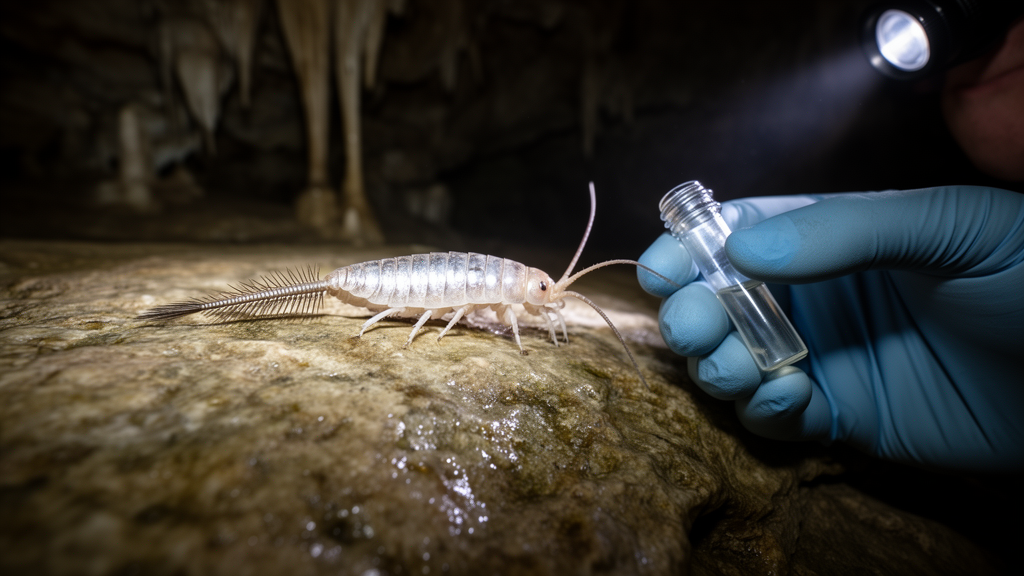
A taxonomic study of cave-dwelling nicoletiid silverfish collected in northern Alabama has identified a new genus and species, Spinanycta alabamensis. The pale insects were documented in Bobcat Cave in Madison County, Muddy Cave in Madison County and Rockhouse Cave in Limestone County, extending the known distribution of troglobiont nicoletiids into the southeastern United States.
The description combined detailed examination of the animals’ morphology with mitochondrial DNA analysis and formal conservation assessments. Specimens came from a biological inventory of cave life in northern Alabama. During visual encounter surveys, teams of at least two people spent a minimum of two person-hours examining cave floors, walls, ceilings, and the undersides of rocks, logs and other debris. They collected encountered animals by hand, preserved them in 100% ethanol and stored them at −20 °C for molecular analysis before accessions were deposited in the Entomology Collection at the Auburn Museum of Natural History.
The holotype is an 8.5 mm male collected on 26 November 2019 in Bobcat Cave, the type locality. Bobcat Cave is developed in Tuscumbia Limestone on Redstone Arsenal near Huntsville and has a mapped length of 454.1 m and a vertical extent of 6.4 m. The description also documented material from Muddy Cave, a 348 m system managed by the Land Trust of North Alabama, and Rockhouse Cave, a 384 m system on Wheeler National Wildlife Refuge.
Spinanycta alabamensis can be distinguished from other American nicoletiids by several anatomical characters. Most notably, the first abdominal sternite of males bears a long, narrow central spine that extends toward the apex of the second sternite, has a central groove and is surrounded by macrochaetae. The genus name combines the Greek “spina,” referring to this spine, with “nycta,” referring to night and to Nyx, the Greek primordial goddess of night. Other diagnostic features include the form of the parameres, styli on the second urosternite, absence of scales, a subtriangular female subgenital plate and sensory structures on the male cerci and appendix dorsalis.
Molecular evidence supported recognition of a separate genus and species. The researchers extracted genomic DNA from 10 specimens representing all three caves. A 529-base-pair fragment of the mitochondrial 16S rRNA locus was amplified and sequenced by the Sanger method. All 10 specimens produced an identical sequence, which BLAST comparisons found to be quite different from sequences available in GenBank: the maximum reported identity was 77.26%. The Alabama sequence differed by 130 to 155 base pairs, or 24.5% to 29.3%, from sequences of previously described American nicoletiid genera. For comparison, populations assigned to the same species differed by an average of 3.4 nucleotides, while sister species differed by an average of 31.2 nucleotides.
Maximum-likelihood phylogenetic analysis placed the Alabama specimens as sister to a well-supported clade containing Speleonycta, Allonicoletia, Texoreddellia and Nicoletia, while remaining distinct from those genera and from other sequenced nicoletiids. The analysis therefore supported the existence of a lineage independent of previously described genera for which 16S sequences were available. The placement of Acanthonima could not be evaluated genetically because it had not been sequenced, although the authors reported clear morphological differences. The study also did not resolve the placement of all nicoletiid genera within their subfamilies, and the reproductive behavior of the new species remains undescribed.
Field observations show that the silverfish occur on mudbanks, beneath mud-covered stones and cobbles, and near pools in cave passages. At Bobcat Cave, where the largest population was observed, as many as 20 individuals were recorded during one survey on 13 September 2023, and individuals were also seen on isolated pool surfaces. At Muddy Cave, animals were found mainly near pools before a tight crawl leading to the cave’s northern section. Only one individual was observed at Rockhouse Cave. Every confirmed locality lies in a cave section that floods during heavy precipitation, but the observations do not establish whether the species tolerates or depends on inundation.
The current geographic range comprises three caves along the north side of the Tennessee River in southern Madison and southeastern Limestone counties. Using a 2 km grid, the authors estimated an extent of occurrence of 124.1 km² and an area of occupancy of 12.0 km². They classified the species as Imperiled, or G2, under NatureServe criteria and Endangered B1a under IUCN Red List criteria, citing its few known occurrences, small and potentially restricted range, intrinsic vulnerability and existing or potential threats. Although all three caves are on protected land, surface runoff associated with urbanization, infrastructure development and activities around Redstone Arsenal may affect populations. Rockhouse Cave also receives substantial unauthorized visitation, vandalism and trash accumulation despite being closed.
The discovery increases the likelihood that additional cave-dwelling nicoletiid diversity remains to be described in the Interior Low Plateau and other karst regions of eastern North America. Earlier reports described eyeless and unpigmented nicoletiids from Cemetery Cave, Talley Ditch Cave and Shelta Cave in Alabama, but the original specimens could not be located for identification. Shelta Cave is 13.4 km from Bobcat Cave and shares several troglobiont and stygobiont species with the caves inhabited by S. alabamensis. The authors considered it possible that the Shelta Cave population belongs to S. alabamensis or a closely related species, while the identities of the insects reported from the other two caves remain unclear.
Subject of Research: Description and conservation assessment of a new cave-dwelling nicoletiid silverfish from northern Alabama
Article Title: A new genus and species of nicoletiid silverfish ( Insecta , Zygentoma , Nicoletiidae ) from caves of northern Alabama, USA
Article References: Espinasa, L., Gutierrez, A., Hinkle, A., & Niemiller, M. L. (2024). A new genus and species of nicoletiid silverfish (Insecta, Zygentoma, Nicoletiidae) from caves of northern Alabama, USA. Subterranean Biology, 49, 1-17. https://doi.org/10.3897/subtbiol.49.119986
Image Credits: AI Generated
DOI: 10.3897/subtbiol.49.119986
Keywords: new species, new genus, cave silverfish, Spinanycta alabamensis, Nicoletiidae, Alabama caves, mitochondrial 16S, karst biodiversity, conservation assessment, genus, species, nicoletiid
Cite Scienmag News
Gavin Prescott. (October 21, 2026). Cave Surveys in Northern Alabama Reveal New Silverfish Genus and Species. Scienmag. https://scienmag.com/cave-surveys-in-northern-alabama-reveal-new-silverfish-genus-and-species/
Gavin Prescott. "Cave Surveys in Northern Alabama Reveal New Silverfish Genus and Species." Scienmag, 21 October 2026, https://scienmag.com/cave-surveys-in-northern-alabama-reveal-new-silverfish-genus-and-species/. Accessed 21 October 2026.
Gavin Prescott. "Cave Surveys in Northern Alabama Reveal New Silverfish Genus and Species." Scienmag. October 21, 2026. https://scienmag.com/cave-surveys-in-northern-alabama-reveal-new-silverfish-genus-and-species/


