


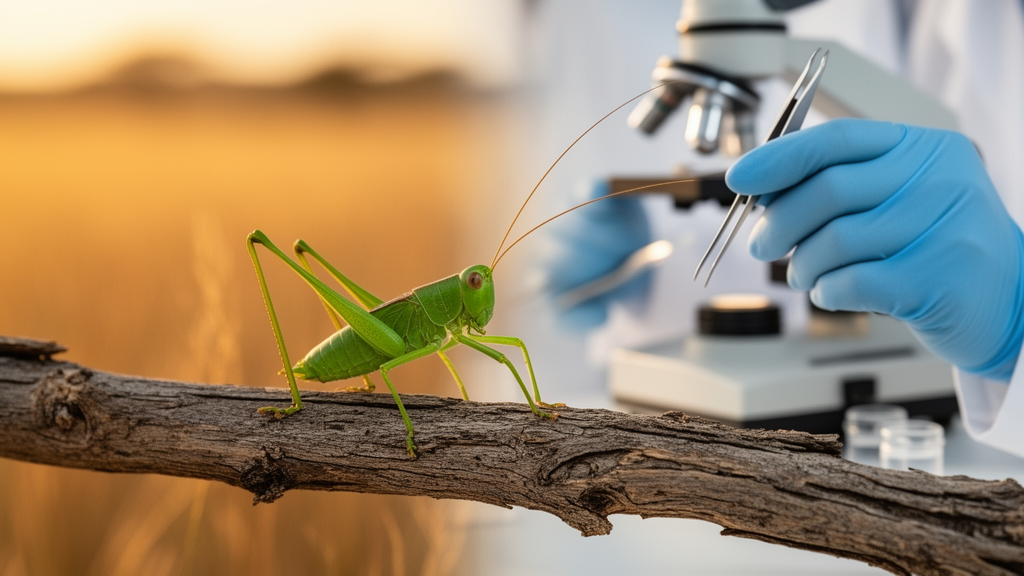
Deep in the legs of two East African katydids sits a tiny structure that most people have never heard of, yet it may hold clues to how these insects sense the world through vibrations. Researchers have now documented the scolopidial accessory organ in two species of the genus Gonatoxia, leaf katydids from Tanzania, providing the first report of this sensory organ for the tribe Holochlorini. The findings, published in the Journal of Orthoptera Research, suggest that this compact vibration detector is widespread among bush-crickets and may play a behaviorally important role in detecting substrate vibrations.
Orthopteran insects, which include katydids, crickets, and grasshoppers, rely on mechanosensory organs in their legs to detect sound, substrate vibrations, and body posture. Among these, the subgenual organ complex is particularly interesting because it contains several separate chordotonal organs, each with clusters of sensory cells arranged in different locations within the proximal tibia. The subgenual organ itself is a key receptor for substrate vibrations and is found across all Orthoptera. In the Ensifera, the group that includes katydids and crickets, up to four different chordotonal organs can be packed into this complex, making it one of the richest mechanosensory setups found in any insect leg.
The accessory organ, known in older German literature as the Nebenorgan, is a relatively small and compact chordotonal organ positioned at the posterior side of the tibia, close to the larger subgenual organ. It typically contains between five and fifteen scolopidial sensilla, the basic mechanosensory units of chordotonal organs. These sensilla sit directly under the leg cuticle and are thought to be tuned to low-frequency vibration stimuli, roughly in the range of 50 to 300 hertz, transmitted through the leg surface. Similar organs have been found in cockroaches, heel walkers, and certain ensiferan taxa including camel crickets and true katydids, hinting at a deep evolutionary history for this sensory structure.
Despite its presence across several orthopteroid groups, the accessory organ has been formally described in only eight tettigonioid species so far, leaving its distribution within this large group unresolved. Within the Phaneropterinae, the largest subfamily of Tettigoniodea, some variation in nerve supply has been observed. Usually the subgenual organ and the accessory organ each receive their own separate nerve branch, but in at least one species, Poecilimon ornatus, the two organs share a single nerve branch. Understanding how widespread these patterns are requires examining more species across different tribes and subgroups.
To fill this gap, researchers turned to two species from the East African genus Gonatoxia, a monophyletic group of five species belonging to the tribe Holochlorini. Gonatoxia immaculata and Gonatoxia helleri, both measuring around five to five and a half centimeters from head to wing tip, were examined using retrograde axonal tracing, a technique that fills sensory neurons with a visible marker so their cell bodies and nerve connections can be mapped under the microscope. The team applied a cobalt chloride solution to cut nerves in the femur, allowed it to travel back along the axons, and then visualized the stained sensory structures after fixation and clearing.
The results were clear and consistent. The accessory organ was present in all leg pairs of both species, positioned close to the posterior part of the subgenual organ and innervated by nerve N5B2, the major leg nerve. The nerve pattern was identical across prothoracic, mesothoracic, and metathoracic legs, with the accessory organ and the posterior subgenual organ each receiving distinct nerve branches from a common branch designated N5B2-T12. The accessory organ was also consistently associated with a single posterior campaniform sensillum, a different type of mechanoreceptor that detects strain in the cuticle itself.
When the researchers counted the sensory cells, they found between seven and twelve scolopidial sensilla in G. immaculata and between five and seven in G. helleri. The slightly higher numbers in G. immaculata held across all leg pairs, and statistical analysis showed no significant differences in sensillum counts among the three leg pairs within that species. Because both species are similar in body size, the difference is unlikely to be a simple scaling effect. One intriguing possibility raised by the authors is that G. helleri, possibly the most recently evolved species in the genus, may be undergoing a form of regressive evolution that reduces the number of sensilla in this organ, though any functional consequences remain to be identified.
The overall neuroanatomy closely resembles what has been documented in other tettigonioids, supporting the idea that the accessory organ is a widespread and possibly ancestral feature of the group. Since it also occurs in related lineages such as the Stenopelmatoidea and Rhaphidophoridae, the organ may even represent a plesiomorphic trait of Tettigoniodea as a whole. The finding of separate nerve branches in two Holochlorini species shows that this pattern has a broader distribution across Phaneropterinae than previously known, with Poecilimon ornatus standing out as a notable exception where the organs share a nerve supply.
What makes this tiny organ potentially exciting is its possible role in behavior. Several bush-cricket species are known to produce tremulation signals, rhythmic body movements that generate substrate vibrations used in communication. Such vibrational signaling can help avoid eavesdropping bats, guide females toward signaling males, and complement acoustic signals during courtship. Substrate vibrations can also warn insects about approaching predators or competitors moving through vegetation. While the subgenual organ typically responds to a broad frequency range of vibrations, the accessory organ may specialize in detecting the low-frequency end of this spectrum, as it does in other polyneopteran insects.
Interestingly, during earlier observations of phonotaxis and courtship in Gonatoxia, no body movements resembling tremulation were detected, leaving open the question of what vibrational stimuli these organs might respond to in the wild. The authors note that the occurrence and physiological role of the accessory organ in tettigonioids require further analysis to determine its contributions to sensory processing and behavior. For now, the documentation of this organ in two previously unstudied species adds an important piece to the puzzle of how katydids sense their vibratory world, and it underscores how much remains to be discovered in the sensory biology of even well-studied insect groups.
Subject of Research: Neuroanatomy of the scolopidial accessory organ in Gonatoxia bush-crickets
Article Title: The scolopidial accessory organ in Gonatoxia bush-crickets ( Tettigonioidea , Phaneropterinae , Holochlorini )
Article References: Strauß, J., Hemp, C., & Heller, K.-G. (2026). The scolopidial accessory organ in Gonatoxia bush-crickets (Tettigonioidea, Phaneropterinae, Holochlorini). Journal of Orthoptera Research, 35(1), 171-178. https://doi.org/10.3897/jor.35.167597
Image Credits: AI Generated
Keywords: katydids, bush-crickets, Gonatoxia, scolopidial accessory organ, subgenual organ, mechanosensory, chordotonal organs, substrate vibrations, Phaneropterinae, Tettigonioidea, neuroanatomy, Tanzania
Cite Scienmag News
Gavin Prescott. (October 17, 2026). Hidden vibration sensors found in East African bush-crickets reveal ancient sensory toolkit. Scienmag. https://scienmag.com/hidden-vibration-sensors-found-in-east-african-bush-crickets-reveal-ancient-sensory-toolkit/
Gavin Prescott. "Hidden vibration sensors found in East African bush-crickets reveal ancient sensory toolkit." Scienmag, 17 October 2026, https://scienmag.com/hidden-vibration-sensors-found-in-east-african-bush-crickets-reveal-ancient-sensory-toolkit/. Accessed 17 October 2026.
Gavin Prescott. "Hidden vibration sensors found in East African bush-crickets reveal ancient sensory toolkit." Scienmag. October 17, 2026. https://scienmag.com/hidden-vibration-sensors-found-in-east-african-bush-crickets-reveal-ancient-sensory-toolkit/


