


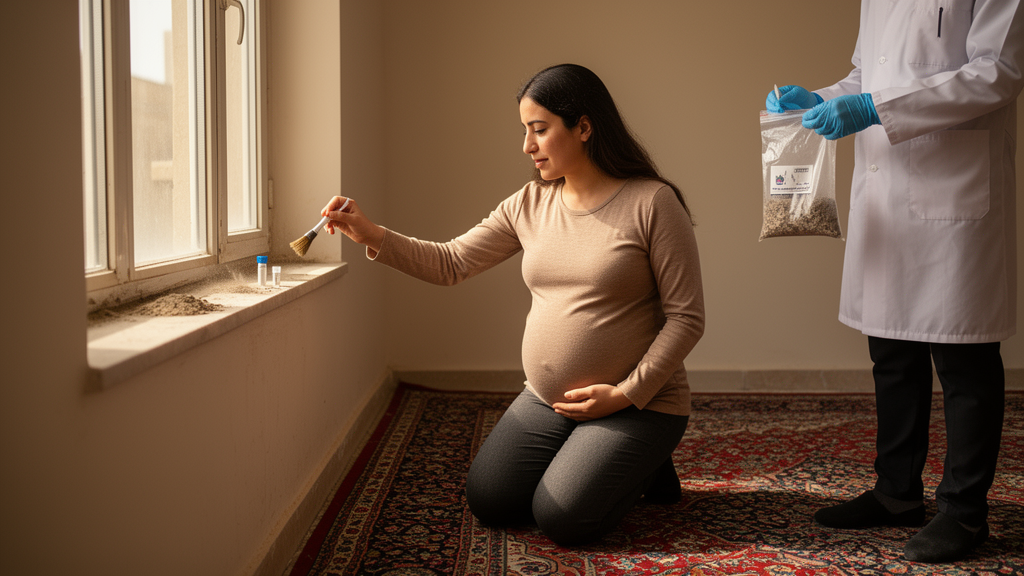
A new study from Isfahan, Iran, has delivered a finding that complicates one of the most common assumptions in environmental health: that the contaminants measured in a person’s home reliably predict the contaminants measurable inside that person’s body. Researchers led by Maryam Moradnia of Isfahan University of Medical Sciences, working with colleagues at Lund University in Sweden and other institutions, paired urine samples with vacuum-collected indoor dust from 80 pregnant women spread across the city’s urban zones. Their results, published in Environmental Geochemistry and Health, show that while both the women’s urinary metal burdens and the city’s Air Quality Index varied sharply from one neighborhood to another, the metal content of the dust inside their homes did not. Even more strikingly, the two measurements — dust and urine — were not significantly correlated at all.
The team focused on four metals with well-documented reproductive and developmental toxicity: chromium, lead, cadmium, and nickel. Each pair of samples came from the same household, allowing a direct, person-by-person comparison between external contamination and internal exposure. Quantification was performed with inductively coupled plasma optical emission spectrometry, a technique sensitive enough to resolve the low microgram-per-liter concentrations typical of urinary biomarkers and the microgram-per-gram loadings found in settled household dust. The study was approved by the ethics committee of Isfahan University of Medical Sciences, and informed consent was obtained from all participants.
In the dust samples, the concentration hierarchy was unambiguous: lead dominated, followed by chromium, then nickel, with cadmium trailing far behind. Lead’s mean concentration in indoor dust reached 111.10 micrograms per gram — a figure consistent with the elevated levels reported in residential dust studies from Istanbul, Toronto, Chengdu, and Macao, where lead routinely tops the metal profile of settled indoor particles. The urinary measurements told a parallel story at much lower absolute levels. Lead again ranked first, at a mean of 10.52 micrograms per liter, followed by chromium at 8.30 micrograms per liter and nickel at 4.14 micrograms per liter. Cadmium, notably, did not register as a leading urinary marker in the reported hierarchy, mirroring its low abundance in the dust matrix.
The spatial analysis produced the study’s most consequential contrast. When the researchers grouped participants by urban zone, urinary metal concentrations differed significantly across zones, with p-values below 0.001. The Air Quality Index showed the same strong spatial variability, also at p < 0.001. Yet the dust measurements refused to follow suit: dust metal concentrations showed no significant spatial differences, and dust lead in particular yielded a p-value of 0.514 — statistically indistinguishable across neighborhoods. In other words, the outdoor environment varied dramatically by location, the women’s internal burdens varied in step with it, but the contamination inside their living rooms was essentially uniform across the city.
One household variable did explain a substantial share of the dust variance. Building age correlated strongly with dust lead levels, with a Spearman rank correlation coefficient of 0.788 and a p-value below 0.001. This is a textbook result in indoor contamination science: older buildings carry legacy lead from deteriorating paint, historical plumbing, and decades of accumulated particulate matter that modern structures simply do not contain. The finding aligns with international reviews of indoor dust, which consistently identify building age, paint condition, and proximity to traffic as the dominant predictors of lead loading in household dust, regardless of the surrounding neighborhood’s ambient air quality.
But the correlation between dust and urine — the link the study was designed to test — failed to materialize. Dust and urinary metal profiles were not significantly correlated, a null result the authors interpret as evidence that environmental contamination does not translate linearly into maternal internal exposure. This decoupling has a mechanistic basis that the toxicology literature has long recognized. Metal bioaccumulation is governed by biodynamics: uptake rates across the gut and lungs, sequestration in bone and soft tissue, and excretion kinetics all vary between individuals and between metals. Lead absorbed decades earlier can be remobilized from maternal bone during pregnancy, meaning a pregnant woman’s urinary lead may partly reflect her own lifetime exposure history rather than the dust currently under her sofa.
Diet, drinking water, occupational contact, and behavioral factors — hand-to-mouth activity, cleaning frequency, ventilation habits — all contribute additional exposure pathways that a single dust sample cannot capture. Urinary biomarkers, meanwhile, integrate exposure across all routes over recent days to weeks, and are further modulated by hydration status, a confounder that pregnancy exposure researchers have flagged as requiring explicit adjustment. The Isfahan results are a quantitative demonstration of why multi-matrix assessment — measuring both environmental reservoirs and biological indicators — is now considered essential for characterizing exposure in vulnerable populations, rather than relying on either measurement alone.
The stakes are not abstract. A growing body of systematic reviews links maternal exposure to lead, cadmium, mercury, and chromium with adverse pregnancy outcomes, including preterm birth and low birth weight, and with neurodevelopmental effects in children. Geographic clustering of elevated blood metal levels among pregnant women has been documented in the United States, and biomonitoring studies in Puerto Rico and Canada have mapped the predictors of urinary and blood metal burdens during pregnancy. Isfahan adds a distinctive context to this literature: a semi-arid metropolis with documented heavy metal contamination in its particulate matter, airborne dust episodes, and a housing stock old enough to carry substantial legacy lead indoors.
Methodologically, the study’s strength lies in its paired design and its explicit spatial framing. By collecting urine and dust from the same households and stratifying by urban zone alongside air quality data, the researchers could test — rather than assume — the coupling between environment and body burden. The answer was a clear negative for the dust-to-urine pathway in this cohort, and a clear positive for the influence of ambient air quality and neighborhood on internal exposure. The practical implication is that remediating indoor dust alone, while worthwhile given the strong lead concentrations found and the building-age effect, would not by itself equalize maternal metal burdens across the city. Exposure reduction strategies would need to address the ambient and dietary routes that the urinary data reflect.
The authors conclude that integrated multi-matrix assessments are essential to accurately characterize pregnant women’s environmental risks, and their data make the case concretely: 80 paired samples, four metals, and two measurement matrices that told two different stories about the same homes. For environmental health researchers, the Isfahan findings are a caution against using household dust measurements as a proxy for internal exposure in biomonitoring studies. For public health officials in rapidly urbanizing cities with aging housing stocks, they are a reminder that the contaminants that matter most to a pregnancy may be arriving by routes no vacuum cleaner can reach — and that the neighborhood a woman lives in may shape her body burden more than the dust in her own home does.
Subject of Research: Heavy metal exposure in pregnant women measured via paired urinary biomarkers and indoor dust samples in Isfahan, Iran
Article Title: Spatial variability of heavy metals in pregnant women: linking urinary biomarkers, indoor dust contamination, and air quality in Isfahan, Iran
Article References: Moradnia, M., Movahedian Attar, H., Hajizadeh, Y., Darvishmotevalli, M., & Chavoshani, A. (2026). Spatial variability of heavy metals in pregnant women: linking urinary biomarkers, indoor dust contamination, and air quality in Isfahan, Iran. Environmental Geochemistry and Health, 48(16), Article 646. https://doi.org/10.1007/s10653-026-03508-x
Image Credits: AI Generated
DOI: 10.1007/s10653-026-03508-x
Keywords: heavy metals, pregnant women, indoor dust, urinary biomarkers, lead exposure, air quality index, Isfahan, environmental health, ICP-OES, spatial variability, cadmium, chromium
Cite Scienmag News
Harold Sullivan. (October 19, 2026). Pregnant Women’s Metal Exposure Doesn’t Match the Dust in Their Homes, Isfahan Study Finds. Scienmag. https://scienmag.com/pregnant-womens-metal-exposure-doesnt-match-the-dust-in-their-homes-isfahan-study-finds/
Harold Sullivan. "Pregnant Women’s Metal Exposure Doesn’t Match the Dust in Their Homes, Isfahan Study Finds." Scienmag, 19 October 2026, https://scienmag.com/pregnant-womens-metal-exposure-doesnt-match-the-dust-in-their-homes-isfahan-study-finds/. Accessed 19 October 2026.
Harold Sullivan. "Pregnant Women’s Metal Exposure Doesn’t Match the Dust in Their Homes, Isfahan Study Finds." Scienmag. October 19, 2026. https://scienmag.com/pregnant-womens-metal-exposure-doesnt-match-the-dust-in-their-homes-isfahan-study-finds/


