


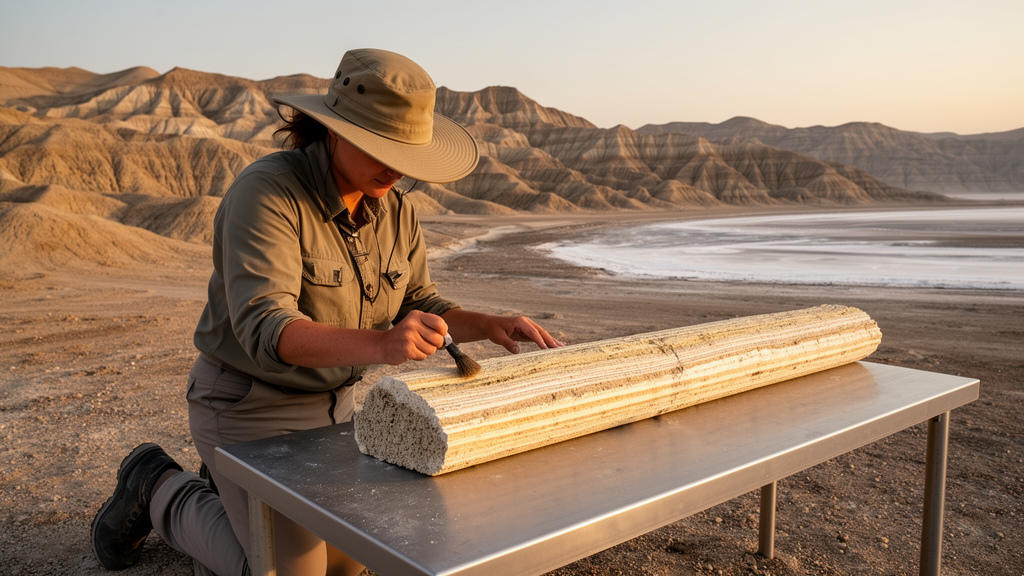
Deep in one of the driest corners of the Tibetan Plateau, a team of Chinese geoscientists has pieced together a nearly two-million-year archive of ancient rainfall, and what it shows is surprising. During the Late Pliocene, roughly 3.6 to 1.8 million years ago, the rhythm of precipitation in the western Qaidam Basin did not beat to a single astronomical drum. Instead, the dominant cycle shifted from long, roughly 100,000-year eccentricity swings to the 20,000-year wobble of Earth’s precession, depending on the prevailing climate background. The finding, published in the journal Climate of the Past, offers a rare window into how monsoon moisture behaved during past episodes of global warmth, and it carries an intriguing implication for a warming future.
The Qaidam Basin is a natural laboratory for studying aridity. Wedged between the Kunlun, Altyn Tagh, Qilian, and Ela mountains on the northeastern Tibetan Plateau, the basin is one of the most enclosed landscapes in Asia. Modern annual precipitation there ranges from a meager 50 to 200 millimeters, while evaporation soars to around 3,000 millimeters, producing a hyper-arid environment where salts such as halite, gypsum, and carbonates accumulate in thick layers. Because the basin sits far from major moisture sources and lies in the rain shadow of the Tibetan Plateau, any signal of increased rainfall is immediately meaningful, and any record of past wetting or drying speaks directly to the reach of the East Asian summer monsoon.
The new study, led by Zeng Luo of Hunan University of Arts and Science with colleagues from Lanzhou University, Hubei Normal University, Linyi University, and other institutions, focuses on the Gansen section, a sedimentary sequence exposed on the northwestern margin of the basin. Previous work had already established a paleomagnetic timeline for the section, anchoring 453 meters of strata to the geomagnetic polarity time scale with ten age control points spanning roughly 3.6 to 1.8 million years ago. Building on that framework, the team collected 149 samples and measured two independent climate-sensitive properties: environmental magnetic parameters and median grain size.
The magnetic approach hinges on a clever ratio. Frequency-dependent magnetic susceptibility, which responds to tiny pedogenic grains of magnetite formed during wet weathering, is divided by hard isothermal remanent magnetization, which reflects hematite produced under drier conditions. The resulting ratio, known as χfd/HIRM, tracks the balance between wet and dry weathering regimes and has proven sensitive to precipitation in arid and semiarid settings. Median grain size provides a complementary signal, because coarser particles in closed, shallow lake environments generally indicate stronger runoff and hydrodynamic energy, both of which scale with rainfall. Together, the two proxies form a paired record of hydroclimatic change.
When the team combined the new measurements with previously published data for the interval from 3.25 to 2.95 million years ago, they obtained an integrated precipitation record covering nearly the entire Late Pliocene. The record divides naturally into three phases. From about 3.6 to 3.25 million years ago, χfd/HIRM values fluctuated widely between 9.2 and 105 times ten to the minus six amperes per meter, averaging 38.3, while median grain size averaged 10.48 micrometers. Three thick halite layers in the stratigraphy corresponded to low points in both proxies, marking pulses of intensified aridity. From 3.25 to 2.95 million years ago, the warm middle Piacenzian interval, both proxies rose and the halite layers vanished, signaling a wetter climate. After 2.95 million years ago, values declined, grain size coarsened and then dropped, and halite layers became more frequent, pointing to renewed drying.
The most striking result emerged from spectral analysis of the densely sampled interval between about 3.6 and 3.3 million years ago. Using the REDFIT procedure, which tests spectral peaks against a red-noise background, the researchers found that the strongest periodicity in the χfd/HIRM record sat near 100,000 years, while the grain-size record peaked closer to 125,000 years. Both signals fall squarely in the eccentricity band, the slow modulation of Earth’s orbital shape that has a far weaker direct effect on insolation than precession or obliquity. A sensitivity test with a coarser interpolation step confirmed that the eccentricity signal was not an artifact of data processing. This pattern contrasts sharply with the 20,000-year precession-dominated cycles that the same team had previously documented for the middle Piacenzian warm period.
Why would the same basin respond to different orbital rhythms at different times? The authors argue that the answer lies in the background climate state. During the wetter middle Piacenzian, when the East Asian summer monsoon was strong, summer moisture could penetrate deep into the Asian interior, and rainfall responded directly to the precessional forcing of summer insolation. During the earlier, drier interval around 3.6 to 3.3 million years ago, the monsoon’s reach was more limited, and precipitation appears to have been governed indirectly by large-scale boundary conditions. One plausible mechanism is that eccentricity-paced changes in high-latitude ice volume, potentially including fluctuations of the Antarctic ice sheet, modulated the thermal contrast between Eurasia and the surrounding oceans and altered ocean circulation patterns, which in turn influenced monsoon intensity. Supporting this idea, five high-value intervals in the precipitation proxies broadly match peaks in the benthic oxygen isotope stack, a global record of ice volume, and the two records show similar filtered variations to the isotope stack in the 40,000-year obliquity band as well.
The broader context strengthens the case. Because large Arctic ice sheets did not develop until roughly 2.7 million years ago, Antarctic variability was likely the dominant high-latitude ice signal during the Late Pliocene, making it a plausible mediator of the eccentricity-scale precipitation signal. Similar nonlinear responses to insolation forcing have been documented elsewhere in North China, including 100,000-year eccentricity cycles in magnetic susceptibility records from the Xinding Basin and in rubidium-strontium ratios from the Sanmenxia Basin. Pollen records from the SG-1b core in the western Qaidam Basin likewise revealed a strong link between 100,000-year precipitation cycles and eccentricity forcing during the interval from 3.5 to 3.0 million years ago. The new Gansen record thus fits into a growing picture in which the monsoon’s orbital fingerprint depends on the prevailing climate regime.
The implications reach beyond the Pliocene. The middle Piacenzian warm period, with atmospheric carbon dioxide concentrations of 400 to 450 parts per million, elevated global temperatures, higher sea levels, and small Arctic ice sheets, is widely regarded as one of the best geological analogs for future anthropogenic warming. Climate model simulations suggest that enhanced land-sea thermal contrast during that interval intensified and westward-extended the western Pacific subtropical high, strengthening the East Asian summer monsoon and pushing its precipitation boundary northwestward. If the same mechanism operates under continued modern warming, the Qaidam Basin and other parts of the arid Asian interior could receive increased summer moisture in the decades ahead, a possibility with significant consequences for water resources in a region where every millimeter of rain matters.
At the same time, the study carries a caution. After about 2.95 million years ago, the record shows clear signs of intensifying aridification, with more frequent salt layers and declining proxy values, consistent with other evidence that the western Qaidam Basin became drier no later than around 3 million years ago. The precession-dominated wet pattern of the middle Piacenzian was therefore not a permanent feature of the Late Pliocene but a window tied to specific background conditions. By showing that the dominant periodicity of precipitation can shift from eccentricity to precession scales as climate states change, the research underscores a fundamental point for paleoclimate science and for projections of future hydrology alike: the response of regional rainfall to orbital forcing is not fixed, and understanding when and why it changes may be as important as knowing the forcing itself.
Subject of Research: Orbital-scale precipitation variability in the western Qaidam Basin during the Late Pliocene
Article Title: Orbital-scale precipitation variations in the western Qaidam Basin during the Late Pliocene: evidence from magnetic parameters and median grain-size
Article References: Luo, Z., Wang, H., Yu, X., Zhang, Z., Song, Z., Yang, J., Chen, W., Su, Q., Lu, Y., & Hua, S. (2026). Orbital-scale precipitation variations in the western Qaidam Basin during the Late Pliocene: evidence from magnetic parameters and median grain-size. Climate of the Past, 22(10), 1913-1925. https://doi.org/10.5194/cp-22-1913-2026
Image Credits: AI Generated
Keywords: Qaidam Basin, Late Pliocene, East Asian summer monsoon, orbital forcing, eccentricity, precession, paleoclimate, magnetic susceptibility, grain size, Tibetan Plateau, aridification, mid-Piacenzian warm period
Cite Scienmag News
Sloane Callahan. (October 19, 2026). Ancient lake sediments reveal a shifting heartbeat of Pliocene rain over the Qaidam Basin. Scienmag. https://scienmag.com/ancient-lake-sediments-reveal-a-shifting-heartbeat-of-pliocene-rain-over-the-qaidam-basin/
Sloane Callahan. "Ancient lake sediments reveal a shifting heartbeat of Pliocene rain over the Qaidam Basin." Scienmag, 19 October 2026, https://scienmag.com/ancient-lake-sediments-reveal-a-shifting-heartbeat-of-pliocene-rain-over-the-qaidam-basin/. Accessed 19 October 2026.
Sloane Callahan. "Ancient lake sediments reveal a shifting heartbeat of Pliocene rain over the Qaidam Basin." Scienmag. October 19, 2026. https://scienmag.com/ancient-lake-sediments-reveal-a-shifting-heartbeat-of-pliocene-rain-over-the-qaidam-basin/


