

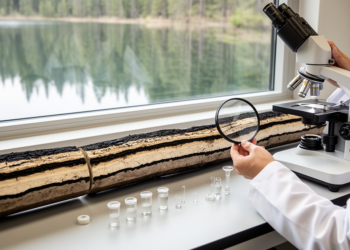
Lake Sediments Link 4,500-Year Fire History to Moisture Variability
A 4,500-year lake-sediment record from northwestern Yunnan associates the region’s strongest wildfire interval with reduced moisture and drier local conditions.
A 4,500-year lake-sediment record from northwestern Yunnan associates the region’s strongest wildfire interval with reduced moisture and drier local conditions.

New sediment records from the Qaidam Basin show that the dominant orbital rhythm of Late Pliocene precipitation shifted from 100,000-year ...
A synthesis of 11,346 zircon U-Pb ages shows that the Yangtze River achieved its final transcontinental integration during the Early ...
A large-scale isotope survey across the Tibetan Plateau shows that nitrogen-fixing legumes underpin the region's carbon sink, and that losing ...
A new review of two decades of data shows that Himalayan snow and ice carry a clear chemical signature of ...
The first eddy covariance measurements over a continental glacier on the Tibetan Plateau reveal persistent sublimation, expose weaknesses in five ...
New research shows that tiny areas of abrupt permafrost thaw on the Tibetan Plateau deliver four times more sediment to ...
New dating of the Altyn Tagh Fault shows that a weakness zone formed over 115 million years ago allowed stresses ...
The first integrated quantification of soil reactive nitrogen emissions on the Tibetan Plateau reveals that soils release substantial HONO and ...
Researchers combined self-organizing maps, K-means clustering, and isotope tracing to reveal that groundwater in the Zheduotang alpine gorge of the ...

Embark on a thrilling journey of discovery with Scienmag.com—your ultimate source for cutting-edge breakthroughs. Immerse yourself in a world where curiosity knows no limits and tomorrow’s possibilities become today’s reality!