


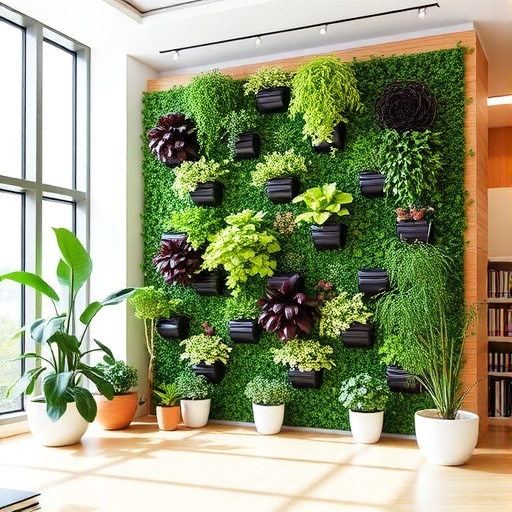
In a groundbreaking study conducted at the University of Seville, researchers have decisively showcased the potential of active vertical garden systems to significantly enhance indoor air quality within enclosed environments. This innovative approach pivots on the utilization of an active living wall (ALW), wherein carefully selected plant species are employed to filter and reduce harmful airborne pollutants. The research took place inside a meticulously designed closed glass chamber stationed at the Higher Technical School of Agricultural Engineering, where conditions were tightly controlled to simulate real-world indoor air pollution scenarios.
Indoor air pollution has emerged as a silent but pervasive threat to public health worldwide. Despite being less visible than outdoor pollution, the contamination of indoor environments with volatile organic compounds (VOCs), nitrogen dioxide (NO2), sulfur dioxide (SO2), and other toxic gases poses substantial risks. These pollutants originate from a variety of common sources, including building materials, furnishings, household cleaning agents, combustion processes, and permeation of urban dust. Such pollutants contribute not only to respiratory ailments but also to the infamous “sick building syndrome,” a condition characterized by occupants experiencing acute health and comfort issues directly tied to their indoor environments.
The pioneering research team, comprising Antonio J. Fernández Espinisa, Sabina Rossini Oliva, Luis Pérez Urrestarazu, and Rafael Fernández-Cañero, methodically evaluated the pollutant removal capabilities of five distinct plant species incorporated within the active living wall setup. The species under investigation were Spathiphyllum wallisii, Tradescantia zebrina, Philodendron scandens, Ficus pumila, and Chlorophytum comosum, each selected for their distinct physiological traits possibly influencing pollutant uptake and degradation.
Experimental procedures involved the introduction of a complex mixture of gaseous pollutants and volatile organic compounds into the sealed chamber, closely mimicking the pollution profile commonly encountered indoors. Nitrogen dioxide (NO2) and sulfur dioxide (SO2), alongside VOCs such as formaldehyde, acetone, n-hexane, and n-heptane, were systematically injected, while sophisticated monitoring techniques tracked the real-time decline in their concentrations. The researchers employed the Pollutant Reduction indicator (PR%), a robust metric quantifying the efficacy of pollutant abatement over time, to precisely gauge the performance of the ALW system.
Results were nothing short of remarkable. After only 24 hours of exposure within the controlled environment, pollutant concentrations plummeted by a staggering 96% to 98% across all active living wall configurations. Notably, the reduction was particularly pronounced for formaldehyde (CH2O) and sulfur dioxide (SO2), underscoring the ALW’s proficiency in tackling some of the most hazardous indoor contaminants. These findings highlight the ALW’s capacity not only to improve air quality but also to provide a sustainable and passive solution for pollution mitigation in urban and built environments.
An intriguing aspect of the study pertains to the differential pollutant removal efficiency observed among the plant species under observation. Variability depended heavily on the specific chemical nature of the pollutant, pointing to the potential for customizing living walls to target particular contaminants of concern within a building’s air. For example, while all species demonstrated considerable efficacy in reducing total volatile organic compounds (TVOCs), certain species, especially Spathiphyllum wallisii, exhibited superior efficiency in reducing nitrogen dioxide levels, achieving a remarkable 60% reduction within just the initial hour post-exposure.
This implies that the synergy between plant physiological processes such as stomatal uptake, enzymatic degradation, and microbial interactions within the rhizosphere plays a pivotal role in modulating pollutant removal rates. Moreover, this study reinforces the hypothesis that fine-tuning plant species composition in living walls can optimize indoor air purification strategies, tailored to specific pollution profiles.
The study also recorded a rapid onset of pollutant abatement capabilities, with TVOC levels falling by approximately 24% to 40% within just fifteen minutes following injection. This rapid responsiveness is critical for mitigating acute pollution episodes and improving occupant comfort virtually in real-time, an advantage over many conventional air purification technologies that rely heavily on mechanical filtration and chemical scrubbing processes.
Beyond the quantified pollutant reduction, the research carries profound implications for sustainable building design, urban planning, and public health policy. Active vertical gardens, integrated thoughtfully within architectural schemes, offer a multipurpose solution: improving indoor environmental quality, enhancing aesthetic value, and contributing to urban greenery and biodiversity. Their installation could substantially reduce dependency on energy-intensive air conditioning and ventilation systems, presenting a carbon-conscious approach aligned with global climate change mitigation efforts.
While these findings present an optimistic outlook, the researchers caution that further investigations are needed to explore long-term performance, maintenance requirements, and economic viability across diverse building types and climates. Additionally, scaling active living wall systems from controlled chamber experiments to real-world applications will necessitate addressing challenges related to airflow dynamics, pollutant load variability, and integration with existing building management systems.
In conclusion, this seminal work underscores the immense promise of botanical biofilters in tackling the often-overlooked problem of indoor air pollution. By harnessing the natural detoxifying capacity of plants within active vertical garden systems, it provides a scientifically validated pathway toward healthier indoor environments, improved human wellbeing, and a greener urban future.
Cite Scienmag News
Russell Cooper. (March 20, 2026). Vertical Gardens Demonstrated to Enhance Indoor Air Quality Effectively. Scienmag. https://scienmag.com/vertical-gardens-demonstrated-to-enhance-indoor-air-quality-effectively/
Russell Cooper. "Vertical Gardens Demonstrated to Enhance Indoor Air Quality Effectively." Scienmag, 20 March 2026, https://scienmag.com/vertical-gardens-demonstrated-to-enhance-indoor-air-quality-effectively/. Accessed 3 September 2026.
Russell Cooper. "Vertical Gardens Demonstrated to Enhance Indoor Air Quality Effectively." Scienmag. March 20, 2026. https://scienmag.com/vertical-gardens-demonstrated-to-enhance-indoor-air-quality-effectively/


