


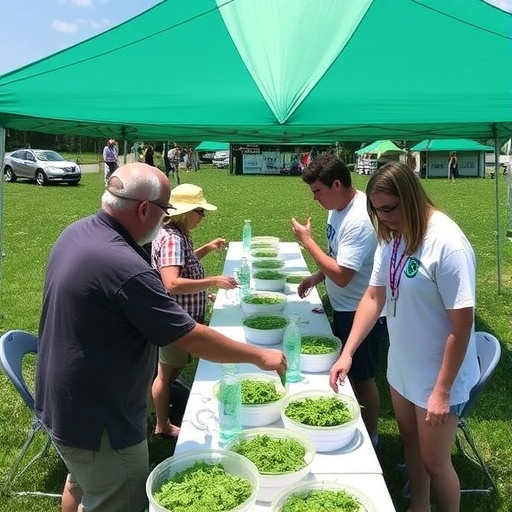
KNOXVILLE, Tenn. — More than 70 university students converged in Knoxville on August 5 and 6 for a demanding test of their ability to identify weeds, interpret herbicide information, design field experiments and solve practical agricultural problems. Hosted by faculty and staff at the University of Tennessee Institute of Agriculture and sponsored by the Southern Weed Science Society, the annual Weed Contest transformed familiar academic subjects into a series of real-world challenges that closely resemble the decisions made every day by farmers, crop consultants, researchers and agricultural extension specialists.
The competition brought together undergraduate and graduate students from 12 land-grant universities, institutions whose missions combine teaching, research and public service in agriculture and related fields. Contestants competed across six categories: weed identification, herbicide identification, written calibration, team calibration, producer problem scenarios and a mystery event. Together, the challenges covered the central technical skills of modern weed science, from recognizing plant species at different stages of growth to calculating how much herbicide and spray solution should be delivered uniformly across a field.
Weed identification is a foundational skill because effective crop protection begins with knowing precisely which plant is competing with a crop. Many weeds can look similar, particularly when they are young, yet their biology, emergence timing, susceptibility to herbicides and potential impact on crop yield may differ substantially. Students were required to draw on visible characteristics such as leaf arrangement, shape, margins, stems, roots and reproductive structures. Correct identification can determine whether a grower chooses mechanical control, a pre-emergence herbicide, a post-emergence treatment or an integrated strategy combining several methods.
Herbicide identification adds another layer of complexity. Modern weed management depends not only on recognizing commercial products but also on understanding active ingredients, modes of action and the biological processes they disrupt. Some herbicides interfere with amino acid production, others affect lipid synthesis, photosynthesis, cell division or plant growth regulation. Knowing these distinctions is essential when selecting treatments for a particular crop and weed spectrum. It is also critical for managing herbicide resistance, a growing agricultural challenge in which repeated exposure to the same mode of action allows naturally tolerant weeds to survive and reproduce.
The calibration events tested whether students could convert a product label and field prescription into an accurate application. Calibration is the process of adjusting equipment so that a sprayer delivers the intended volume over a specified area. Errors can have serious consequences: underapplication may leave weeds uncontrolled and accelerate resistance, while overapplication can injure crops, contaminate non-target areas and increase production costs. Students had to work with measurements involving travel speed, nozzle output, spray width, tank volume and application rate. In a team setting, they also had to coordinate their calculations and equipment decisions under time pressure, reflecting the collaborative nature of professional agricultural work.
The producer problem scenarios required contestants to approach weed control as a decision-making problem rather than a simple identification exercise. In a working farm, recommendations must account for crop growth stage, soil characteristics, weather, field history, planting system, available equipment, economic limits and legal restrictions. A technically effective herbicide may not be suitable if rain is imminent, if the crop is too sensitive, if the field borders a vulnerable habitat or if the target weeds have developed resistance. Students were therefore challenged to connect plant biology, chemistry, equipment operation and farm management into solutions that could be implemented outside the classroom.
This year’s mystery event focused on laying out a field research trial, a task that exposed students to the logic of experimental design. A useful field trial must produce results that can be distinguished from random variation caused by soil differences, moisture gradients, uneven weed populations or other environmental factors. Researchers commonly use replicated treatments, carefully defined plot dimensions and randomized placement to reduce bias and estimate the reliability of observed effects. Students had to translate a research question into a practical experimental layout, demonstrating why agricultural science depends not only on applying treatments but also on collecting evidence in a way that can withstand statistical analysis.
The University of Tennessee Weed Team, composed of graduate students Hayden Love, Sally Reed, Gavin Sparks and Logan Smith, won first place in the team calibration event. Sparks also finished fifth overall, while the University of Arkansas earned first place in the team competition and received the “Broken Hoe” trophy. Awards recognized the top three teams and the top five individual contestants. Although the contest is structured as a competition, its broader purpose is professional preparation: participants practice explaining technical decisions, responding to unfamiliar conditions and working with peers from institutions across the region.
“Each year, this event challenges our next generation of weed scientists with applying their knowledge in realistic, hands-on scenarios,” said Tom Mueller, a weed science professor in the UT Department of Plant Sciences. “Participants also have the opportunity to network with professors and students from across the region, offering a holistic understanding of weed science beyond their individual institutions.” That combination of practical testing and professional exchange is increasingly important as agriculture confronts herbicide resistance, shifting weather patterns, evolving regulations and pressure to reduce unnecessary chemical use while protecting yields.
The contest changes location each year, allowing different universities and agricultural regions to showcase their research environments and production systems. Its challenges reflect a discipline that sits at the intersection of ecology, chemistry, engineering and economics. The University of Tennessee Institute of Agriculture, which includes the Herbert College of Agriculture, the UT College of Veterinary Medicine, UT AgResearch and UT Extension, supports teaching, research and outreach throughout Tennessee and beyond. By bringing students into direct contact with the technical demands of weed management, the event highlights how the future of crop production will depend on scientists who can move confidently between laboratory knowledge, field measurements and decisions made under real agricultural conditions.
Web References: Southern Weed Science Society Collegiate Weeds Contest: https://www.swss.ws/collegiate-weeds-contest/; University of Tennessee Institute of Agriculture: https://utia.tennessee.edu/
References: Information provided by the University of Tennessee Institute of Agriculture and the Southern Weed Science Society.
Cite Scienmag News
Alan Morgan. (August 18, 2026). UTIA Hosts Southern Weed Science Society Weed Contest. Scienmag. https://scienmag.com/utia-hosts-southern-weed-science-society-weed-contest/
Alan Morgan. "UTIA Hosts Southern Weed Science Society Weed Contest." Scienmag, 18 August 2026, https://scienmag.com/utia-hosts-southern-weed-science-society-weed-contest/. Accessed 3 September 2026.
Alan Morgan. "UTIA Hosts Southern Weed Science Society Weed Contest." Scienmag. August 18, 2026. https://scienmag.com/utia-hosts-southern-weed-science-society-weed-contest/


