


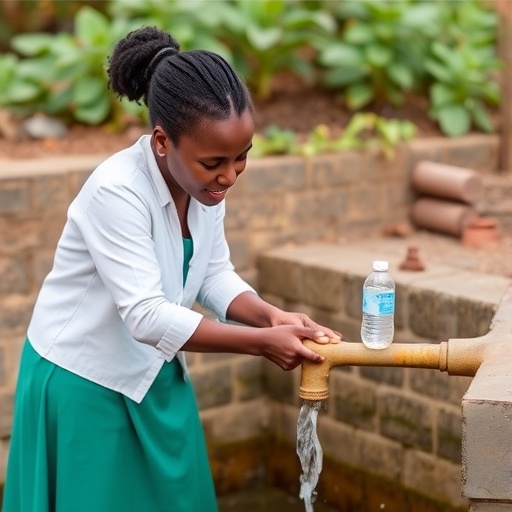
In the bustling urban landscape of Beira, Mozambique, a transformative approach to water infrastructure is quietly reshaping the fundamental experience of millions. Access to clean, safe water remains an elusive promise for many in rapidly urbanizing regions across the globe, where aging systems and intermittent supply jeopardize public health daily. A pioneering study, recently published in Nature Water, offers compelling evidence that upgrading water networks can have a profound impact on microbial water quality and overall water access. This investigation, focused on community water supply improvements, highlights the complex interplay between infrastructure upgrades, household water handling practices, and residual contamination risks.
At the heart of this study lies an ambitious evaluation of urban water system interventions targeted at neighborhoods within Beira, Mozambique. Researchers enlisted 642 households as a representative sample to examine both water source and household stored water, assessing the presence of Escherichia coli (E. coli), a key indicator of microbial contamination and potential health hazards. By comparing neighborhoods with newly replaced water service lines to those without, the study establishes a robust framework to isolate the effect of targeted infrastructure enhancements on water quality and accessibility.
The findings reveal a noteworthy reduction in microbial contamination—specifically, a 33% decline in E. coli presence in water directly obtained from improved household sources. Even stored water within households showed a 14% reduction in contamination, underscoring that while direct supply improvements are critical, downstream handling and storage remain pivotal points for intervention. The study’s nuanced approach elucidates that source water quality improves significantly through infrastructure development; however, contamination risks are not entirely eliminated once water enters household storage, pointing to enduring vulnerabilities shaped by intermittent supply challenges.
A salient outcome of this research is the demonstrated value of direct household connections to the piped water network, independent of whether the neighborhood had undergone broader infrastructural upgrades. Households with such direct connections exhibited a 24% lower prevalence of E. coli in their source water compared to those relying on indirect or communal access. This distinction underscores the health and convenience benefits yielded directly from household-level control over water access, reinforcing calls for universal connections in urban water planning strategies.
Still, the benefits of a direct piped connection did not extend fully into the domain of stored water quality. The study notes no statistically significant difference in contamination levels of stored water among households with or without direct connections. Such findings suggest that water storage practices—often necessitated by intermittent supply regimes—constitute a critical resistance point where contamination can recur or persist, undermining improvements achieved at the point of source collection.
This research contextualizes its findings within the broader phenomenon of water intermittency—a pervasive challenge in many urban centers of low- and middle-income countries. Intermittent water supply, characterized by unpredictable and limited flow hours, forces households to store water for extended periods, thereby increasing the risk of recontamination through environmental exposure or handling. These operational realities highlight the fact that even the best physical infrastructure may fall short unless complemented by reliable supply schedules and behavioral interventions targeted at safe water storage.
Beyond microbial assessments, the study assesses household access and satisfaction with water services, bringing a human-centered lens to the technical outcomes. Households benefiting from infrastructure interventions and with direct connections reported better water access and greater satisfaction levels. These psychosocial dimensions matter greatly, as consumer confidence and consistent access can directly influence public health outcomes and drive sustainable usage patterns.
This study’s methodological rigor owes much to its matched cohort design, which controls for confounding factors between intervention and comparison neighborhoods. Such an approach is pivotal in isolating the effects of the intervention amidst complex, dynamic urban settings where multiple overlapping factors influence water security. It offers a blueprint for future evaluations aiming for evidence-based urban water management policies, particularly in resource-constrained settings.
In examining community water supply interventions within Beira, the study traverses multifaceted dimensions—from engineering investments in physical water lines to microbial water safety metrics and sociobehavioral insights on consumer satisfaction. The evidence lays bare the promising yet imperfect nature of infrastructure-led improvements, underscoring the necessity for holistic approaches that address both supply reliability and household-level water handling behaviors.
The public health implications of this study cannot be overstated. Diarrheal diseases and other waterborne infections remain leading causes of morbidity and mortality worldwide, disproportionately burdening vulnerable populations in urban informal settlements. By evidencing that infrastructure upgrades tangibly reduce microbial contamination at the source and improve overall water access, this study strengthens the case for prioritization of urban water investment as a cornerstone in disease prevention strategies.
Moreover, findings illuminate critical policy pathways: not only does expanding direct household connection coverage amplify public health benefits, but concomitant efforts to mitigate intermittency and promote safe storage practices must be integrated. This dual focus may ultimately unlock the full potential of urban water system transformations, safeguarding against preventable disease transmission.
Such research also resonates beyond Beira’s boundaries, serving as a cautionary exemplar for rapidly urbanizing cities globally contending with aging water systems and expanding informal settlements. The balancing act between infrastructure investments and the realities of water usage patterns elucidated here can inform sustainable development frameworks and international aid programs targeting equitable water access.
The innovative use of microbial water quality testing alongside comprehensive household surveys enriches the study’s robustness, demonstrating how multi-dimensional data collection can unveil nuanced health access dynamics that traditional infrastructure indicators alone may obscure.
In sum, the PAASIM matched cohort study offers a landmark contribution to the understanding of urban water supply interventions’ efficacy in real-world settings. By delivering quantifiable evidence that strategic water network upgrades in Beira reduce E. coli contamination and enhance household water access and satisfaction, it charts a promising course toward realizing safe water as a universal human right.
Future research spurred by these insights might focus on integrating water supply continuity improvements alongside infrastructure upgrades, as well as piloting targeted hygiene education and storage solutions to close the contamination loop. Together, these steps could significantly bolster the reliability and safety of urban drinking water systems, fostering resilient, healthy communities capable of thriving amid 21st-century urbanization challenges.
This seminal work not only advances technical knowledge but also embodies an urgent humanitarian ethos, recognizing that at its core, water infrastructure is not just pipes and pumps but fundamentally the lifeblood of vibrant urban societies.
Cite Scienmag News
Violet Maxwell. (April 17, 2026). Urban Water Upgrades Boost Drinking Water in Mozambique. Scienmag. https://scienmag.com/urban-water-upgrades-boost-drinking-water-in-mozambique/
Violet Maxwell. "Urban Water Upgrades Boost Drinking Water in Mozambique." Scienmag, 17 April 2026, https://scienmag.com/urban-water-upgrades-boost-drinking-water-in-mozambique/. Accessed 3 September 2026.
Violet Maxwell. "Urban Water Upgrades Boost Drinking Water in Mozambique." Scienmag. April 17, 2026. https://scienmag.com/urban-water-upgrades-boost-drinking-water-in-mozambique/


