


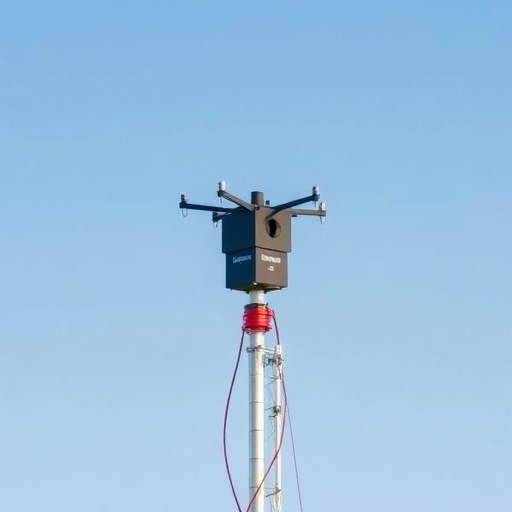
Wireless communication, an indispensable part of our daily lives, is on the cusp of a transformative leap thanks to pioneering research emerging from the University of British Columbia’s Okanagan campus. Dr. Anas Chaaban and his team from the School of Engineering have developed a groundbreaking approach that promises to dramatically enhance the strength, clarity, and security of wireless signals by advancing the capabilities of stacked intelligent surfaces (SIS). This technology is poised to redefine how electromagnetic waves are manipulated, potentially unlocking unprecedented levels of performance in next-generation wireless systems.
Stacked intelligent surfaces represent an innovative departure from conventional wireless hardware architectures. Rather than relying on the bulky, power-intensive circuitry that characterizes traditional communication devices, SIS technology uses meticulously engineered layers of materials that interact directly with electromagnetic waves. These surfaces are composed of numerous discrete elements designed to subtly alter the waves as they propagate through, functioning in a manner akin to neural networks used in artificial intelligence. Each element performs precise modifications on incoming signals, collectively transforming the wave properties and enabling exceptionally efficient signal processing with drastically reduced energy consumption.
In conventional SIS designs, these wave-modifying elements operate linearly, limiting their ability to perform complex transformations on the signal. This linearity restricts the scope of operations to relatively simple manipulations, which curtails the potential for advanced applications such as multi-layered signal processing and interference mitigation. Dr. Chaaban’s team, however, introduces a novel nonlinear architecture which imbues each element with the capability to enact nonlinear functions on electromagnetic waves. This breakthrough allows these intelligent surfaces to emulate the intricate calculations performed by modern AI systems, particularly in how data is processed and filtered.
The nonlinear behavior integrated into each unit of the intelligent surface marks a paradigm shift. By incorporating nonlinearity, these surfaces can generate highly sophisticated wave patterns, facilitating operations that linear systems are simply incapable of achieving. This opens up a wealth of possibilities for wireless communication, including more resilient encoding schemas and dynamic signal routing. Co-author and doctoral student Omran Abbas emphasizes that harnessing nonlinearity provides a foundational enhancement to SIS’s operational intelligence, bridging the gap between simple signal relay and complex AI-like processing at the physical layer of communication.
Simulations of wireless networks utilizing these nonlinear stacked intelligent surfaces have demonstrated remarkable improvements in communication reliability. Notably, they reduce symbol error rates—a critical metric that measures how accurately data is transmitted and received in noisy or interference-heavy environments. The complex wave interactions enabled by the nonlinear elements create signal patterns that are far more robust against external disruptions. This resilience not only improves the fidelity of transmitted data but also enhances overall network efficiency, setting a new standard for wireless signal processing techniques.
The potential for physical realization of this advanced technology is bolstered by contributions from Dr. Loïc Markley, a collaborator possessing deep expertise in periodic structures and metamaterials. His work focuses on designing and fabricating the nonlinear unit cells that form the fundamental building blocks of these intelligent surfaces. With a successful physical prototype on the horizon, the team is poised to transition from theoretical models and simulations to real-world applications, offering a tangible demonstration of the profound advantages nonlinear SIS can deliver in wireless communication systems.
Beyond raw communication performance, the nonlinear intelligent surfaces offer significant promise for cybersecurity in wireless networks. Given the inherently unpredictable transformations imparted on electromagnetic waves by nonlinear elements, unintended receivers would find it substantially more difficult to intercept or decode transmitted signals without precise knowledge of the nonlinear functions applied. This feature introduces an innovative layer of security native to the physical transmission medium, providing an added safeguard against eavesdropping and unauthorized data access in increasingly connected and vulnerable wireless environments.
While these findings are currently grounded in detailed simulations and theoretical explorations, the UBC Okanagan team underscores the importance of continued research to fully validate and optimize nonlinear SIS for practical deployment. Future work aims to refine the physical designs, develop scalable manufacturing techniques, and rigorously test these devices under various real-world environmental conditions. Such efforts will be crucial in transitioning the technology from a laboratory prototype to a robust wireless communication component suitable for integration into consumer devices and infrastructure.
Experts in the field recognize the transformative potential of this innovation in the broader context of upcoming wireless standards. Dr. Chaaban highlights that nonlinear stacked intelligent surfaces could play a vital role in enabling the capabilities envisioned for 6G and beyond. These next-generation wireless systems demand unprecedented levels of speed, reliability, energy efficiency, and security—challenges that traditional communication architectures struggle to meet. By embedding intelligent, nonlinear processing directly into the physical environment of signal propagation, this technology offers a fundamentally new instrumentation for future networks.
This research thus paves the way toward smarter, more adaptive wireless environments. Imagine networks where surfaces in the physical world—not just complex central processors—actively participate in signal conditioning, tailoring communication in real time based on context, noise, or security needs. The implications extend far beyond mobile phones to encompass interconnected systems such as autonomous vehicles, remote sensing arrays, and massive IoT deployments, where signal integrity and security are paramount.
As the UBC team continues to explore these nonlinear intelligent surfaces, the multidisciplinary nature of the project becomes apparent, intersecting fields such as electromagnetics, artificial intelligence, materials science, and wireless communications engineering. The ability to co-opt principles from AI and metamaterials into physical layer communication technologies reflects the increasingly integrated and innovative approach driving modern research, and marks a critical step forward in harnessing the full potential of electromagnetic wave manipulation for practical use.
In conclusion, the advent of nonlinear stacked intelligent surfaces emerges as a landmark advancement with far-reaching consequences for the trajectory of wireless communication technology. By blending sophisticated nonlinear transformations with the inherent efficiencies of intelligent surfaces, this approach sets a promising course toward making wireless systems stronger, clearer, and more secure. If realized at scale, such innovation could fundamentally reshape how information flows through space, ushering in a new era of connectivity defined not just by speed, but by intelligence embedded in the very fabric of the communication channel.
Keywords
Wireless Communication, Stacked Intelligent Surfaces, Nonlinear Systems, Electromagnetic Wave Manipulation, Signal Processing, Artificial Neural Networks, Wireless Security, 6G Technology, Metamaterials, Signal Reliability, Nonlinear Unit Cells, Energy-Efficient Communications
Cite Scienmag News
Blake Davidson. (April 30, 2026). UBCO Discovery Poised to Revolutionize Future Wireless Networks. Scienmag. https://scienmag.com/ubco-discovery-poised-to-revolutionize-future-wireless-networks/
Blake Davidson. "UBCO Discovery Poised to Revolutionize Future Wireless Networks." Scienmag, 30 April 2026, https://scienmag.com/ubco-discovery-poised-to-revolutionize-future-wireless-networks/. Accessed 6 September 2026.
Blake Davidson. "UBCO Discovery Poised to Revolutionize Future Wireless Networks." Scienmag. April 30, 2026. https://scienmag.com/ubco-discovery-poised-to-revolutionize-future-wireless-networks/


