


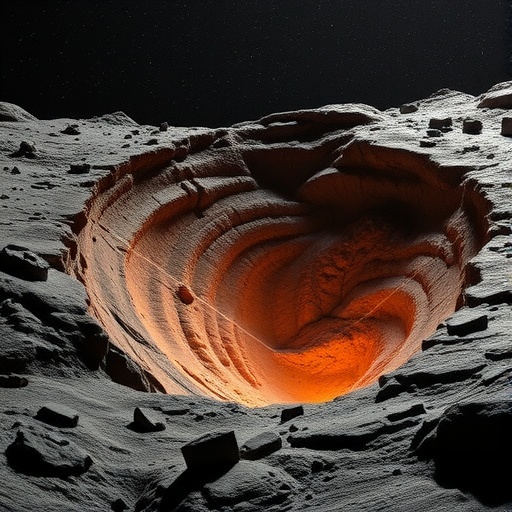
A groundbreaking discovery by a team of South Korean geoscientists sheds new light on the origins of Earth’s atmospheric oxygen, revealing compelling evidence that impact-generated hydrothermal lakes may have been critical cradles for early life. This revelation, derived from the identification of stromatolites within the Hapcheon impact crater—the only confirmed impact structure on the Korean Peninsula—provides a novel perspective on microbial ecosystems thriving in the aftermath of catastrophic asteroid collisions.
Stromatolites, the laminated bio-geological formations shaped by cyanobacteria and other microbial communities, represent some of the earliest fossilized evidence of life on our planet, dating back over 3.5 billion years. These organisms are instrumental in oxygenic photosynthesis, a process that profoundly transformed Earth’s atmosphere during the Great Oxidation Event (GOE) approximately 2.4 billion years ago. The presence of stromatolites in the Hapcheon crater offers a rare window into post-impact environmental conditions that may have fostered the flourishing of these oxygen-producing microbes in localized aquatic habitats.
The Hapcheon crater, initially confirmed in a 2021 study by the Korea Institute of Geoscience and Mineral Resources (KIGAM), is an approximately several-kilometer-wide impact structure formed by an ancient extraterrestrial collision. The recent research goes beyond site confirmation, detailing the discovery of stromatolite-like deposits in the crater’s northwestern basin area. These biological vestiges, measuring between 10 and 20 centimeters across, exhibit complex layering consistent with biogenic stromatolites, suggesting that vigorous microbial ecosystems once thrived in this hydrothermal lacustrine environment.
Post-impact hydrothermal lakes form when the immense heat generated by an asteroid impact melts subsurface rock, releasing mineral-rich fluids into newly created crater basins. The sustained thermal and chemical gradients within such lakes offer a stable, nutrient-dense environment conducive to microbial metabolism. Heat-intensive water-rock interactions facilitate the precipitation of mineral substrates, creating scaffolds around which biofilms and microbial mats can accrete, hence promoting stromatolite growth. This discovery impressively ties the physical aftermath of extraterrestrial collisions to the biological evolution of early life on Earth.
Critical geochemical investigations underpinning this study reveal multilayered stromatolite structures with distinct signatures reflecting a complex history of formation. Notably, inner layers yield elevated markers indicative of hydrothermal alteration at higher temperatures, implying that stromatolite genesis commenced soon after the impact event when fluids were hotter and more chemically reactive. The outer layers, conversely, record cooler formation conditions, pointing to a gradual thermal decline as the crater lake system evolved. Importantly, these layers also incorporate exotic extraterrestrial material intermingled with fragments of indigenous bedrock, confirming the crater’s impact origin and subsequent biological colonization.
This innovative research challenges and enriches current models addressing the dynamics of the Great Oxidation Event by proposing that ‘oxygen oases’—localized environments with high oxygen production—could have been seeded in post-impact hydrothermal lakes. While global oxygen levels rose precipitously during the GOE, the spatial heterogeneity of oxygen generation remains a topic of active inquiry. The notion that asteroid impact sites provided isolated niches for cyanobacterial expansion adds a crucial dimension to our understanding of biosphere evolution under varying planetary conditions.
Moreover, the findings extend their significance beyond Earth’s confines, bearing astrobiological implications for the search for ancient life on Mars. Mars’ early surface geology reveals numerous impact craters, many of which would have hosted substantial, long-lived hydrothermal lakes analogous to that at Hapcheon. The research team speculates that these Martian basins could preserve fossilized biosignatures or geochemical traces of microbial activity, thereby representing prime targets for future robotic or, potentially, crewed missions aiming to detect extraterrestrial life remnants.
This study’s interdisciplinary approach combined high-resolution petrographic analysis, isotope geochemistry, and impact geology to reconstruct the paleoenvironmental conditions within the crater. The synergy of field sampling, laboratory mineralogical characterization, and comparative morphological analysis of stromatolites facilitated robust interpretations of microbial colonization timelines relative to thermal evolution of post-impact hydrothermal systems. This fusion of methodologies underscores the complex interplay between catastrophic geological events and biological resilience and adaptation in Earth’s deep past.
The research not only underscores the geological significance of the Hapcheon crater but also elevates its status as a crucial archive of early biosphere-environment interactions. It propels the study of impact-related ecosystems to the forefront of geobiology and planetary sciences, inviting further exploration of similar craters worldwide to decipher their roles as incubators of life. The possibility that such environments provided sustained niches for oxygen-producing microbes could rewrite narratives regarding the spatial and temporal patterns of atmospheric oxygen escalation.
Lead author Dr. Jaesoo Lim highlights the profound implications of the findings, stating, “This is the first comprehensive evidence suggesting that stromatolites could form in hydrothermal lakes created by asteroid impacts. Such environments may have provided favorable conditions for early microbial ecosystems.” This insight prompts reassessment of impact craters’ ecological roles, not merely as destructive forces but also as genesis sites fostering biological innovation during critical windows of Earth’s evolutionary timeline.
Furthermore, the intricate mineralogical compositions identified in the stromatolites imply complex biogeochemical feedbacks operating under hydrothermal influences. Minerals such as carbonates and silicates within the stromatolitic matrices reflect microbe-mineral interactions that facilitate energy acquisition and structural stability of microbial mats. These processes impact carbon cycling and contribute to the geological record, enabling elucidation of ancient metabolic pathways and environmental conditions through detailed isotopic studies.
The discoveries emerging from the Hapcheon impact crater offer a tantalizing paradigm for understanding how extraterrestrial impacts could have not only shaped Earth’s geology but also enhanced biological complexity. By combining paleobiology with impact morphology and hydrothermal geochemistry, this research paves the way for integrated studies addressing origins-of-life questions both on Earth and across the solar system. The synchronicity of catastrophic events with biotic innovation remains a captivating frontier that continues to inspire scientific inquiry.
As planetary exploration advances, the concept of impact-generated hydrothermal systems as cradles of life will undoubtedly influence mission planning and the interpretation of extraterrestrial sedimentary records. The Hapcheon crater study thus situates itself at the nexus of geology, biology, and planetary science, heralding a transformative era where impact structures are recognized not only as relics of destruction but also as reservoirs of life’s earliest chapters.
News Publication Date: 14-Apr-2026
Web References:
- KIGAM
- DOI link: 10.1038/s43247-026-03206-7
References:
- Lim, J., et al. (2026). Discovery of stromatolite formation in post-impact hydrothermal lacustrine environments and its implications for early Earth. Communications Earth & Environment. DOI: 10.1038/s43247-026-03206-7.
- Previous confirmation of Hapcheon crater: Gondwana Research, 2021.
Keywords
Impact craters, stromatolites, early life, hydrothermal lakes, Great Oxidation Event, microbial ecosystems, Hapcheon crater, oxygen oases, extraterrestrial impacts, geobiology, planetary science, Mars astrobiology
Cite Scienmag News
Grant Pearson. (May 20, 2026). Ancient Asteroid Impact Site Uncovers Potential Signs of Early Life. Scienmag. https://scienmag.com/ancient-asteroid-impact-site-uncovers-potential-signs-of-early-life/
Grant Pearson. "Ancient Asteroid Impact Site Uncovers Potential Signs of Early Life." Scienmag, 20 May 2026, https://scienmag.com/ancient-asteroid-impact-site-uncovers-potential-signs-of-early-life/. Accessed 3 September 2026.
Grant Pearson. "Ancient Asteroid Impact Site Uncovers Potential Signs of Early Life." Scienmag. May 20, 2026. https://scienmag.com/ancient-asteroid-impact-site-uncovers-potential-signs-of-early-life/


