


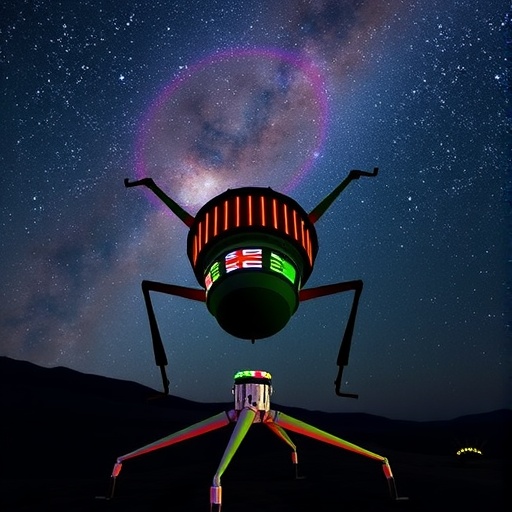
In a remarkable stride for astrophysical observation and space weather monitoring, the U.S. Naval Research Laboratory (NRL) successfully launched its Glowbug-2 instrument aboard the Department of War (DoW) Space Test Program – Houston 11 (STP-H11) payload. The launch took place on May 15th at approximately 6:05 p.m. EDT from Cape Canaveral Space Force Station in Florida. This mission represents a critical advancement in the detection and analysis of gamma-ray bursts (GRBs), some of the universe’s most cataclysmic and enlightening cosmic events.
Glowbug-2 is a sophisticated gamma-ray detection system designed to autonomously identify and precisely localize short gamma-ray bursts, intense flashes of high-energy photons generated by the violent mergers of neutron stars and black holes. These brief but immensely powerful bursts illuminate extreme physics processes that are key to understanding the fundamental workings of the cosmos. As these celestial phenomena occur millions of light-years away, having a sensitive and rapid-response instrument like Glowbug-2 in orbit dramatically enhances our capability to capture these fleeting bursts.
The technological core of Glowbug-2 consists of four large scintillating panels made from specialized crystals that emit visible light when struck by gamma rays. This light emission is then captured with cutting-edge photodetectors, converting the faint flashes into electrical signals for further analysis. The instrument operates with a high degree of autonomy, capable of detecting candidate bursts and generating real-time alerts to ground-based researchers instantly. This rapid notification system is pivotal in coordinating multi-messenger observations, integrating data from complementary observatories, including gravitational wave detectors on Earth.
Multi-messenger astrophysics — the integrated study of cosmic events through various signals like electromagnetic radiation, gravitational waves, and neutrinos — stands to benefit immensely from Glowbug-2’s mission. By providing timely electromagnetic observations corresponding to gravitational wave detections, Glowbug-2 helps decode the complex processes underlying neutron star and black hole collisions, ultimately unraveling key questions about matter under extreme conditions and the synthesis of heavy elements in the universe.
Beyond its astrophysical mission, Glowbug-2 also serves a critical secondary function of monitoring local ionizing radiation environment in Earth’s orbit. This capability holds substantial relevance for defense and space operations, delivering real-time data on space weather and radiation phenomena that could impact satellites, astronauts, and other sensitive technologies in low Earth orbit. Enhanced monitoring of gamma-ray sources closer to home allows for improved prediction and mitigation responses for the U.S. defense and space communities.
According to Dr. J. Eric Grove, principal investigator for Glowbug-2, while the instrument’s primary objective is astronomy-centric, the broader defense community is increasingly interested in understanding localized gamma-ray radiation sources. The dual-use nature of Glowbug-2’s design adds extensive value to the mission by bridging fundamental scientific research with practical defense applications, emphasizing the instrument’s versatility.
Glowbug-2 builds on the proven success of its predecessor, Glowbug-1, which operated for nearly two years and cataloged over 100 gamma-ray bursts alongside numerous significant solar flare events. This heritage underscores the efficacy of the detection technology and operational strategies employed by the NRL team. Glowbug-2 inherits advanced improvements in sensitivity and data processing, ensuring it can extend and deepen our observational reach into gamma-ray transient phenomena.
This instrument’s sensors share a lineage with the hardware being developed for NASA’s upcoming StarBurst Multimessenger Pioneer mission, signifying a continued collaboration between NRL and NASA in employing state-of-the-art radiation detection technologies. These shared components underline both the cost-effectiveness and high-performance standards achieved by the NRL in space-based particle detection instrumentation.
The Glowbug-2 mission is planned for an initial term of one year, with potential extensions based on its performance and the operational needs of the International Space Station (ISS) and partner agencies. This timeline will ensure a significant window for data collection, analysis, and integration with other astrophysical observatories and space weather monitoring efforts.
Collaborative efforts are also a highlight of the Glowbug-2 initiative. As noted by Dr. Richard Woolf, NRL mission manager and co-investigator, the team intends to coordinate with other simultaneous Space Test Program payloads aboard the ISS to maximize scientific output. Prompt alerts issued by Glowbug-2 upon detecting gamma-ray events will encourage complementary instruments to search for coincident data, enriching the multi-instrumental understanding of explosive cosmic phenomena.
Glowbug-2 arrived at the ISS as part of NASA’s Commercial Resupply Services-34 mission, having spent approximately 38 hours in transit aboard the SpaceX Dragon spacecraft. Onboard the Dragon with Glowbug-2 were multiple scientific experiments, supplies, and equipment, highlighting the station’s multi-faceted role as a hub for advanced research and technology demonstration in orbit.
This mission is funded by NASA’s Astrophysics Research and Analysis (APRA) program, reinforcing NASA’s commitment to expanding humanity’s understanding of the high-energy universe. The Glowbug instruments’ ongoing success in both fundamental science and space environment monitoring continues to showcase the significant contributions of the U.S. Naval Research Laboratory to astrophysics and space defense.
The U.S. Naval Research Laboratory, with its broad expertise in scientific and engineering innovation spanning from the ocean floor to outer space, consistently drives cutting-edge research with operational relevance for the U.S. Navy and the Department of Defense. Located in Washington, D.C., with major facilities across the country, NRL facilitates collaborations with a wide spectrum of scientific partners and institutions to advance space science and technology.
In conclusion, the deployment of Glowbug-2 marks a substantial leap forward in both astrophysical gamma-ray detection and strategic space situational awareness. Its capacity to deliver near-instantaneous alerts upon gamma-ray burst detection is a critical enabler for the rapidly emerging field of multi-messenger astrophysics. Simultaneously, its sensor package plays a pivotal role in enhancing our understanding of hazardous radiation environments in near-Earth space, thereby supporting both scientific discovery and national security interests. With Glowbug-2’s operations now underway aboard the ISS, researchers anticipate rich datasets that will illuminate some of the universe’s most energetic and enigmatic events, while actively safeguarding the space domain.
News Publication Date: May 15, 2026
Web References:
- Glowbug-2 technical overview SPIE Digital Library
- Department of War Space Test Program
- NASA Commercial Resupply Services-34 mission
- StarBurst Multimessenger Pioneer mission
Keywords
Gamma-ray bursts, short GRBs, multi-messenger astrophysics, neutron star collision, black hole merger, gamma-ray detector, space radiation monitoring, Naval Research Laboratory, STP-H11 payload, International Space Station, space weather, space defense
Cite Scienmag News
Grant Pearson. (May 18, 2026). NRL Unveils Glowbug-2 to Advance Space Domain Awareness and Detect Cosmic Anomalies. Scienmag. https://scienmag.com/nrl-unveils-glowbug-2-to-advance-space-domain-awareness-and-detect-cosmic-anomalies/
Grant Pearson. "NRL Unveils Glowbug-2 to Advance Space Domain Awareness and Detect Cosmic Anomalies." Scienmag, 18 May 2026, https://scienmag.com/nrl-unveils-glowbug-2-to-advance-space-domain-awareness-and-detect-cosmic-anomalies/. Accessed 4 September 2026.
Grant Pearson. "NRL Unveils Glowbug-2 to Advance Space Domain Awareness and Detect Cosmic Anomalies." Scienmag. May 18, 2026. https://scienmag.com/nrl-unveils-glowbug-2-to-advance-space-domain-awareness-and-detect-cosmic-anomalies/


