


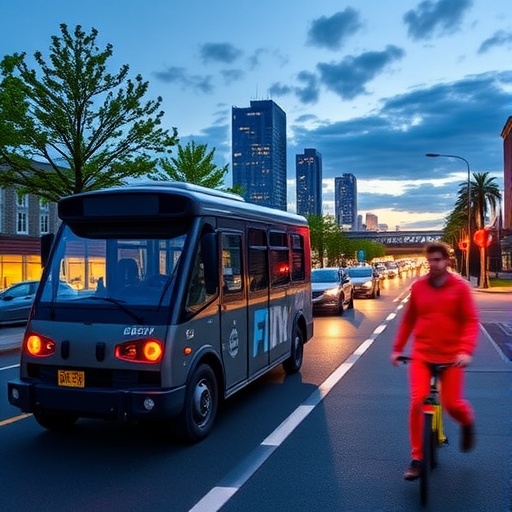
In an era where transportation remains one of the most energy-intensive sectors globally, Stanford University has launched a transformative initiative designed to overhaul how we move people and goods on land, through the air, and across the seas. The new Sustainable Mobility Center, housed within the Precourt Institute for Energy at the Stanford Doerr School of Sustainability, is poised to rethink mobility systems by integrating cutting-edge technologies with systemic sustainability principles. The center’s ambitious aim is to redefine transportation infrastructure and operations to be environmentally responsible, cost-effective, reliable, safe, and equitable on a global scale.
Traditional vehicles, powered primarily by fossil fuels, offer dismal energy efficiency. Studies show conventional cars convert only about 1% of the gasoline’s energy into actual motion, with the remainder dissipated as heat or used to propel heavy vehicle frames with little return in demonstrated utility. This startling inefficiency not only implies vast squandered resources but also exacerbates environmental degradation and climate change impacts. It is within this context that the Sustainable Mobility Center recognizes the urgent need for systemic rethinking—moving beyond incremental tech improvements to holistic redesign.
One of the key challenges the Center addresses is the inherent complexity of global transportation ecosystems. This complexity arises from the intricate interplay of vehicles, infrastructure, energy grids, operational frameworks, human behaviors, and policy environments. For example, while electric vehicles (EVs) reduce local pollution, their dependence on electric grids powered in part by fossil fuels shifts pollution burdens geographically rather than eliminating them. Moreover, the surge in EV adoption poses significant questions regarding grid stability and demand management, reflecting the interconnectedness of mobility and energy systems.
Stanford faculty co-directors Marco Pavone and Ram Rajagopal emphasize that this initiative is more than a technological endeavor; it is a profound cultural and systemic shift grounded in interdisciplinary innovation. The center leverages Stanford’s strengths across AI, autonomy, energy research, and data science, embedding these advances into transportation design for real-world scalability. AI and autonomous systems, in particular, are viewed as essential catalysts for achieving efficiency, safety, and coordination levels previously unattainable in the movement of people and goods.
The center’s approach is shaped by a systems-level philosophy, recognizing that reducing emissions or improving technology in isolation will not suffice. Instead, it demands coordinated redesigns that harmonize vehicle innovation, digital and physical infrastructures, energy generation and distribution, policy frameworks, and human-centric service design. This multifaceted approach acknowledges mutually reinforcing relationships. For instance, optimizing multi-modal transport networks requires simultaneous consideration of logistics, infrastructure resilience, economic incentives, and behavioral adaptations.
Integral to the center’s mission is bridging advanced research with practical impact. The leadership team combines expertise extending from fundamental energy science and power systems to autonomous vehicle engineering and entrepreneurial ventures in smart grid technologies. This breadth ensures the center operates at the nexus of theoretical insight, technological innovation, and real-world deployment, facilitating smoother pathways from lab breakthroughs to urban and regional mobility transformations.
The center’s activities will be sustained through collaborative industry partnerships, with corporate sponsors funding research and strategic initiatives. This model ensures that research remains attuned to market realities and fosters ecosystems where academia, industry, and government align around shared sustainability objectives. The founding industrial supporters—including major players from automotive manufacturing, shipping, logistics, energy, and technology sectors—underscore the broad stakeholder commitment needed to accomplish these objectives.
To tackle the inherently complex challenges in sustainable mobility, the center has framed several “Grand Challenges.” These include zero-emission freight logistics, development and scaling of sustainable aviation fuels, creation of intelligent logistics systems, establishment of multi-modal transportation networks, and enhancement of infrastructure resilience. Pursuing solutions for these challenges demands coordinated progress across adjacent technical domains so that advancements in vehicles, infrastructure, policies, and safety synchronize to unlock transformative benefits.
The Sustainable Mobility Center’s research structure is organized around five key pillars. These pillars encapsulate critical dimensions necessary for holistic mobility redesign. First is energy systems, focusing on electrification strategies, sustainable fuel development, grid interaction, and resilience. Second is infrastructure, emphasizing digital and physical assets such as charging networks and data-enabled transport systems. Third encompasses economics and policy, tackling incentive alignment and regulatory frameworks to ensure equitable and widespread adoption. Fourth pillar prioritizes safety, aiming to secure trustworthiness and resilience especially as autonomous technologies proliferate. The final pillar advocates interdisciplinary design that melds engineering, urban planning, and behavioral sciences to center human experience and systemic coherence.
By convening distinguished academic, industrial, and government leaders, the center fosters a collaborative ecosystem dedicated to defining priorities and articulating pathways for sustainable mobility innovations. This approach not only accelerates research synergies but also promotes scalable deployment of solutions that address intertwined sustainability imperatives—from emissions reductions and energy efficiency to social equity and economic viability.
With emerging technologies like AI and autonomy perceived not just as complementary but as central pillars of sustainability, the center is positioned to drive a paradigm shift in mobility systems. The persistent energy waste and environmental costs inherent in legacy transportation modes call for bold innovation, and Stanford’s initiative provides a beacon for how integrated technological, economic, and policy strategies can coalesce to reimagine our planet’s mobility future.
As the Sustainable Mobility Center embarks on this mission, it beckons a new era where the movement of goods and people is seamlessly efficient, environmentally harmonious, financially accessible, and robustly safe. The integration of advanced AI, smart infrastructures, and sustainable energy networks promises to revolutionize mobility with far-reaching impact—paving the way for cleaner cities, healthier communities, and a regeneration of trust in transportation as a foundation for equitable global progress.
News Publication Date: Not explicitly stated; inferred May 21 for inaugural meeting
Web References:
– https://sustainablemobility.stanford.edu
– https://energy.stanford.edu
– https://fuels.stanford.edu
– https://ora.stanford.edu
References: Not explicitly provided in the original content.
Cite Scienmag News
Sloane Callahan. (May 18, 2026). Sustainable Mobility Center Pioneers the Future of Global Transportation. Scienmag. https://scienmag.com/sustainable-mobility-center-pioneers-the-future-of-global-transportation/
Sloane Callahan. "Sustainable Mobility Center Pioneers the Future of Global Transportation." Scienmag, 18 May 2026, https://scienmag.com/sustainable-mobility-center-pioneers-the-future-of-global-transportation/. Accessed 4 September 2026.
Sloane Callahan. "Sustainable Mobility Center Pioneers the Future of Global Transportation." Scienmag. May 18, 2026. https://scienmag.com/sustainable-mobility-center-pioneers-the-future-of-global-transportation/


