


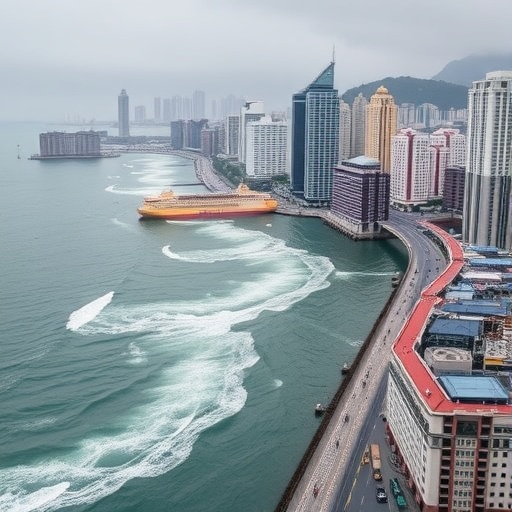
Macau’s recent advancements in disaster management underscore the critical importance of non-structural measures in mitigating the impacts of devastating typhoons and associated storm surges. In a landmark study conducted by researchers at the Institute of Science Tokyo, significant progress was documented in how this densely populated coastal city has bolstered its resilience through innovative early warning systems, strategic evacuation protocols, and effective public communications. This research offers a vital case study for other similarly vulnerable urban centers seeking to balance engineering solutions with adaptive social strategies to manage increasingly frequent and severe weather phenomena.
Located at the mouth of the Pearl River Delta and bordered by the South China Sea, Macau is highly susceptible to coastal flooding triggered by storm surges during typhoons. Historically, the city has faced immense challenges due to its high population density and relatively flat topography, which amplify flood risk. The recent research analyzed the city’s emergency responses to three major storms over the past decade—Typhoon Hato in 2017, Mangkhut in 2018, and Ragasa in 2025—uncovering crucial lessons from resident interviews and comprehensive assessments of the city’s disaster mitigation infrastructure and communication protocols.
The pivotal moment for disaster management reform in Macau can be traced back to Typhoon Hato in 2017, when severe storm surge flooding wreaked havoc across urban sectors. Criticism over delayed warnings and inadequate evacuation measures culminated in institutional accountability, notably the resignation of the Meteorological Bureau Director. This event sparked a thorough reevaluation of existing disaster preparedness strategies and catalyzed the introduction of enhanced early warning systems that issue alerts earlier in the storm timeline, affording residents critical additional time to seek safety.
Among the most impactful improvements was the development of a color-coded storm surge alarm system. This scheme, delineated into five discrete levels, provided a clear and rapid visual reference for residents to understand the severity of impending flood risks. To complement the alert system, the government deployed physical infrastructure such as hazard indication poles placed strategically throughout flood-prone zones to constantly remind citizens of local flood risks. The integration of these visual cues reinforced community awareness and readiness in a tangible, immediate manner.
Equally transformative were the government-led initiatives to actively guide evacuation processes. Authorities organized evacuation patrols to monitor public adherence to instructions and ensure timely compliance. The introduction of subsidies enabled commercial establishments to install deployable flood barriers, enhancing localized flood defenses without reliance on large-scale structural projects such as seawalls or dikes. This soft adaptation approach represents a strategic shift toward flexible, cost-efficient, and community-inclusive disaster management.
The study underscores the vital role of public trust and clear communication channels in disaster resilience. Surveys conducted after Typhoon Ragasa revealed that approximately two-thirds of respondents recognized significant improvements in government responsiveness. Key factors influencing positive perceptions included faster dissemination of warnings, shorter durations of power outage, installation of drainage systems, deployment of portable floodgates, and expedited post-storm cleanup efforts. These operational refinements not only mitigated physical damage but also strengthened community confidence and cooperation.
Contrastively, Macau’s contemporaneous reliance on non-structural measures diverges from approaches seen in neighboring Japan, where extensive coastal defenses like seawalls and dikes predominate. While Japan’s strategy focuses on engineered physical barriers, Macau’s model accentuates social preparedness, informational transparency, and resident engagement. The installation of mangrove plantations for natural buffer zones and the institutional memory of past inundations collectively scaffold a resilient social-ecological system able to adapt dynamically to climatic threats.
Professor Hiroshi Takagi from the Institute of Science Tokyo commented on the nuanced interplay between technological innovation and social dynamics: “Our external assessment highlights that improved resilience emerges not solely from hard infrastructure but significantly from adaptive governance, timely warnings, and public-endorsed evacuation protocols. Macau exemplifies how a suite of soft measures, implemented jointly by municipal authorities and citizens, can substantially diminish disaster impacts.”
Importantly, the research articulates that disaster mitigation in hyper-dense urban spaces necessitates multifaceted strategies. The successful outcomes in Macau derive from synchronizing technological upgrades—such as water-level monitoring stations and storm-surge warning posts—with proactive human factors, including government patrols advocating for orderly evacuations and residents’ firsthand experiences informing community-based risk assessments. This integration not only reduces immediate harm but cultivates an enduring culture of preparedness.
This study also identifies the potential for scalability and replication of Macau’s non-structural measures in other typhoon-prone cities with limited resources for extensive physical infrastructure projects. Emphasizing earlier alerts, transparent communication, and government-led evacuation efforts, municipalities can enhance their disaster response frameworks effectively without prohibitive expenditures on large coastal defenses. The findings advocate for a paradigm shift wherein governance, citizen engagement, and environmental monitoring coalesce as pillars of resilience.
The comprehensive approach adopted in Macau highlights not only disaster risk reduction but also public health considerations through minimizing the exposure and displacement of vulnerable populations. By reducing the physical and psychological burdens inflicted by typhoons, such systems promote recovery and sustainable urban living in the face of climate uncertainties. This alignment of environmental safety with human wellbeing signals a redefinition of resilience in urban coastal contexts.
In summary, Macau’s evolution from a city vulnerable to catastrophic typhoon devastation to one exhibiting enhanced coastal resilience is a testament to the efficacy of early warnings and soft adaptation measures. While physical infrastructure remains a component of disaster preparedness, this research foregrounds non-structural innovations as central to reducing typhoon impacts. As climate change intensifies the frequency and ferocity of tropical cyclones worldwide, Macau’s model offers a powerful blueprint for cities seeking an integrated balance of technology, policy, and community action.
Cite Scienmag News
Courtney Benton. (June 4, 2026). How Macau Enhanced Typhoon Resilience Without Building Massive Seawalls. Scienmag. https://scienmag.com/how-macau-enhanced-typhoon-resilience-without-building-massive-seawalls/
Courtney Benton. "How Macau Enhanced Typhoon Resilience Without Building Massive Seawalls." Scienmag, 4 June 2026, https://scienmag.com/how-macau-enhanced-typhoon-resilience-without-building-massive-seawalls/. Accessed 5 September 2026.
Courtney Benton. "How Macau Enhanced Typhoon Resilience Without Building Massive Seawalls." Scienmag. June 4, 2026. https://scienmag.com/how-macau-enhanced-typhoon-resilience-without-building-massive-seawalls/


