


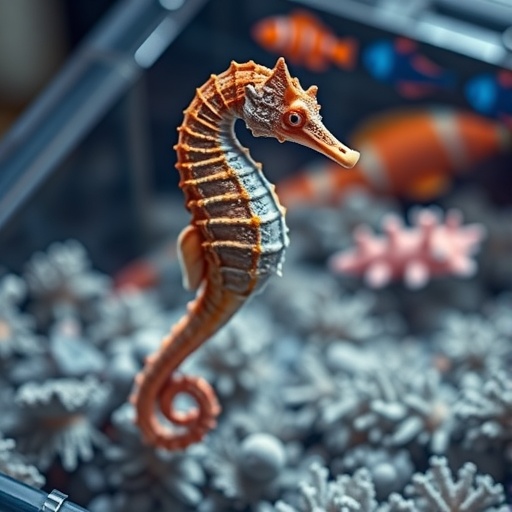
When the topic of wildlife trafficking emerges in public discourse, the images that often spring to mind include rhino horns or baby orangutans being clandestinely transported as illegal pets. However, there exists a lesser-known yet equally insidious form of trafficking that targets marine species, a practice which wreaks havoc on fragile ocean ecosystems globally. Among the most frequently smuggled marine wildlife are shark fins, seahorses, and sea cucumbers—commodities highly prized for food, traditional medicine, and ornamental use. These items often slip undetected through traditional border controls, concealed within luggage or parcels, posing a formidable challenge for enforcement agencies worldwide.
The complexities of intercepting such shipments at border points stem not only from the ingenious ways traffickers disguise these goods but also from the limitations of current scanning technologies and detection methods. Recognizing this persistent gap, scientists at Macquarie University have harnessed cutting-edge artificial intelligence to revolutionize how we detect illegal marine wildlife trade. Their groundbreaking approach involves retooling standard 3D X-ray computed tomography (CT) scanners—equipment already installed in many airports—to identify illicit marine species with remarkable precision.
X-ray CT scanners differ substantially from typical 2D X-ray machines by generating volumetric images from multiple X-ray projections taken around an object. This capacity allows the creation of detailed three-dimensional renderings, providing depth and structural information that can reveal concealed contraband objects. By leveraging this technology and augmenting it with advanced neural network algorithms, Dr. Vanessa Pirotta and her team have developed a model capable of discerning shark fins, seahorses, and sea cucumbers with 92% overall accuracy, signaling a quantum leap forward in anti-trafficking measures.
The endeavor began with the assembly of an extensive database of CT scans comprising 298 images of these marine species. These samples were sourced from real-world wildlife trafficking seizures, adding authenticity and practical relevance to the dataset. Each specimen was scanned multiple times in varied orientations and contexts to simulate the myriad ways trafficked goods might be arranged within baggage. To bolster the model’s robustness, researchers introduced scans containing multiple species and even engineered scenarios mimicking smuggler tactics, such as wrapping items in tin foil or concealing them within children’s toys.
This rigorous training enabled the artificial intelligence system to internalize subtle morphological characteristics that differentiate illicit marine wildlife from benign items commonly found in luggage. Notably, the detection accuracy varied slightly across species, with the algorithm identifying 95% of shark fins, 96% of seahorses, and 86% of sea cucumbers. Although these figures underscore impressive performance, the importance of minimizing false positives was also addressed. The algorithm maintained a commendable false positive rate of just 13%, broken down into 2% for shark fins, 1% for sea cucumbers, and 9% for seahorses—values that affirm the system’s practical applicability in high-throughput screening environments.
The implications of this technology extend beyond mere detection. Trafficking in marine wildlife is an estimated multi-billion-dollar industry, jeopardizing the survival of already vulnerable populations. For instance, shark finning has contributed to alarming declines in shark numbers worldwide, while the illegal trade in seahorses fuels unsustainable exploitation of these charismatic but delicate creatures. Sea cucumbers, whose ecological role includes nutrient recycling and habitat maintenance in marine environments, often suffer from underreported illegal harvests, exacerbating ecosystem imbalance. By providing enforcement officials with a potent automated screening tool, this AI-enhanced CT scanning system stands to disrupt illicit supply chains significantly and strengthen conservation efforts.
However, caution remains warranted. Dr. Pirotta emphasizes that while this AI-driven approach represents a substantive advance, it is not a panacea capable of supplanting human expertise or other detection methods, such as sniffer dogs or manual inspections. The algorithm’s effectiveness is inherently conditioned by the quality and breadth of data used for training, which is currently limited to a few select species. Broader applications would necessitate incorporating more diverse species and trafficking scenarios to cover the multifaceted nature of marine wildlife crime comprehensively.
Moreover, the costly nature of 3D CT scanners restricts their availability, particularly in resource-constrained regions where smuggling activities may be prevalent. At present, many airports continue to rely on 2D scanners, which lack the capability to produce volumetric images essential for this AI application, potentially impeding the widespread adoption of such technologies. Nonetheless, integrating AI-assisted detection with existing security protocols promises synergistic gains — enhancing overall detection rates and enabling more targeted and efficient interventions by customs authorities.
The novel methodology devised by the Macquarie team also incorporates the innovative use of Threat Image Projection (TIP). TIP involves inserting digitally manipulated images containing smuggled items into routine X-ray scans to simulate real-world conditions where threats are rare. This approach enables continuous testing and improvement of algorithm performance without exposing operators to actual illegal goods, fostering a safer and more adaptive learning environment for detection technologies.
Crucially, this research was conducted within a collaborative framework involving Rapiscan Systems, the manufacturer of the RTT110 3D X-ray equipment utilized. Although some authors are affiliated with Rapiscan, measures were taken to ensure scientific impartiality, with other researchers declaring no commercial conflicts of interest. The study was published in Frontiers in Ocean Sustainability, reflecting the intersection of marine conservation, technological innovation, and sustainable development goals.
The deployment of AI algorithms in the fight against marine wildlife trafficking exemplifies the transformative potential of cross-disciplinary solutions integrating biology, computer science, and security technology. As illegal wildlife trade continues to evolve with sophistication, so too must our detection and enforcement strategies. By illuminating hidden cargo and revealing otherwise undetectable contraband, intelligent systems like this offer a beacon of hope for the protection of oceanic biodiversity and the safeguarding of vulnerable species from the relentless pressures of illicit exploitation.
In sum, the application of AI-enhanced 3D CT scanning marks a pioneering stride towards intercepting the global marine wildlife smuggling crisis. While challenges remain, this technology heralds a future where illegal shipments hiding in plain sight within luggage can be uncovered swiftly and accurately, enabling authorities to act decisively and uphold the integrity of marine ecosystems worldwide.
News Publication Date: 8-Jun-2026
Web References:
DOI link
Cite Scienmag News
Margaret Porter. (June 7, 2026). AI Technology May Detect Smuggled Seahorses Hidden in Luggage, Inspired by Finding Nemo. Scienmag. https://scienmag.com/ai-technology-may-detect-smuggled-seahorses-hidden-in-luggage-inspired-by-finding-nemo/
Margaret Porter. "AI Technology May Detect Smuggled Seahorses Hidden in Luggage, Inspired by Finding Nemo." Scienmag, 7 June 2026, https://scienmag.com/ai-technology-may-detect-smuggled-seahorses-hidden-in-luggage-inspired-by-finding-nemo/. Accessed 4 September 2026.
Margaret Porter. "AI Technology May Detect Smuggled Seahorses Hidden in Luggage, Inspired by Finding Nemo." Scienmag. June 7, 2026. https://scienmag.com/ai-technology-may-detect-smuggled-seahorses-hidden-in-luggage-inspired-by-finding-nemo/


