


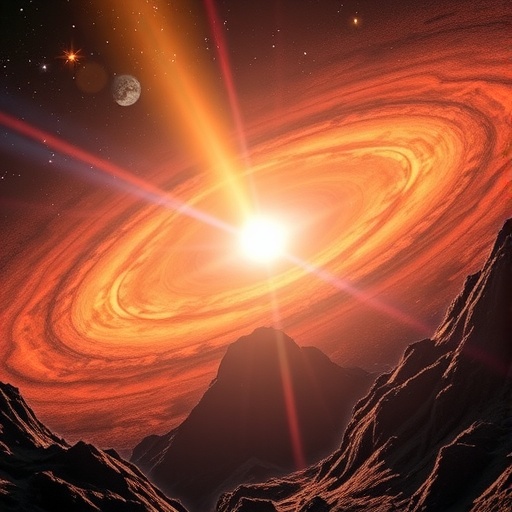
The International Gamma Ray Astrophysics Laboratory, known as INTEGRAL, represents a monumental achievement in space-based astronomy, particularly in the study of high-energy phenomena. Launched by the European Space Agency, INTEGRAL has revolutionized our understanding of the universe by offering an unprecedented view into gamma rays—the highest-energy form of electromagnetic radiation. Designed with a large field of view for gamma-ray imaging, complemented by precise X-ray and optical monitoring instruments, INTEGRAL operates in a unique orbit that allows for extended, uninterrupted observations far from Earth’s radiation belts. This capability has enabled a wealth of discoveries that continue to shape astrophysics.
INTEGRAL’s architecture sets it apart from other observatories. At its core, the satellite carries multiple instruments tailored to capture a broad spectrum of high-energy photons. Its gamma-ray instruments provide detailed imaging, timing, and spectroscopy data, mapping the chaotic and energetic processes powering cosmic sources such as black holes, neutron stars, and supernovae. Simultaneously, its X-ray and optical monitors deliver complementary information, offering insights into the environments surrounding these extreme objects. The synergy across energy bands allows scientists to perform multifaceted analyses that were previously impossible.
One of INTEGRAL’s most striking contributions is in the field of nucleosynthesis—the cosmic formation of new atomic nuclei. By detecting gamma-ray signatures from radioactive decay products, INTEGRAL provides direct observational evidence of element formation in supernova explosions and other stellar processes. This capability bridges theoretical models with empirical data, advancing our comprehension of how the building blocks of matter are created and disseminated throughout the cosmos. INTEGRAL’s detailed spectroscopy of these gamma-ray lines offers a window into the intricate nuclear reactions occurring in extreme astrophysical environments.
Supernova modeling has also witnessed a paradigm shift thanks to observations from INTEGRAL. Through its precise measurements of gamma-ray emissions originating from exploded stars, scientists can trace the explosion mechanics and energy distribution in unprecedented detail. This allows astrophysicists to refine their models of stellar death and the resultant formation of neutron stars or black holes. The mission’s data help address longstanding questions about the asymmetry of explosions, the role of magnetic fields, and the process of shock wave propagation in the aftermath of these cataclysmic events.
Furthermore, INTEGRAL has significantly furthered our understanding of cyclotron lines—distinctive features in the X-ray spectra of neutron stars caused by electrons spiraling around intense magnetic fields. Observations from the satellite have illuminated the structure and intensity of these magnetic fields, which can reach trillions of times stronger than Earth’s. Studying cyclotron lines allows astrophysicists to probe the exotic physics governing matter under extreme conditions, including neutron star crust composition, magnetic field evolution, and particle acceleration mechanisms.
The large orbit of INTEGRAL, carefully selected to maximize observation time free from Earth’s atmosphere and interference, has been critical in the quality and continuity of its data. By avoiding the South Atlantic Anomaly and operating far beyond the Van Allen belts, the satellite gathers extensive, uninterrupted datasets. This approach has enabled long exposure times essential for capturing faint gamma-ray sources and for conducting timing analyses of transient phenomena such as gamma-ray bursts or pulsations from compact objects. As a result, INTEGRAL has provided some of the most reliable and comprehensive archives of high-energy astrophysical data ever collected.
INTEGRAL’s legacy extends beyond the scientific discoveries alone—it lies also in its methodological innovations and the rich data repositories it has generated. Its observations have fueled countless publications and sparked new research avenues within the astrophysical community. The diversity of sources and emission mechanisms studied—ranging from the steady glow of galactic binaries to the fleeting brilliance of gamma-ray bursts—demonstrate the versatility and depth of the mission’s scope. This massive trove of data continues to be a resource for researchers aiming to investigate the universe’s most energetic processes.
Importantly, INTEGRAL’s comprehensive datasets have been instrumental in the study of gamma-ray bursts (GRBs), among the most energetic events observed in the cosmos. By rapidly detecting and localizing GRBs, INTEGRAL aids in investigating their origins, which often link to massive star collapses or neutron star mergers. The satellite’s fast timing capabilities capture the burst evolution, revealing clues about the underlying physics driving these extreme explosions. Such observations contribute fundamentally to multimessenger astronomy, complementing gravitational wave detections and neutrino observations.
The mission has also made strides in unraveling the mysteries of the galactic center, a region shrouded in complex high-energy processes and the home of a supermassive black hole. INTEGRAL’s gamma-ray imaging capabilities penetrate dense interstellar dust obscuring this region in visible light. The data collected uncover intricate emission patterns arising from interactions between cosmic rays and molecular clouds, as well as from accretion phenomena near the black hole. These insights help piece together the dynamics governing the heart of our Milky Way.
In addition, INTEGRAL has been pivotal in the investigation of positron annihilation in the galaxy, a phenomenon producing a distinctive gamma-ray line at 511 keV. The satellite’s observations illuminated the surprising spatial distribution of positron annihilation radiation, challenging existing theoretical models. By mapping these emissions, INTEGRAL provides clues on the production sites of positrons, whether from stellar sources such as pulsars, radioactive decays, or more exotic processes possibly linked to dark matter annihilation. This enigma remains a topic of active research thriving on INTEGRAL’s legacy.
The mission’s capability to conduct gamma-ray spectroscopy also advances our understanding of cosmic ray sources. Gamma rays indicate where cosmic rays interact with interstellar matter, forming a background that traces energetic particle acceleration sites like supernova remnants and pulsar wind nebulae. By studying the spectral features and temporal variations of gamma-ray emission, INTEGRAL enables probing of particle acceleration mechanisms—knowledge crucial for astrophysics and particle physics alike.
Importantly, the mission’s data set offers valuable insights into transient high-energy phenomena occurring within our galaxy and beyond. The detection of novae, X-ray binaries in outburst, magnetar flares, and other variable sources has been enriched by INTEGRAL’s sensitivity and timing resolution. Continuous monitoring has allowed characterization of these phenomena’s life cycles and emission mechanisms, contributing to a broader understanding of stellar evolution and compact object dynamics.
INTEGRAL’s contributions are not limited to astrophysical phenomena alone but extend into fundamental physics, allowing tests of relativistic effects in strong gravitational fields and constraints on theories of quantum gravity. Observations of time delays and energy dispersion in gamma-ray bursts provide experimental arenas for investigating potential violations of Lorentz invariance. These cutting-edge applications demonstrate the mission’s relevance across multiple scientific domains, highlighting the interplay between astrophysics and high-energy physics.
The hopeful outlook for continued exploration of INTEGRAL’s extensive data archives is a testament to the mission’s lasting influence. As new analysis techniques, including machine learning and advanced spectral fitting, become more prevalent, the ability to extract fresh insights from the existing data only improves. This suggests a future where INTEGRAL’s legacy not only endures but expands, offering multiple generations of astrophysicists robust tools to unravel the universe’s most energetic and enigmatic phenomena.
Ultimately, the INTEGRAL mission stands as a beacon of international collaboration and technological excellence, exemplifying the power of sustained space observations to transform our cosmic perspective. Its comprehensive legacy catalogues and high-quality data repositories remain an invaluable scientific heritage, inspiring ongoing research and discovery. As the astrophysics community continues to mine its treasures, INTEGRAL’s profound impact will resonate well into the coming decades, underscoring the significance of gamma-ray astrophysics in decoding the universe’s high-energy frontier.
Cite Scienmag News
Grant Pearson. (May 15, 2026). INTEGRAL Mission: Unveiling Cosmic Gamma-Ray Mysteries. Scienmag. https://scienmag.com/integral-mission-unveiling-cosmic-gamma-ray-mysteries/
Grant Pearson. "INTEGRAL Mission: Unveiling Cosmic Gamma-Ray Mysteries." Scienmag, 15 May 2026, https://scienmag.com/integral-mission-unveiling-cosmic-gamma-ray-mysteries/. Accessed 3 September 2026.
Grant Pearson. "INTEGRAL Mission: Unveiling Cosmic Gamma-Ray Mysteries." Scienmag. May 15, 2026. https://scienmag.com/integral-mission-unveiling-cosmic-gamma-ray-mysteries/


