


In the realm of climate science, the uncertainties surrounding the Antarctic ice shelves’ basal melt and their subsequent contribution to global sea-level rise have long challenged researchers and policymakers alike. Recent advances now shed light on the intricate interplay between oceanic changes and ice-shelf melt, revealing that the feedback between these processes is not merely a marginal effect but a pivotal driver shaping the future state of polar ice. Using a high-resolution, circumpolar ocean-sea-ice model incorporating interactive ice shelves, researchers have disentangled the complicated mechanisms governing this melt, offering a new lens through which sea-level projections can be understood and refined.
Understanding the drivers of Antarctic ice-shelf basal melt is crucial because these floating ice extensions buttress the enormous grounded ice sheets inland. Their thinning or collapse directly affects the stability of the Antarctic Ice Sheet—changes that propagate through increases in ice discharge and consequent global sea-level rise. Yet, previous climate projections have largely overlooked the dynamic feedback between melting-induced freshwater input and the circulation of ocean water beneath and surrounding these ice shelves, potentially underestimating or misrepresenting future melt rates and their impacts.
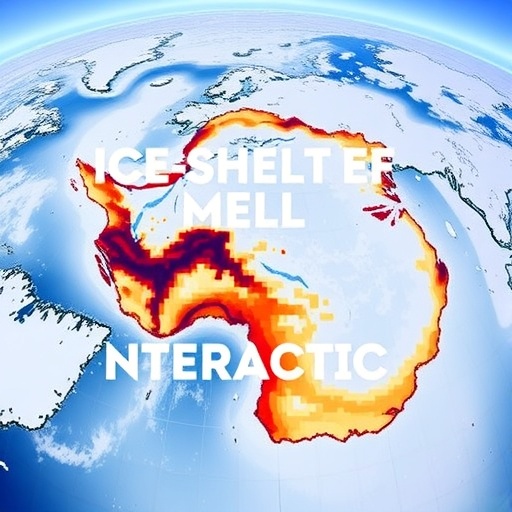
The study’s simulations reveal that the feedback arising from meltwater discharge alongside externally forced ocean changes is strikingly significant. In fact, the melt-induced feedback accounts for approximately two-thirds of the increase in melt rates observed across Antarctic ice shelves under future climate forcing scenarios. This challenges the conventional notion that melt rates are primarily determined by direct ocean warming, underscoring that feedback loops can amplify or buffer these responses in spatially complex ways.
At the heart of this phenomenon is the behavior of dense shelf water—water with high salinity and low temperature that accumulates on the continental shelf. As climatic warming induces freshening from basal meltwater input, this water mass becomes lighter, disrupting conventional flow patterns. The reduced density allows warmer, deeper ocean waters to intrude under the ice shelves, intensifying basal melting. This positive feedback loop—warming driving melt, which then further promotes warming beneath the ice shelves—poses a precarious threat to ice-shelf stability.
However, the system’s dynamics are far from a simple runaway scenario. The freshened meltwater is not confined to its origin points but is transported westward along the continental shelf. Downstream regions encounter this lower-salinity water, which acts as a barrier obstructing the inflow of warm ocean water. Consequently, this induces a negative feedback response that dampens basal melting further along the shelf, illuminating the geographical heterogeneity in melt responses.
This dual feedback mechanism thus constructs a complex spatial mosaic whereby regions characterized by initially dense shelf waters become hotspots of amplifying melt feedback, while those downstream experience mitigating influences from transported meltwater. Crucially, this indicates that basin-wide assessments of ice-shelf melt and contributions to sea-level rise must incorporate these spatially variable feedbacks rather than relying on uniform melt parameterizations.
The insights stem from a sophisticated coupled ocean-sea-ice-ice shelf model that encapsulates interactive physical processes between ocean circulation, sea ice formation, and basal ice-shelf melting. By integrating these interactive components, the model advances beyond static or parametrized approaches, capturing emergent behaviors stemming from the interplay of local physical changes and large-scale ocean dynamics.
Of particular note is the methodological innovation allowing this study to separate the contributions of externally forced ocean warming—driven by atmospheric changes—from those arising internally through meltwater feedbacks. This distinction enables quantification of each process’s relative importance, offering clarity to earlier conflicting estimates and enhancing the fidelity of future projections.
The dependency of melt feedback strength on local water mass properties—density, salinity, and temperature—emphasizes the need for high-resolution observations and model parameterizations that can resolve these fine-scale structures. This precision is vital if we are to reliably foresee where the ice shelves are most vulnerable and how the ocean’s response to climate change will modulate their demise.
Furthermore, the findings underscore a critical consideration for global sea-level rise assessments: the Antarctic ice sheet’s contribution is tightly coupled to nuanced oceanographic feedbacks that amplify or dampen basal melting. Neglecting these mechanisms may lead to underestimations of sea-level rise and misguide adaptation policies, particularly for coastal regions facing the brunt of rising oceans.
The study’s approach and findings serve as a clarion call for climate modelers and Earth system scientists to incorporate interactive melt feedbacks in their simulations. As ice-shelf melt is not a passive response but an active agent shaping ocean circulation and vice versa, future projections must treat this relationship as dynamic and reciprocal.
Looking ahead, the elucidation of these competing feedbacks provides a framework for integrating observation-driven constraints via satellite data, in situ oceanographic measurements, and autonomous underwater vehicles exploring beneath ice shelves. Such data can validate and inform model improvements, narrowing uncertainties in melt projections and better informing international climate mitigation and adaptation strategies.
In summation, this research marks a pivotal step toward unraveling the complexities of Antarctic ice-shelf basal melt and its intertwined relationship with ocean circulation. The revelation that melt-driven feedbacks wield influence comparable to external forcing reshapes our understanding of polar system dynamics and their global implications. Acknowledging and quantifying these processes brings us closer to credible, actionable forecasts of sea-level rise in an era of rapid climate change.
As the urgency to comprehend and respond to climate-driven sea-level rise accelerates, this nuanced understanding of Antarctic feedback mechanisms equips scientists and decision-makers with deeper insights. By embedding these insights into next-generation climate models, humanity gains a sharper foresight into how Earth’s coldest continent will reshape our planet’s future shores.
The ongoing refinement of Antarctic ocean-ice interaction models with feedback-aware frameworks heralds a new era of climate science—one where the complex dance between melting ice shelves and ocean currents is recognized as central, dynamic, and vital to our planetary prognosis.
Cite Scienmag News
Violet Maxwell. (May 15, 2026). Antarctic Ice-Shelf Melt Driven by Competing Feedbacks. Scienmag. https://scienmag.com/antarctic-ice-shelf-melt-driven-by-competing-feedbacks/
Violet Maxwell. "Antarctic Ice-Shelf Melt Driven by Competing Feedbacks." Scienmag, 15 May 2026, https://scienmag.com/antarctic-ice-shelf-melt-driven-by-competing-feedbacks/. Accessed 3 September 2026.
Violet Maxwell. "Antarctic Ice-Shelf Melt Driven by Competing Feedbacks." Scienmag. May 15, 2026. https://scienmag.com/antarctic-ice-shelf-melt-driven-by-competing-feedbacks/


