


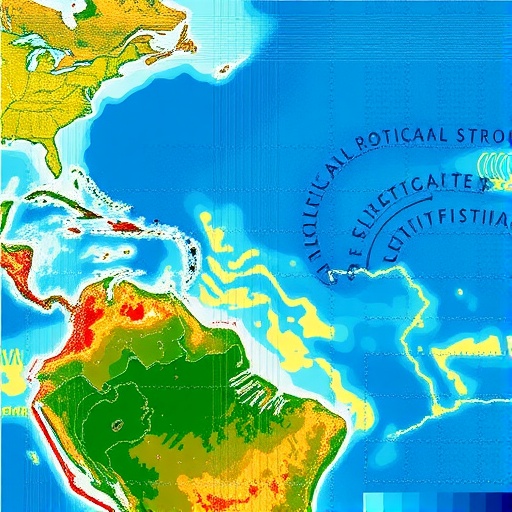
A warmer ancient ocean may have struggled to perform one of the most important chemical processes sustaining marine life, according to a new study published in Nature Communications. Researchers report that nitrogen fixation in the tropical Atlantic Ocean was reduced during the warm late Pliocene, a period roughly 3.3 to 2.6 million years ago when Earth’s climate offers a valuable natural comparison for a warming planet.
The finding matters because nitrogen is one of the essential ingredients required to build proteins, genetic material and chlorophyll. Although Earth’s atmosphere is composed of nearly 78 percent nitrogen gas, most organisms cannot use atmospheric nitrogen directly. In the ocean, specialized microorganisms convert inert nitrogen gas, or N₂, into biologically available compounds such as ammonia. This process, known as nitrogen fixation, supports the growth of microscopic marine plants and helps regulate the productivity of entire ocean ecosystems.
The study, led by M. Yehudai, J.R. Farmer, M. Straub and colleagues, focuses on a period when global temperatures were higher than during much of the preindustrial era. The late Pliocene is often examined by climate scientists because atmospheric carbon dioxide concentrations and global temperatures approached conditions that may resemble aspects of a future warming world. It was not an exact analogue of modern climate change, but it provides an unusually deep-time laboratory for testing how marine chemical cycles respond to persistent warmth.
Nitrogen fixation is performed primarily by microorganisms known as diazotrophs. These organisms possess the nitrogenase enzyme, a complex biological catalyst capable of breaking the exceptionally strong triple bond that holds N₂ molecules together. The process requires substantial energy and is highly sensitive to environmental conditions, including temperature, oxygen availability, light, phosphorus supply and the balance of other nutrients. Any shift in those controls can alter how much “new” nitrogen enters the ocean’s food web.
The researchers’ conclusion that tropical Atlantic N₂ fixation declined during the warm late Pliocene points to a disruption in the balance between climate and marine nutrient supply. When nitrogen fixation falls, the ocean may receive less biologically usable nitrogen from the atmosphere. That reduction can limit the growth of phytoplankton, the microscopic organisms responsible for a large share of marine primary production and a significant proportion of global oxygen generation. Because phytoplankton also absorb carbon dioxide through photosynthesis, changes in their abundance can influence the movement of carbon between the atmosphere and the ocean.
The tropical Atlantic is particularly important in this story. It is a major region of ocean circulation, receives nutrients from continental dust and rivers, and connects atmospheric processes with the wider global ocean. Nitrogen-fixing organisms in tropical waters can thrive when dissolved nitrogen is scarce but other nutrients, especially phosphorus and iron, remain available. However, warming can modify stratification, the layering of seawater that restricts vertical mixing. Stronger stratification may keep nutrient-rich deep water from reaching sunlit surface waters, potentially changing which microorganisms have a competitive advantage.
The study also highlights why temperature alone cannot explain the biological response of the ancient ocean. Warmer water can accelerate some microbial reactions, but it can simultaneously reduce oxygen solubility, intensify density layering and alter the supply of phosphorus and trace metals required by nitrogen-fixing organisms. In addition, changes in wind patterns, rainfall, dust transport and ocean circulation may have reshaped the delivery of nutrients to the tropical Atlantic. The reported decline therefore reflects a broader reorganization of the marine environment rather than a simple biological reaction to heat.
Scientists reconstruct ancient nitrogen fixation using chemical signals preserved in seafloor sediments. Although the citation does not specify the study’s individual analytical methods, such research commonly examines nitrogen isotope ratios and other geochemical indicators that record how nitrogen moved through past ecosystems. Nitrogen isotopes can help distinguish between atmospheric nitrogen entering the ocean through fixation and nitrogen that has already been biologically processed. Sediment cores effectively preserve snapshots of ancient ocean chemistry, allowing researchers to compare nutrient cycling across climatic intervals separated by millions of years.
The new result is likely to attract attention because it complicates the assumption that a warmer ocean will simply become more biologically active. Some marine organisms may expand under higher temperatures, while others may lose access to the nutrients they need. A reduction in nitrogen fixation could create a feedback loop in which less available nitrogen suppresses phytoplankton growth, weakens carbon uptake in some regions and changes the composition of marine communities. The strength and direction of that feedback, however, will depend on local circulation, nutrient ratios and the ability of microorganisms to adapt.
The late Pliocene record cannot provide a direct forecast of the modern ocean, whose warming is occurring much faster and alongside unprecedented carbon dioxide emissions, pollution and human-driven changes to ecosystems. Still, the evidence from the tropical Atlantic offers a warning: climate change can reshape the ocean’s invisible nutrient machinery long before large ecological consequences become obvious. As researchers continue to investigate how nitrogen fixation responded to ancient warmth, the central question is no longer whether climate affects marine nutrient cycles, but how those changes will alter the ocean’s capacity to support life and regulate Earth’s climate.
Cite Scienmag News
Violet Maxwell. (August 6, 2026). Tropical Atlantic nitrogen fixation declined during the warm late Pliocene. Scienmag. https://scienmag.com/tropical-atlantic-nitrogen-fixation-declined-during-the-warm-late-pliocene/
Violet Maxwell. "Tropical Atlantic nitrogen fixation declined during the warm late Pliocene." Scienmag, 6 August 2026, https://scienmag.com/tropical-atlantic-nitrogen-fixation-declined-during-the-warm-late-pliocene/. Accessed 4 September 2026.
Violet Maxwell. "Tropical Atlantic nitrogen fixation declined during the warm late Pliocene." Scienmag. August 6, 2026. https://scienmag.com/tropical-atlantic-nitrogen-fixation-declined-during-the-warm-late-pliocene/


