


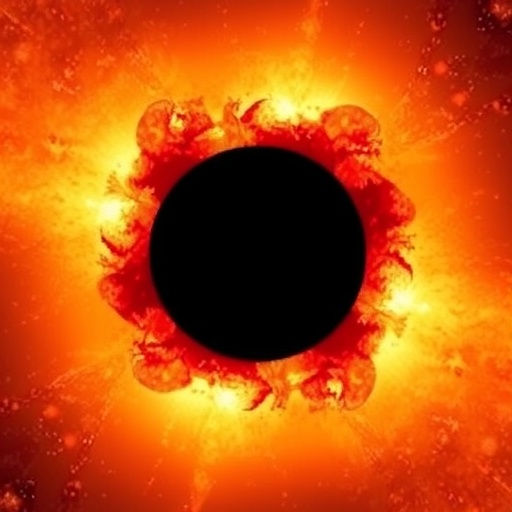
In a groundbreaking astronomical achievement, an international team of researchers, including scientists from University College London (UCL), has successfully detected and precisely measured the mass of the most distant dormant supermassive black hole ever observed. Situated at the heart of the massive red galaxy MRG-M0138, this enigmatic black hole lies over 10 billion light-years away from Earth, presenting a unique glimpse into the early universe when the cosmos was merely three billion years old, a quarter of its current age. The findings, published in the prestigious journal Science, mark a significant leap forward in our ability to study these celestial titans in the distant cosmos.
This massive black hole, weighing in at an astonishing six billion solar masses, had remained virtually invisible due to its dormant nature. Unlike active black holes that accrete surrounding gas and emit intense radiation, this quiescent giant reveals itself only through the gravitational influence it exerts on nearby stars. By tracking the velocities and motion patterns of these stars, the research team could infer the presence and calculate the mass of the black hole with unprecedented accuracy for such a remote object. This method, known as stellar dynamics, has traditionally been limited to relatively closer galaxies, making this observation at such a cosmological distance a remarkable feat.
The cornerstone of this discovery was data provided by NASA’s James Webb Space Telescope (JWST), a powerful observatory equipped with cutting-edge instruments capable of dissecting the detailed internal structures of faraway galaxies. For this study, the JWST’s NIRSpec Integral Field Spectrograph was utilized to map the velocity of stars in exquisite detail inside MRG-M0138. Coupling JWST’s high-resolution capabilities with the natural phenomenon of gravitational lensing—a cosmic magnifying glass created when the gravitational field of a massive foreground galaxy cluster bends and amplifies light from the background galaxy—the researchers managed to reconstruct the internal kinematics of this distant galaxy with exceptional clarity.
Gravitational lensing amplified the image of MRG-M0138 by a factor of approximately 30, magnifying features that would normally be impossible to resolve at such a vast distance. This natural zoom enabled the team to peer deep into the galaxy’s core where the black hole’s gravity dominates, known as its “sphere of influence.” Within this region, the intense gravitational pull accelerates stars to higher velocities, a vital clue that allowed astronomers to “weigh” the black hole. Previous applications of this technique in the local universe have successfully measured supermassive black holes, but none have reached back as far into cosmic history, with prior records limited to 700 million light-years.
A critical aspect of this discovery lies in the dormant state of both the black hole and its host galaxy. Unlike galaxies that house active galactic nuclei or quasars glowing with the radiation from gas accreting onto a black hole, MRG-M0138 exhibits no such activity. Its black hole is starved of inflowing material, and the galaxy itself shows little evidence of ongoing star formation, suggesting a mature and quiescent evolutionary phase. This passive nature offers vital clues to the lifecycle of galaxies and their central black holes, hinting at a past era when this system may have exhibited intense quasar activity before exhausting or expelling the gas needed for star birth.
The implications of this finding extend far beyond a solitary measurement. Understanding how supermassive black holes evolve in tandem with their host galaxies remains one of the foremost challenges in astrophysics. Locally, the masses of black holes closely correlate with properties of their galaxies, such as bulge mass and stellar velocity dispersion. However, the evolution of this relationship over billions of years remains elusive due to the scarcity of direct measurements at large cosmological distances. By pulling back the curtain on this distant black hole, researchers now have a critical data point from the universe’s youth, enabling further exploration into the coevolutionary history of galaxies and their central engines.
Professor Richard Ellis of UCL, a senior author of the study, highlighted the transformative nature of this research: “By measuring the collective stellar motions in the core of this distant galaxy, we have taken a key step towards charting the growth and influence of black holes during the universe’s formative years. It opens the door to understanding the fundamental role these invisible giants play in galaxy evolution across cosmic time.” This insight helps resolve how black holes affect star formation and galaxy dynamics by either fueling or suppressing growth depending on their activity state.
Dr. Andrew Newman, lead author from Carnegie Science, emphasized the synergy between space-based infrared observations and gravitational lensing: “Our ability to combine JWST’s unparalleled sensitivity with the lensing effect allows us to probe black hole gravitational spheres of influence previously inaccessible. This breakthrough extends the powerful stellar dynamical method into the early universe, transforming how we study inactive black holes over cosmic history and offering fresh perspectives on their genesis and growth.”
The mass measurement of this black hole not only sets a new distance record for dormant black hole observation but also challenges existing models of early universe cosmology and supermassive black hole formation. Traditionally, researchers expect such enormous black holes to grow rapidly during active quasar phases, but this dormant state indicates a complex lifecycle involving periods of both growth and quiescence that affect the broader galactic environment. It suggests feedback mechanisms where energetic outflows from earlier active periods may have suppressed subsequent star formation by heating or expelling galactic gas.
Looking ahead, the research team anticipates further discoveries of dormant black holes in the early universe as JWST continues its mission. By expanding the sample size, astronomers hope to map the demographics and properties of black holes and their host galaxies across epochs, unraveling how these massive objects influence the universe’s large-scale structure development. Such comprehensive data will refine theoretical models addressing black hole feeding, growth spurts, inactivity, and their impact on star formation shutdown, building a more detailed narrative of cosmic history.
The unprecedented marriage of high-resolution JWST spectroscopy and gravitational lensing techniques has thus cracked open a window on a realm that was previously inaccessible. It is a formidable demonstration of humanity’s capacity to reach back billions of years to hold the invisible—and colossal—architects of galaxy evolution accountable. This discovery serves as a cornerstone for future explorations that will further illuminate the mysterious lives of supermassive black holes and their profound influence across the cosmos.
News Publication Date: 4-Jun-2026
References: Andrew B. Newman, Meng Gu, Sirio Belli, Richard S. Ellis, et al., ‘A stellar dynamical mass measurement of an inactive black hole at redshift 2,’ Science, DOI: 10.1126/science.adx5816
Keywords
Supermassive Black Hole, Dormant Black Hole, James Webb Space Telescope, Gravitational Lensing, Stellar Dynamics, Early Universe, Galaxy Evolution, NIRSpec Spectrograph, Redshift 2, Quasar, Galaxy MRG-M0138, Cosmic History
Cite Scienmag News
Grant Pearson. (June 4, 2026). Scientists Measure the Farthest Dormant Black Hole Yet. Scienmag. https://scienmag.com/scientists-measure-the-farthest-dormant-black-hole-yet/
Grant Pearson. "Scientists Measure the Farthest Dormant Black Hole Yet." Scienmag, 4 June 2026, https://scienmag.com/scientists-measure-the-farthest-dormant-black-hole-yet/. Accessed 4 September 2026.
Grant Pearson. "Scientists Measure the Farthest Dormant Black Hole Yet." Scienmag. June 4, 2026. https://scienmag.com/scientists-measure-the-farthest-dormant-black-hole-yet/


