


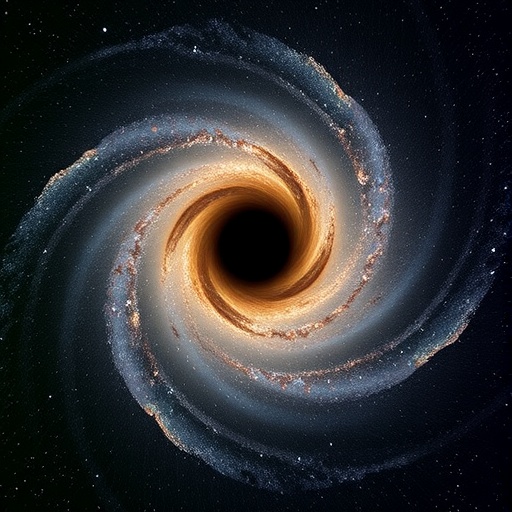
After a half-century enigma, astrophysicists at Northwestern University have unveiled compelling evidence of a powerful wind emanating from Sagittarius A (Sgr A), the supermassive black hole anchoring the center of our Milky Way galaxy. This groundbreaking discovery resolves a critical, long-standing puzzle in our understanding of black hole physics and galactic evolution, bringing to light the subtle mechanics of feedback processes in our own cosmic backyard.
Sagittarius A has been subject to intense study for decades, given its central role in the dynamics of the Milky Way. Theoretical models for black hole accretion suggest that as matter spirals inward, immense gravitational energy is released, not only drawing material in but also ejecting some of it outward as energetic winds or jets. These outflows are fundamental to regulating star formation and galactic growth by moderating how much material accumulates near the black hole. However, until now, direct observational proof of such winds around Sgr A remained elusive. This absence of evidence made Sgr A* an oddity, a black hole seemingly breaking universal laws.
The breakthrough came from harnessing an unprecedented depth of observational data, primarily from the Atacama Large Millimeter/Submillimeter Array (ALMA) in Chile. Over five years, researchers collected extraordinarily detailed radio-wave measurements to map carbon monoxide—the signature of cold molecular gas—within one parsec of the black hole, equivalent to a mere three light-years. This high-resolution imaging, enhanced by a novel calibration technique that removed the overpowering radio emissions from Sgr A* itself, enabled an unprecedentedly sharp view of the cold molecular environment surrounding the black hole, enhancing sensitivity by a factor of 100 and spatial clarity by 80-fold compared to previous studies.
A striking feature emerged from these data: a vast, cone-shaped void nearly one parsec in length and spanning 45 degrees in width, conspicuously devoid of the cold molecular gas that permeates the vicinity. This cavity’s shape and scale are consistent with a scenario where a hot, energetic wind blows outward from Sgr A*, clearing or thermally ionizing the colder material as it expands. Such a wind would exert enough pressure to carve out this hollowed-out region by either physically pushing away or heating the cold gas beyond detectability.
To validate these findings, the team integrated data from NASA’s Chandra X-ray Observatory, which had previously identified bright X-ray emissions in the exact same area. This high-energy radiation corresponds to hot gas, perfectly filling the cavity seen in the ALMA data—the cold void overlain by hot gas creates a composite image of the ongoing dynamic between inflows and outflows at our galaxy’s heart. The alignment of these disparate datasets lends robust credibility to the interpretation: the black hole is actively driving winds that reshape its immediate environment.
One might conjecture that powerful winds observed might originate from the multitude of massive stars populating the galactic center. Yet the team’s calculations strongly argue against this, showing that stellar winds collectively fall short in energy output and spatial extent to create such a prominent cavity. The energy required to sustain this structure exceeds what is feasible from stellar contributions alone, pointing definitively to Sgr A as the source. The conical shape, spatial coincidence, and energetic assessment converge on the same conclusion—Sgr A is not merely accreting but actively expelling material through energetic outflows.
Detecting these winds had long been hampered by the challenging observational environment. From Earth, our vantage point lies within the galactic plane, demanding that telescopic observations pierce through dense clouds of interstellar gas, dust, and ionized material which obscure and scatter emissions. Previous efforts lacked the resolution and sensitivity to distinguish the subtle footprint of such winds against the overpowering background. The innovative application of advanced calibration and multi-wavelength data integration thus represents a methodological leap in black hole astrophysics.
This discovery also sheds light on the current relatively quiet phase of Sgr A*. Unlike the highly luminous and active black holes in many other galaxies, which blaze with intense radiation and powerful outflows, our galaxy’s central black hole is subdued, exhibiting more temperate activity levels. The wind traced through this study has likely persisted for at least 20,000 years, implying a sustained, albeit modest, feedback process. This quieter state reflects a common phase in the life cycle of black holes, which challenges the focus on only the most extreme and luminous galactic nuclei often emphasized in astronomical research.
Understanding the exact mechanics of this wind involves appreciating the delicate balance of forces near a supermassive black hole. Material spiraling inward accelerates to relativistic speeds, releasing gravitational energy that can heat infalling gas to millions of degrees. Some of this energy converts into pressure that drives outflows along specific directions, rather than falling uniformly inward. The resulting anisotropic winds sculpt the surrounding medium, influencing not just the immediate vicinity but potentially the broader galactic ecosystem by regulating gas flows, star formation rates, and chemical enrichment.
The detection of the wind also implies a dynamic and evolving interaction between Sgr A* and its environment, contradicting the notion of a static or dormant black hole at our galaxy’s core. Instead, these outflows reaffirm that the black hole plays an active role, albeit subtler than energetic quasars, in shaping the Milky Way’s central molecular zone. This insight provides a valuable analog for understanding similar, but often more violent, processes in distant galaxies, improving models of galaxy evolution universally.
This milestone in black hole astrophysics underscores how persistent, multi-wavelength observational campaigns, aligned with sophisticated data processing techniques, can resolve questions that have lingered for decades. It also opens new avenues for probing how supermassive black holes in their intermediate or quiescent phases maintain a delicate dialogue with their surroundings, a crucial factor in the broader narrative of cosmic structure formation.
In summary, the proof of a large, active wind streaming from Sagittarius A* marks a paradigm shift in our understanding of the Milky Way’s core. The confluence of ALMA’s high-definition imaging of cold gas and Chandra’s penetrating view of hot plasma paints a vivid picture of a central black hole that, though relatively subdued, asserts its influence through steady winds. This discovery enriches the broader astrophysical canon, affirming that even the quietest galactic nuclei harbour dynamic, transformative processes crucial for galaxy-scale phenomena.
News Publication Date: June 4, 2026
Keywords
Sagittarius A*, supermassive black hole, galactic center, black hole wind, ALMA, Chandra X-ray Observatory, cold molecular gas, galactic feedback, galaxy evolution, astrophysics, Milky Way, black hole accretion
Cite Scienmag News
Grant Pearson. (June 4, 2026). Missing Wind from Milky Way’s Black Hole Discovered. Scienmag. https://scienmag.com/missing-wind-from-milky-ways-black-hole-discovered/
Grant Pearson. "Missing Wind from Milky Way’s Black Hole Discovered." Scienmag, 4 June 2026, https://scienmag.com/missing-wind-from-milky-ways-black-hole-discovered/. Accessed 5 September 2026.
Grant Pearson. "Missing Wind from Milky Way’s Black Hole Discovered." Scienmag. June 4, 2026. https://scienmag.com/missing-wind-from-milky-ways-black-hole-discovered/


