


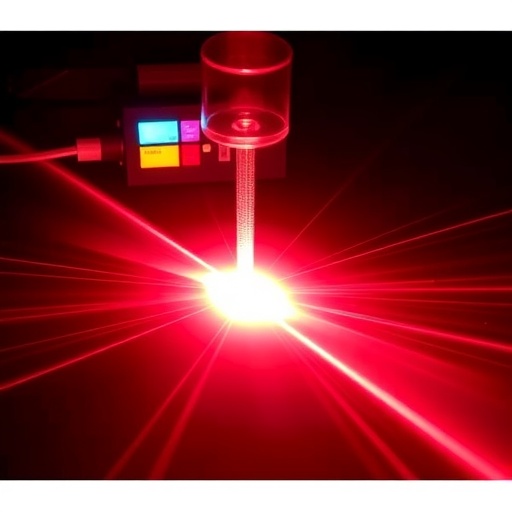
An international team of physicists has created an exceptionally high-flux mixture of two atomic quantum gases under microgravity, opening a new path toward precision tests of fundamental physics in space. Using the MAIUS-B apparatus inside the Einstein Elevator at Leibniz University Hannover, Germany, researchers produced Bose-Einstein condensates made from rubidium and potassium atoms and studied their behavior in near-weightless conditions. The achievement depended on a highly compact laser and optical system developed with major contributions from researchers at Johannes Gutenberg University Mainz.
Bose-Einstein condensates form when atoms are cooled to temperatures extremely close to absolute zero. Under these conditions, the atoms lose much of their individual behavior and occupy a shared quantum state, behaving collectively like a single macroscopic matter wave. This makes BECs powerful tools for investigating quantum mechanics, gravity and the limits of measurement. Producing a condensate from one atomic species in space was first demonstrated during the MAIUS-1 mission in 2017. Creating and controlling two different species simultaneously, however, requires substantially more complex hardware and finely tuned control of the atoms.
Rubidium and potassium respond differently to laser light, magnetic fields and cooling forces, meaning each species requires its own set of carefully selected laser frequencies and control sequences. The MAIUS-B experiment therefore needed approximately twice the number of lasers used in a single-species system, along with additional optical, electronic and vacuum components. Despite this increased complexity, the researchers managed to keep the system close to the size and mass of earlier mobile platforms, a crucial achievement for equipment designed to operate in rockets, aircraft and space stations.
The Mainz research group, led by Professor Patrick Windpassinger and Dr. André Wenzlawski at JGU’s Institute of Physics, developed the optical interfaces connecting the laser modules to the vacuum chamber in which the atoms are cooled and manipulated. These interfaces are not merely passive connections. They must direct laser beams with extreme precision into the atom chamber while maintaining alignment during launch vibrations, mechanical shocks and changing temperatures. Even tiny shifts in the beam paths can reduce cooling efficiency or disrupt the delicate sequence required to form a quantum gas.
A central component is a set of compact optical benches developed jointly by JGU and the University of Hamburg. The benches are made from Zerodur, a glass-ceramic material known for its exceptionally low thermal expansion. Conventional materials can expand or contract as temperatures change, slightly shifting mirrors, lenses and beam paths. Zerodur minimizes these movements, helping the laser system retain its alignment during demanding operations. That stability is particularly important for a space-bound quantum sensor, where recalibration may be difficult or impossible once the instrument is in operation.
The experiment was carried out in the Einstein Elevator, a facility that provides repeated periods of microgravity by rapidly moving a capsule through a tall vertical shaft. This environment allows scientists to investigate ultracold atoms without the persistent influence of Earth’s gravitational pull. In microgravity, atomic clouds can be held and manipulated for longer periods, giving researchers more time to study their expansion, interactions and response to external forces. The MAIUS-B apparatus was operated both in the Einstein Elevator and in laboratory environments, allowing the team to test its performance over extended periods.
According to the researchers, the system produced the highest atomic flux reported to date for a dual-species Bose-Einstein condensate mixture. Atomic flux describes how many atoms can be prepared and delivered through the experimental sequence over a given period. A higher flux means more particles are available for measurements, improving the statistical precision of a quantum sensor. The apparatus reportedly outperformed existing mobile systems by an order of magnitude, a tenfold improvement that could significantly increase the speed and sensitivity of future experiments.
The technical advance has implications far beyond the production of an unusual state of matter. Quantum sensors based on ultracold atoms can measure acceleration, rotation and gravitational fields with extraordinary precision. In future space missions, mixtures of different atomic species could be released into free fall and compared directly. If the atoms accelerate identically, the result would support Einstein’s equivalence principle, which states that all objects fall in the same way regardless of their composition. Any measurable difference could point to new physics beyond current theories of gravity.
The Mainz-developed technology is expected to contribute to future projects such as BECCAL, a German-American atomic laboratory planned for the International Space Station. By combining compact laser systems, mechanically stable optical benches and high-flux dual-species condensates, researchers are moving quantum experiments from specialized laboratories toward operational platforms in space. The QUANTUS IV–MAIUS project was coordinated by the Center of Applied Space Technology and Microgravity in Bremen and funded by the German Space Agency at the German Aerospace Center. Its results demonstrate how miniaturization can transform fragile laboratory-scale quantum experiments into robust instruments capable of exploring the deepest questions about gravity, motion and the structure of the universe.
News Publication Date: 28-Jul-2026
Web References: https://doi.org/10.1038/s41467-026-75968-9
References: Nature Communications, DOI: 10.1038/s41467-026-75968-9
Keywords
Bose-Einstein condensate, quantum gases, microgravity, MAIUS-B, rubidium, potassium, quantum sensors, space physics, laser technology, equivalence principle, Einstein Elevator, Johannes Gutenberg University Mainz
Cite Scienmag News
Katie Riggs. (August 5, 2026). High-precision laser enables record flux in mixed quantum gases. Scienmag. https://scienmag.com/high-precision-laser-enables-record-flux-in-mixed-quantum-gases/
Katie Riggs. "High-precision laser enables record flux in mixed quantum gases." Scienmag, 5 August 2026, https://scienmag.com/high-precision-laser-enables-record-flux-in-mixed-quantum-gases/. Accessed 3 September 2026.
Katie Riggs. "High-precision laser enables record flux in mixed quantum gases." Scienmag. August 5, 2026. https://scienmag.com/high-precision-laser-enables-record-flux-in-mixed-quantum-gases/


