


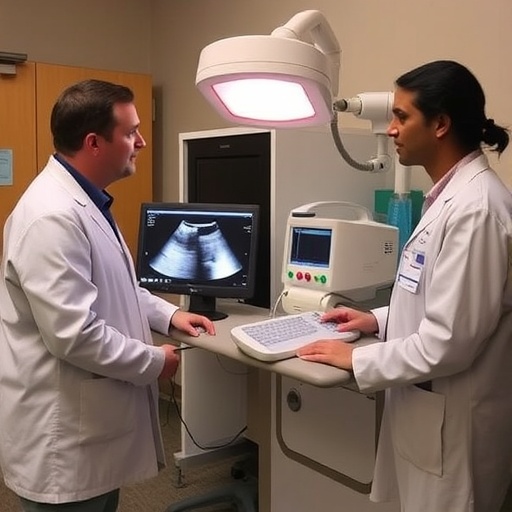
For decades, the medical community has known ultrasound primarily as a diagnostic tool—a non-invasive way to peer inside the human body, revealing vital information about organs, tissues, and even the earliest images of a developing fetus. However, groundbreaking research from scientists at the Kaunas University of Technology (KTU) is reshaping our perception of ultrasound, demonstrating its potential as an active therapeutic agent that goes far beyond imaging. Their pioneering study shows that low-frequency ultrasound waves can directly manipulate blood flow by influencing the behavior of red blood cells, a discovery that could revolutionize treatment approaches for cardiovascular disorders, Alzheimer’s disease, diabetes, and more.
Unlike the conventional high-frequency ultrasound used in diagnostic imaging, KTU researchers found that ultrasound interacts with blood in complex and contrasting ways depending on the frequency applied. Their experiments revealed that red blood cells—erythrocytes—respond differently to varying ultrasound frequencies: some frequencies encourage these cells to clump together, while others promote their dispersion into individual cells. This dual effect holds significant promise for modulating blood viscosity, a critical factor in efficient oxygen transport and circulation.
Erythrocytes naturally form reversible clusters known as aggregates, influencing the viscosity of blood. High-frequency ultrasound waves create standing acoustic waves that push these cells into low-pressure zones, fostering aggregation. This clustering raises blood viscosity, can elevate blood pressure and pulse rate, and potentially impair oxygen exchange. According to Vytautas Ostaševičius, the leading KTU professor behind this research, understanding and controlling such effects is pivotal for advancing therapeutic ultrasound technologies.
Conversely, low-frequency ultrasound waves produce traveling acoustic waves. Unlike their high-frequency counterparts, these traveling waves exert shear forces strong enough to break up erythrocyte aggregates into single cells. This dissociation reduces blood viscosity and increases the surface area available for oxygen exchange, potentially enhancing tissue oxygenation. To date, this remarkable effect—using low-frequency ultrasound to mechanically separate red blood cells—had not been demonstrated in the scientific literature, marking a significant leap forward in our understanding of ultrasound-blood interactions.
The genesis of this research traces back to the urgent needs during the COVID-19 pandemic, where healthcare practitioners sought rapid, non-invasive techniques to aid patients struggling with severe respiratory distress. With the body’s oxygenation process severely compromised in such cases, the team hypothesized that ultrasound might serve as a non-pharmacological catalyst to intensify the interaction between hemoglobin and oxygen. By testing hundreds of blood samples under varying ultrasound intensities, the researchers meticulously mapped the parameters influencing erythrocyte behavior and oxygen exchange dynamics.
Integral to their work, the KTU scientists employed digital twin technology to optimize ultrasound transducer designs. This innovation facilitated the development of a low-frequency ultrasound transducer capable of delivering acoustic waves approximately four times deeper into biological tissues than traditional devices. Harnessing digital twins—highly accurate virtual replicas of physical systems—enabled precise calibration, simulation, and refinement of ultrasound parameters for enhanced therapeutic efficacy. This cutting-edge technology is now protected by an international patent, underscoring its novelty and potential market impact.
The implications of this technology reach far beyond respiratory support. In oncology, for example, tumor tissues often exhibit mechanical fragility relative to healthy tissues. By leveraging traveling acoustic waves, low-frequency ultrasound could selectively target and disrupt the mechanical integrity of tumors, facilitating more effective treatments. Although preliminary, such research signals a promising avenue for complementary cancer therapies aimed at overcoming the persistent challenge of hypoxia—or low oxygen levels—within tumor microenvironments, which often hinders therapeutic outcomes.
Neurological diseases like Alzheimer’s also stand to benefit from ultrasound innovations. One intriguing application under exploration is the transient opening of the blood-brain barrier (BBB) using focused ultrasound waves. The BBB acts as a highly selective shield protecting brain tissue but also limits the delivery of therapeutic agents. Low-frequency ultrasound’s capability to modulate blood flow and cellular arrangement may, in the future, enable enhanced and targeted drug delivery directly to affected brain regions, offering hope for improved management of neurodegenerative disorders.
Similarly, diabetic foot ulcers present a significant clinical challenge due to impaired blood circulation that stymies wound healing. KTU researchers envision that ultrasound’s beneficial influence on blood flow can accelerate the recovery process by reducing blood viscosity and improving oxygenation in ischemic tissues. Such non-invasive interventions could reduce dependency on advanced surgical procedures or prolonged pharmaceutical regimens traditionally required for ulcer management.
Beyond these immediate applications, the broader medical community can anticipate future possibilities leveraging the mechanical effects of ultrasound on blood properties. These include supportive therapies for cardiovascular and pulmonary diseases, where circulation efficiency is paramount, and the precision delivery of drugs to targeted tissues, thus minimizing systemic side effects and maximizing therapeutic concentration at the disease site.
While the technology is still in its experimental phase, the KTU research team has fundamentally expanded our understanding of ultrasound’s role in medicine—from passive diagnostics to dynamic modulation of physiological processes. The realization that ultrasound waves can mechanically influence blood at a cellular level provides a foundation for pioneering and non-invasive treatments that may one day complement, or even replace, existing pharmaceutical and surgical interventions.
Vytautas Ostaševičius and his colleagues emphasize that this new frontier of ultrasonic therapy bridges mechanical engineering, biophysics, and medicine, offering a fresh lens through which to envision patient care. As research continues, the potential to alleviate some of humanity’s most pressing health challenges with sound waves becomes ever more tangible, inspiring a future where ultrasound is indeed a cornerstone of rehabilitation and therapy.
The peer-reviewed study, titled “Advances in Ultrasonic Rehabilitation,” was published in the journal Sensors on April 15, 2026. This work is a testament to the innovative spirit of the Kaunas University of Technology and heralds a new chapter in the application of ultrasonic waves for therapeutic purposes, opening exciting horizons across multiple disciplines in health science.
News Publication Date: 15-Apr-2026
Web References: Advances in Ultrasonic Rehabilitation – Sensors Journal
References: DOI: 10.3390/s26082428
Keywords
Ultrasound therapy, low-frequency ultrasound, erythrocyte aggregation, blood viscosity, non-invasive treatment, oxygen exchange, cardiovascular disease, Alzheimer’s disease, diabetic foot ulcers, acoustic waves, therapeutic ultrasound, Kaunas University of Technology
Cite Scienmag News
Denise Maddox. (May 18, 2026). KTU Researchers Explore Ultrasound’s Role in Enhancing Blood Flow Beyond Diagnostics. Scienmag. https://scienmag.com/ktu-researchers-explore-ultrasounds-role-in-enhancing-blood-flow-beyond-diagnostics/
Denise Maddox. "KTU Researchers Explore Ultrasound’s Role in Enhancing Blood Flow Beyond Diagnostics." Scienmag, 18 May 2026, https://scienmag.com/ktu-researchers-explore-ultrasounds-role-in-enhancing-blood-flow-beyond-diagnostics/. Accessed 5 September 2026.
Denise Maddox. "KTU Researchers Explore Ultrasound’s Role in Enhancing Blood Flow Beyond Diagnostics." Scienmag. May 18, 2026. https://scienmag.com/ktu-researchers-explore-ultrasounds-role-in-enhancing-blood-flow-beyond-diagnostics/


